

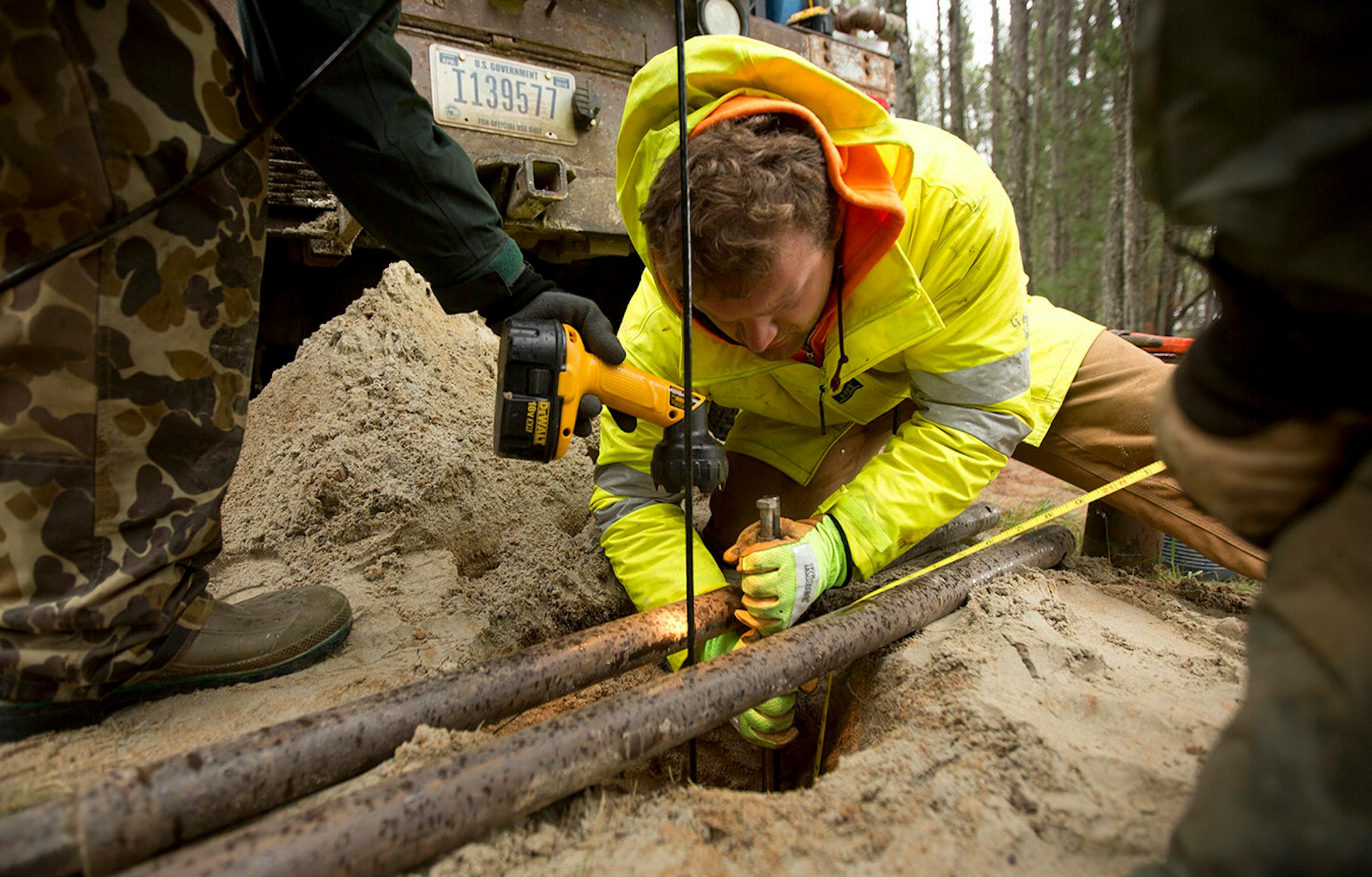
PINEWOOD, MINN. -- The rusty, 1950s-era drilling rig bored noisily in the sandy soil, stopping at a depth of 27 feet. As workers lifted out the spiral bit, a whiff of petroleum drifted up the hole. "That's some Bemidji crude oil," said Jared Trost, a hydrologist for the U.S. Geological Survey in charge of the rig.
Thousands of gallons of crude oil gurgle underground at this spot off a gravel road 12 miles northwest of Bemidji, Minn. It isn't a new shale oil discovery.
The crude oil is the stubborn remnant of a massive 1979 pipeline rupture. Over the past three decades, this site has become a science center unlike any other in the world. Using data collected mostly from bore holes, scientists have produced a gusher of research discoveries, including some that have influenced U.S. pollution cleanup policy.
"We are trying to take advantage of a bad situation and learn what we can from it," said Mindy Erickson, a USGS hydrologist based in Mounds View who manages the research site.
The site is slightly larger than a football field, has no buildings and consists mainly of hundreds of wells drilled for sampling and other research. The pipeline that ruptured, spilling nearly 450,000 gallons of crude oil in 1979, runs through the middle of it.
Much of the spilled oil was cleaned up in the weeks after the accident, but techniques used 35 years ago left about 100,000 gallons in the ground.
"Today, you wouldn't walk away with that much oil in the ground — that just wouldn't happen," said Scott Lounsbury, senior environmental manager for Enbridge Energy, the Calgary-based pipeline owner.
Enbridge didn't actually walk away. It helped launch a research project that's still going 31 years later.
![This rust-coated drilling rig, which dates to 1956, has bored dozens of test wells at the site of a 1979 spill near Bemidji, Minn., that for decades has been a U.S. Geological Survey research site for the study of movement and natural breakdown of underground crude oil. Here, crews bore 27 feet below the surface to survey the groundwater for oil from the 1979 spill. ] BRIAN PETERSON • brian.peterson@startribune.com Solway, MN 5/12/2014](https://arc.stimg.co/startribunemedia/G2SZCMGW24KDYDNGQLILHDCCF4.jpg?&w=1080)
![At the site of 1979 crude oil pipeline rupture near Bemidji, Minn., scientists have dotted the landscape with bore holes to study of the lingering underground pollution. Here, US Geological Survey hydrologist Jared Trost stands among the many bore holes used by scientists to study the movement and breakdown of crude oil that flowed through soil to the water table. ] BRIAN PETERSON • brian.peterson@startribune.com Solway, MN 5/12/2014](https://arc.stimg.co/startribunemedia/UHBGI6WKKOQYPQHLESQIZCITM4.jpg?&w=1080)


