

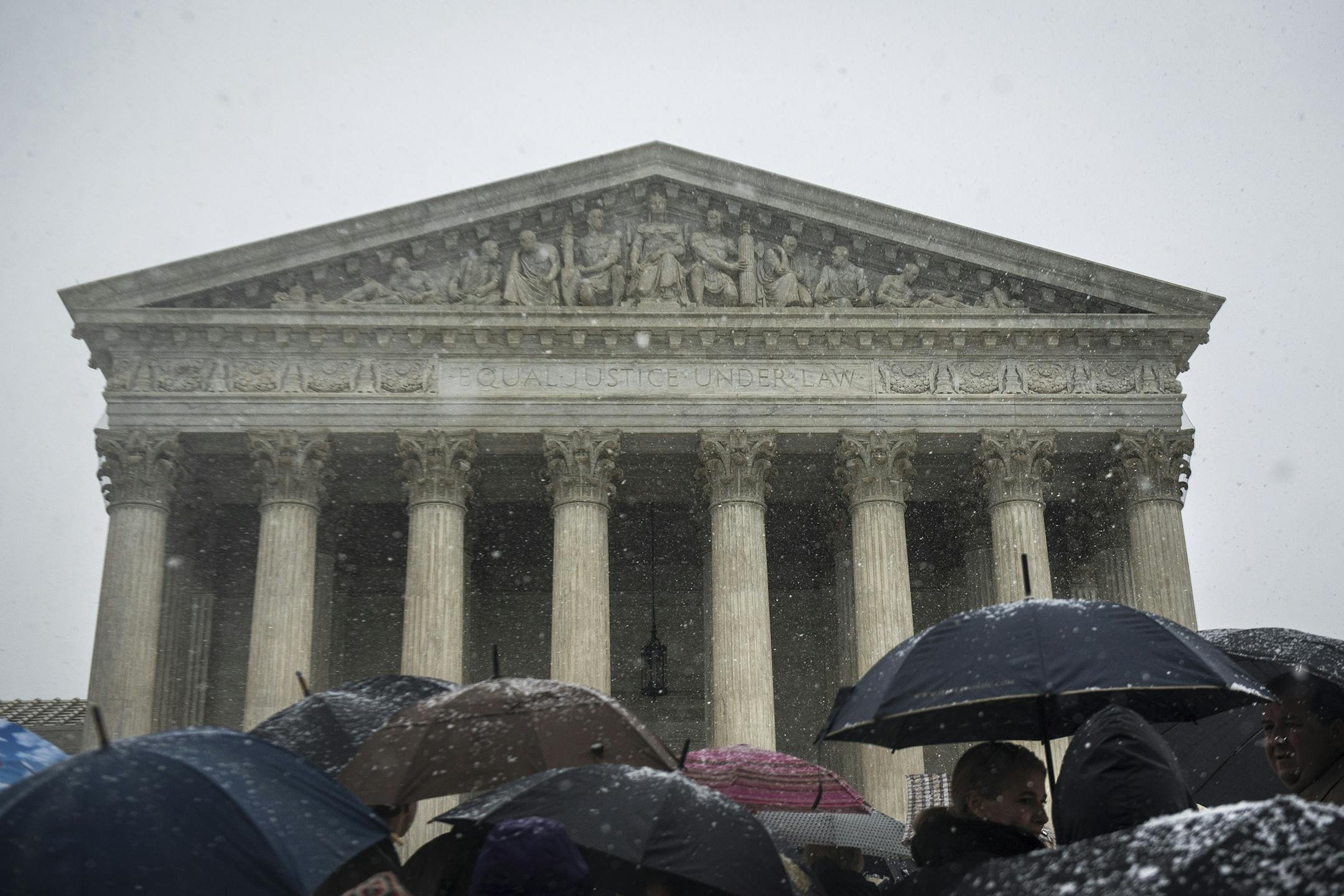
The Supreme Court will hear arguments on Wednesday in King vs. Burwell, the latest high-stakes litigation over the future of the Affordable Care Act. The question at hand is whether the law permits the federal government to help pay insurance premiums for people anywhere in the United States — or, as the plaintiffs argue, only in states that have established their own health care exchanges.
Just 16 states (including Minnesota) have established such exchanges. If the court rules in favor of the plaintiffs, an estimated 9.6 million people who bought insurance through HealthCare.gov will lose their coverage.
Tough luck, say the plaintiffs: The harsh consequences of a ruling in their favor should be irrelevant to the justices, whose only job is to interpret the statutory text. In any event, the plaintiffs contend, those harsh consequences are perfectly consistent with what Congress meant the law to accomplish.
But the plaintiffs are mistaken. It's not irrelevant that a ruling in their favor would inflict such damage. To the contrary, that fact helps us correctly interpret the statute's text. Indeed, it shows that the plaintiffs' understanding of that text is wrong.
As the Supreme Court has said time and again, no provision of a statute should be read in isolation. Laws must be read as a whole, with an eye to harmonizing their interdependent parts. That means the court is reluctant to read a stray passage here or there in a way that would destabilize an entire statutory scheme.
The plaintiffs, ignoring that cardinal principle, instead base their argument on snippets of text in a statutory provision that the Affordable Care Act added to the tax code. That provision, which addresses the tax credits that poor and working-class people can use to help pay for a health plan, links the size of those credits to the cost of a plan bought "through an exchange established by the state." According to the plaintiffs, those seven words represent a congressional threat to the states: Either set up exchanges or lose billions of dollars in tax credits.
But would Congress really have issued a threat of this magnitude in such a backhanded way? When Vito Corleone in "The Godfather" made a man an offer "he couldn't refuse," he wasn't subtle about it: "Either his brains or his signature would be on the contract." That's how you threaten somebody. The phrase "through an exchange established by the state" doesn't cut it.
The states had no reason to suspect that Congress would threaten them by inserting an innocuous phrase into a technical provision of the tax code. Instead, the states properly focused their attention on parts of the statute that detailed the consequences for refusing to establish an exchange. That would have been the natural place for Congress to level a threat at the states.


