
French train rescue shows how heroes are made: With military training

Bravery alone often isn't enough, which brings us to today's topic — reinstituting the draft.

August 25, 2015 at 4:24PM
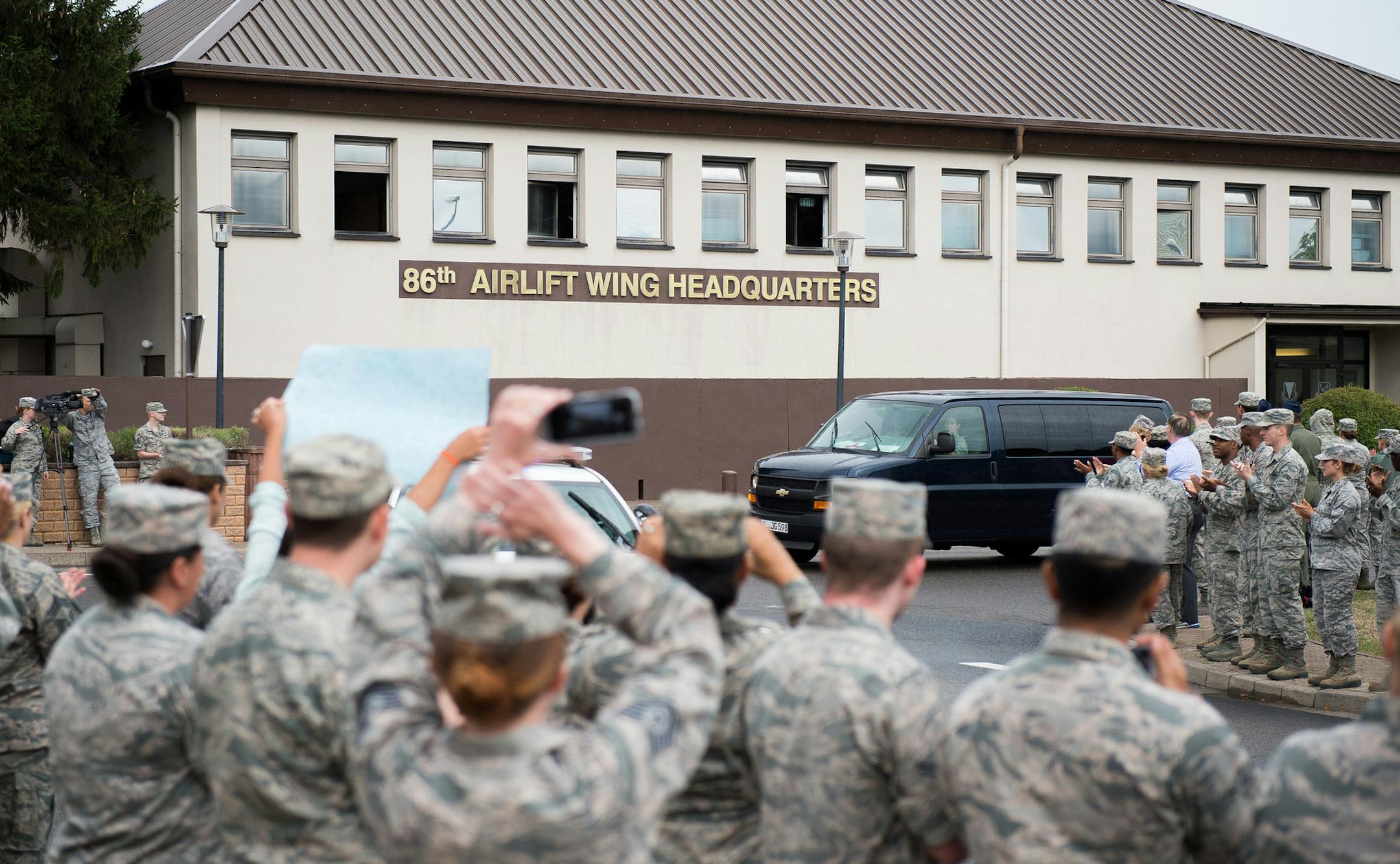
In this Aug. 24, 2015 picture, provided by U.S, Airforce Ramstein , Airman 1st Class Spencer Stone is greeted with a "Heroic Welcome" as he and Oregon National Guardsman Aleksander Skarlatos arrive at Ramstein Air Base, Germany. More than 200 Airmen and their families came out to line the streets and thank Stone and his friends for their bravery. Stone arrived at Ramstein while in transit to Landstuhl Regional Medical Center for follow-on medical treatment. Stone received multiple injuries, all
Airman 1st Class Spencer Stone was greeted with a “Heroic Welcome” Aug. 24 as he and Oregon National Guardsman Aleksander Skarlatos arrived at Ramstein Air Base, Germany. More than 200 airmen and their families came out to line the streets and thank Stone and his friends for their bravery. Stone arrived at Ramstein while in transit to Landstuhl Regional Medical Center for follow-on medical treatment. He received multiple injuries, all of which were noncritical, while subduing an armed gunman on a train traveling from Amsterdam to Paris. (The Minnesota Star Tribune)

Europe's media is still abuzz with the extraordinary story of three Americans who tackled a suspected terrorist on Friday on a train in Northern France. The question being asked is this: Were they displaying a distinctly American can-do spirit?

That's probably inevitable, but a better question would be: Should Western countries consider reintroducing compulsory military service to spread some can-do spirit around?

An article published Monday by the French newspaper Le Monde focused on the attitude of the three Americans, exemplified when one, 22-year-old Oregon National Guard specialist Alek Skarlatos, said to his 23-year-old friend, U.S. Air Force Airman First Class Spencer Stone, "Let's go."

"Will these three words become a hashtag?" the daily asks, describing the bravery and decisiveness of the men as an argument against passivity in such situations.

President Francois Hollande, awarding the Americans the Legion of Honor on Sunday along with a Briton who helped out, praised their "sang froid." A former British Army colonel, writing in Britain's Daily Telegraph, declared: "It's an American thing. I salute it."

According to Stone's account at a news conference, he saw the gunman, widely reported to be a 26-year-old Moroccan named Ayoub El-Khazzani, struggling with his rifle and ran to tackle him. Stone put El-Khazzani in a choke hold; Skarlatos disarmed him. When El-Khazzani then pulled a pistol, Skarlatos wrestled that from him, too. Then El-Khazzani pulled a box cutter and stabbed at Stone, nearly severing his thumb. The two young men pummeled the Moroccan until he was unconscious, aided by their friend, Anthony Sadler, a student, and Chris Norman, a 62-year-old Briton. They tied him up.

The four Anglo-Saxons weren't, however, the first to try to stop El-Khazzani. A man who has asked to remain anonymous reportedly threw himself at the gunman when he was still in the train's toilet, strapping on weapons. He was overpowered. A U.S.-born university professor from Paris, Mark Moogalian, then wrestled the semiautomatic from El-Khazzani, only to be shot with a pistol. The gunman retrieved his rifle.

If Hollywood makes a film out of this, I'm sure, "Let's go" would be at the heart of the narrative. The bravery of all six men is overwhelming, as is the power of their recognition that if they failed to act, everyone in the train carriage was probably going to die.

So, too, is the concern that El-Khazzani, who appears to have lived in Spain and France and was on a terrorist watch list in both countries, presages more such attacks as hundreds of jihadists return to Europe from Syria. El-Khazzani says he was just trying to rob people on the train and found the weapons abandoned in a park.

Soft targets — from trains to buses to bars to shopping malls — can be attacked. No police force can protect them all, and no intelligence service can monitor every suspect. So if this incident tells us anything useful about defending against terrorism, it is that ordinary people will sometimes be the only defense. The key to making ordinary people effective isn't the American spirit, it's training. Because they knew what to do, Stone and Skarlatos were confident enough to say, "Let's go," and empowered to succeed.

Moogalian is still alive, his wife says, thanks to Stone. The American said he saw the professor was bleeding profusely from his neck, realized a tourniquet would do no good, and plunged two fingers of his undamaged hand into the wound to cap a burst artery. He kept his fingers there until help arrived. Without military-level first aid training, I doubt he would have had the knowledge or confidence to act so effectively.

Conscription-based militaries are out of vogue in most of Europe and in the United States, and for good reason. They're expensive, inefficient and unpopular (I know I wouldn't have wanted to join the army at 18). Reinstituting the draft, or national service as it used to be called in Britain, would as yet be a vast overreaction to the scale of the threat.

Even so, it's worth considering that the most effective defense against a certain kind of attack that appears increasingly part of the jihadist tool kit, may be to make the training Stone and Skarlatos had much more widespread.

about the writer

about the writer

Marc Champion, Bloomberg View

More from Commentaries

See More
card image
Alex Kormann/The Minnesota Star Tribune

The administration’s justifications keep changing. The focus on county jails is just one of the latest.

card image
card image