
For November mortgage rates, the picture is hazy

November 7, 2020 at 3:12PM
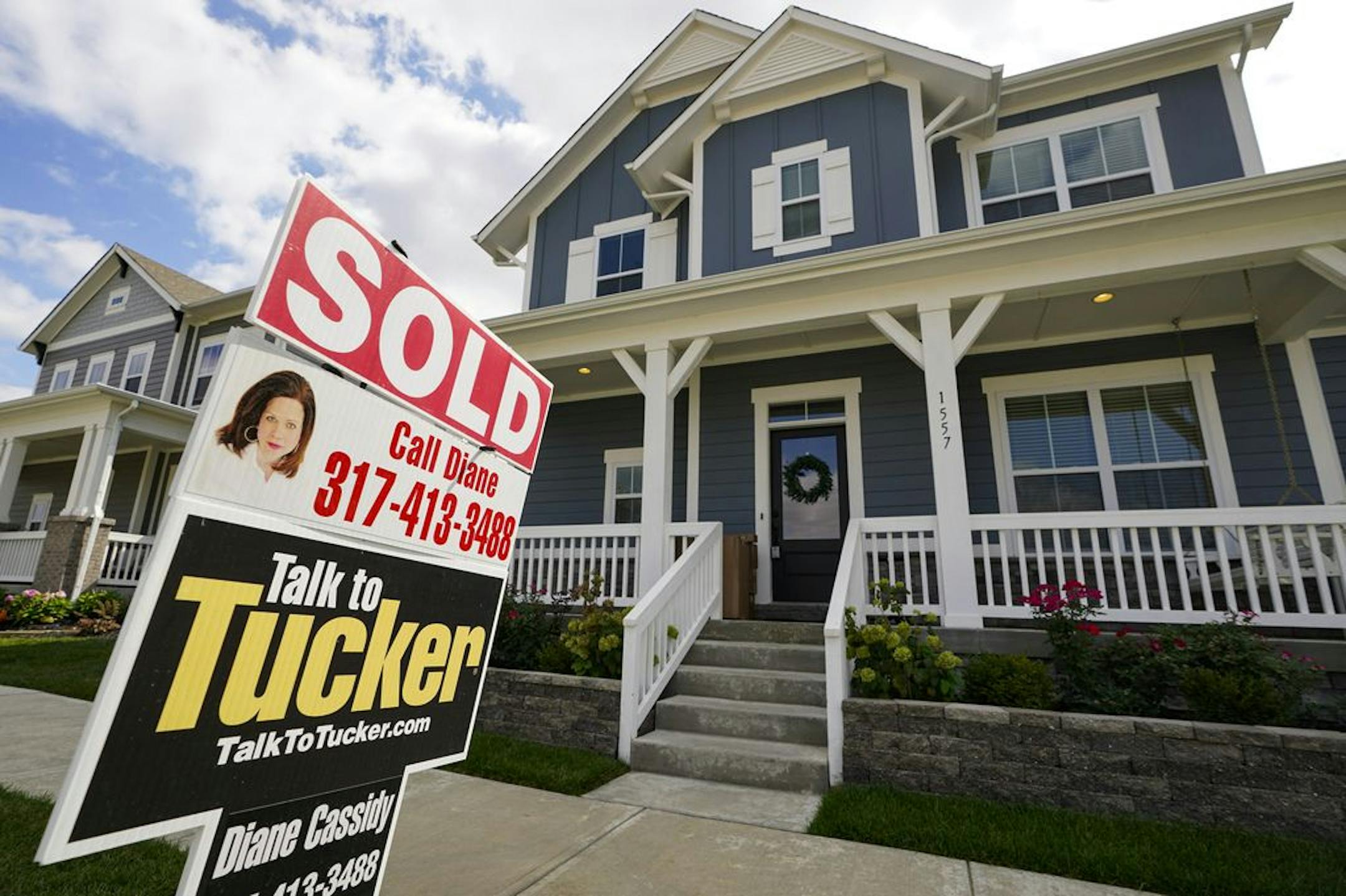
A "sold" sign is posted on a home in Westfield, Ind., Friday, Sept. 25, 2020. The housing market has staged a furious comeback this summer, even as the economy struggles to regain its footing. Home sales have surged to the highest level in more than a decade. The strength has been driven by ultra-low mortgage rates, fierce competition for a dearth of properties on the market and a wave of millennials and others vying to become homeowners.
A "sold" sign is posted on a home in Westfield, Ind., Friday, Sept. 25, 2020. The housing market has staged a furious comeback this summer, even as the economy struggles to regain its footing. Home sales have surged to the highest level in more than a decade. The strength has been driven by ultra-low mortgage rates, fierce competition for a dearth of properties on the market and a wave of millennials and others vying to become homeowners. (Associated Press/The Minnesota Star Tribune)

Mortgage rates move unpredictably in the weeks after presidential elections — not always, but often enough to humble any forecaster who is asked to predict mortgage rates in November of an election year.

To see how difficult it is to predict the future, answer this one-question quiz about the past: What happened to mortgage rates after the disputed 2000 election — did they go up, down or stay about the same?

The answer is that the 30-year fixed-rate mortgage was steady in November, remaining in a range of 7.73% to 7.79%, according to Freddie Mac records. But the rate tumbled more than half a percentage point that December, which is an unusually fast descent.

It fell both before and after the Supreme Court's Bush v. Gore decision on Dec. 12, and averaged 7.13% in the last week of the year.

Since 2000, election-year Novembers have sent rates up, down, about the same, and up again.

• When George W. Bush was reelected in 2004, mortgage rates climbed.

• The 2008 election occurred during a financial crisis, and mortgage rates plummeted almost 1 percentage point in five weeks with the 30-year fixed averaging 5.53% the week ending Dec. 4.

• When Barack Obama was reelected in 2012, mortgage rates dropped, but not as dramatically as four years before. The 30-year fixed fell from 3.39% the week before the election to 3.32% the week ending Nov. 29.

• In 2016, mortgage rates zoomed upward when Donald Trump was elected. The 30-year fixed averaged 3.47% the week before the election, and climbed to 4.08% the week ending Dec. 1. It was the opposite of what had happened in December 2000.

This history lesson teaches us a couple of things:

First, mortgage rates moved more than half a percentage point soon after three of the last five presidential elections (up once, down twice, if you are keeping score).

Second, those big movements in rates hadn't been widely predicted. Each time, observers gave after-the-fact explanations for the movement of mortgage rates, but the experts could have summoned equally plausible explanations if rates had moved the opposite way.

If there's any advice to give, it's this:

Don't try to time the mortgage market based on the expected election results. You might be surprised not only by the winner, but by the market's reaction as well.

E-mail: hlewis@nerdwallet.com. Twitter: @HoldenL.

about the writer

about the writer

Holden Lewis

More from Business

See More
card image
Fairview Health Services

The school is changing an elective course while still working with the Eden Prairie-based health care giant after students raised concerns.

This transmission electron microscope image shows SARS-CoV-2, the virus that causes COVID-19, isolated from a patient in the U.S., emerging from the surface of cells cultured in the lab. (NIAID/TNS) ORG XMIT: 1659810
card image