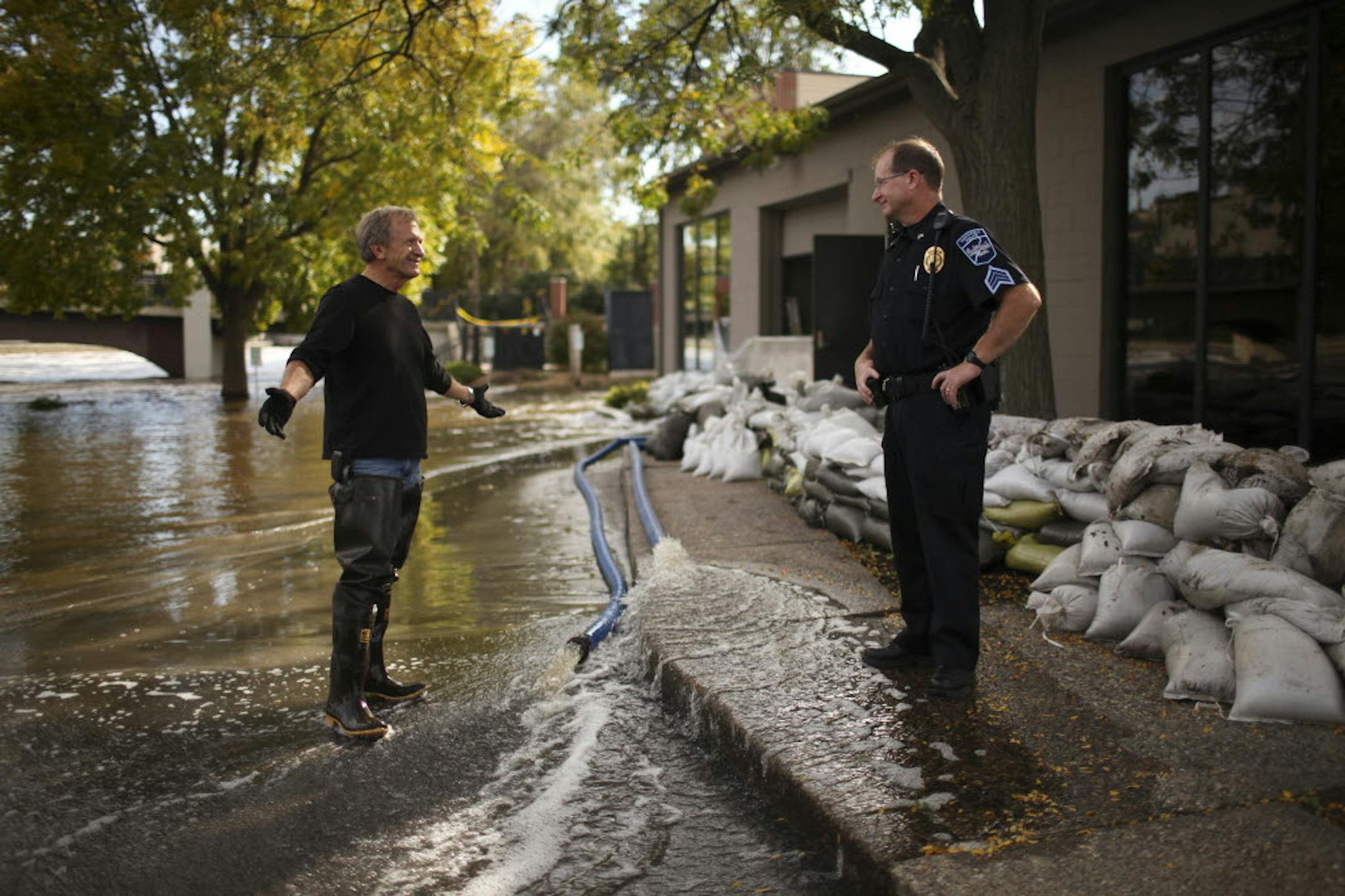
Floodwaters from last week's heavy rains rolled into the metro area Monday, closing two key Minnesota River crossings and forcing thousands of commuters onto detours that will likely remain crowded the rest of this week.
Meanwhile, federal emergency officials began to fan out across 34 southern Minnesota counties to assess flood damage that may require even more aid than the $212 million in state and federal relief spent to help Minnesotans recover from the floods of 2007.
Gov. Tim Pawlenty said Monday he expects to call a special legislative session in early October to approve spending to help flood-stricken communities. Pawlenty said the session would take no longer than a day and be held sometime between Oct. 7 and Oct. 12.
The costs of the flood could complicate a tight cash-flow situation for the state, which already is facing a nearly $6 billion deficit in 2012-13. But Pawlenty has predicted a $235 million cushion at the end of the current budget period next June and said he doesn't expect the state flood relief costs to rise higher than that. Bridges taking Hwy. 101 and Hwy. 41 across the river in the southwest metro area will remain closed indefinitely this week, diverting more than 32,000 cars a day onto Interstate Hwy. 35W, where one northbound lane was already closed Monday for crews to dig a protective ditch, and Hwy. 169. Congestion on southbound I-35W toward the river lingered past 6 p.m. Monday.
"Seek alternate routes and remain patient. That's all we can do," said MnDOT spokesman J.P. Gillach.
MnDOT may also build a protective dike along I-35W, where the National Weather Service projected river floodwaters will rise to within a foot of the road surface by midweek. Gillach said Monday the agency would decide whether to build a dike along I-35W -- for the first time since 2001 -- "within 24 hours."
Sharing costs
About three-quarters of the cost of repairing bridges, roads and sewers could be paid by the federal government, with the rest coming from the state. A combination of state borrowing from selling bonds, cash and federal funding is expected to be used to finance the relief effort.