
Editorial: Supercommittee's work is 'step one'

Grand bargain unlikely, but more modest effort still is progress.

November 20, 2011 at 11:10PM
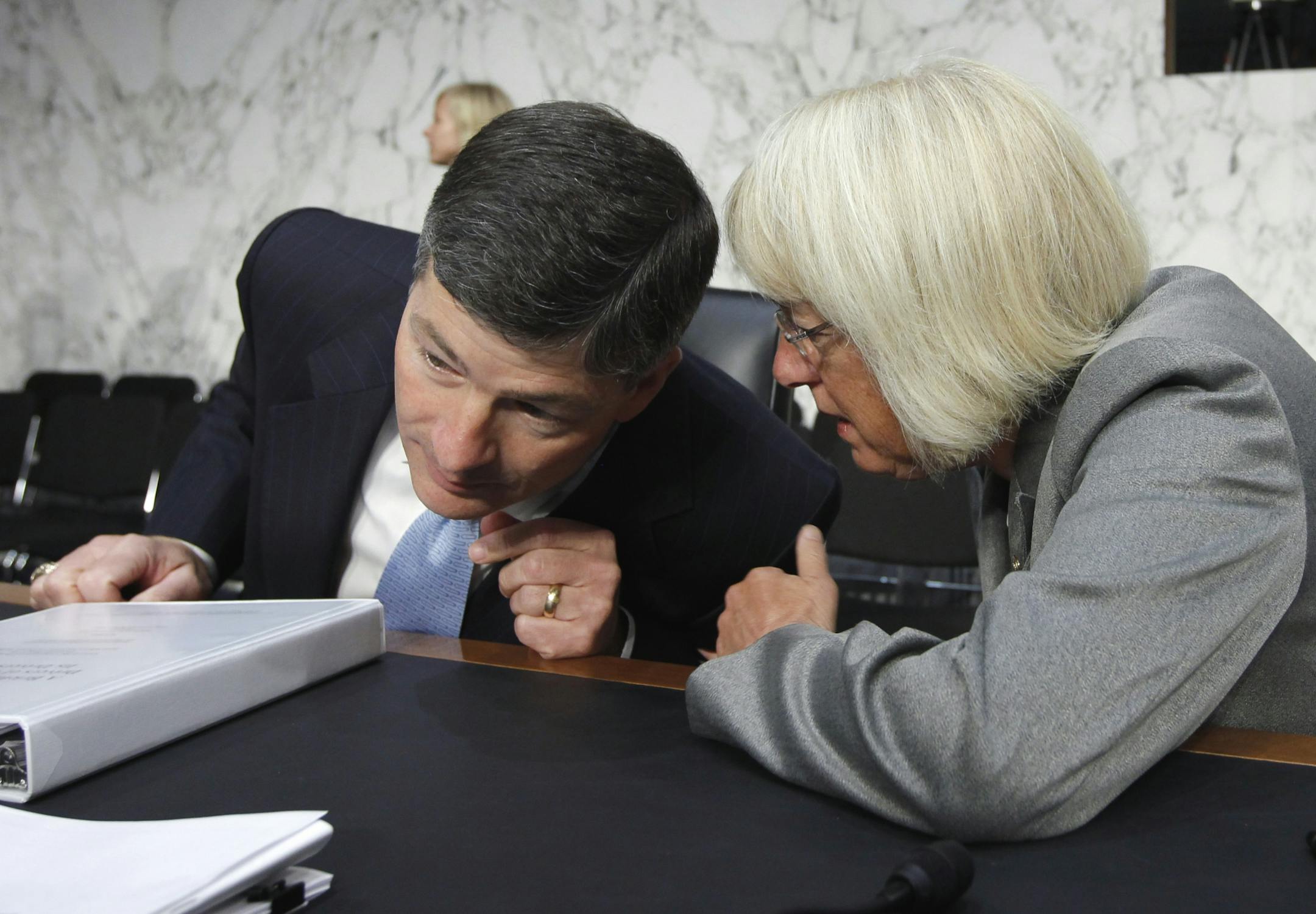
Joint Select Committee on Deficit Reduction Co-Chairs Rep. Jeb Hensarling, R-Texas, left, and Sen. Patty Murray, D-Wash., right, conferred in Washington.
Joint Select Committee on Deficit Reduction Co-Chairs Rep. Jeb Hensarling, R-Texas, left, and Sen. Patty Murray, D-Wash., right, conferred in Washington. (Associated Press/The Minnesota Star Tribune)

The "supercommittee" nickname given to the Congressional Joint Select Committee on Deficit Reduction conjures the image of caped politicians with superhero powers working to slay the nation's massive debt.

But the committee's historic report, due by Wednesday, should serve as a reminder that the panelists are 12 ordinary mortals in pinstripes who had a scant few months to wrestle with a complex problem: significantly reducing the government's borrowing.

And that their assignment -- the result of last summer's debt-ceiling deal -- came when the gulf between Republicans and Democrats is as wide and angry as it's ever been.

Faced with immense pressure to "go big" on deficit reduction -- to find a game-changing $4 trillion in savings -- the committee is bound to disappoint if its report falls short of that very high bar. Some pundits are already dubbing the panel the "not-so-supercommittee" or even worse, an outright failure.

That's premature.

Congress for 20 years has ducked its responsibility to tell the electorate the truth: The desire for high benefits and low taxes equals deficit spending.

And if party leaders and the president couldn't agree on a "grand bargain" during the debt-ceiling negotiations, why would 12 rank-and-file Republicans and Democrats be able to compromise?

Still, it was worth having the bipartisan panel of six House members and six senators take a crack at solutions. Their work, no matter the outcome, is further evidence that Congress is finally getting serious about dealing with deficit spending.

The supercommittee's efforts also will add to the groundbreaking work done over the past year on the deficit by the Simpson-Bowles Commission, the U.S. Senate's "Gang of Six" and other budget experts.

If a grand bargain isn't struck this year, these efforts at least have honestly outlined the nation's financial problems and the painful solutions needed.

They may not have yielded concrete political progress, but "intellectual and ideological progress has been made under the radar," said Joshua Gordon, policy director for the Concord Coalition. "You really do have some building blocks for the next time it comes to the fore."

What's important to remember this week is that the supercommittee's work isn't the last or only shot at the problem. An agreement that achieves only the minimum savings target -- $1.2 trillion -- should be viewed as an important step, a down payment of sorts, toward balancing the nation's books.

Failing to reach an agreement would trigger the same amount of cuts, though this across-the-board approach would not prioritize valuable programs over less efficient ones.

Both outcomes add up to a solid amount of savings when coupled with the $1 trillion already cut in last summer's debt-ceiling deal -- as long as Congress doesn't try to undo some of those cuts next year before they take effect in 2013. Voters must punish faux deficit hawks who try this.

These more modest measures aren't ideal, but they're a start.

And tackling the nation's monumental debt problem in a series of smaller steps has historically worked better than trying to solve it with one big piece of legislation, a point made in a smart analysis by Michael Linden, a Center for American Progress budget expert.

Congress wound up doing end runs around the 1985 Gramm-Rudman-Hollings Act because the nation simply wasn't ready for its far-reaching cuts.

More moderate approaches, such as the 1990 Omnibus Budget Reconciliation Act and a 1993 measure with a similar moniker, both of which balanced cuts with more revenue, proved to be more sustainable.

Late 2012 presents another opportunity to make more progress. The presidential election will be over, and the nation will be as far from the next race as it can be, making it more palatable for politicians to stick their necks out.

The Bush tax cuts will be about to expire, and another round of debt-ceiling negotiations will need to get under way. Both political parties will have reasons to compromise.

"We need to keep the process in motion," said former Minnesota Republican Rep. Bill Frenzel, now with Brookings Institution. "It won't move as fast as we want it to move but it's moving."

about the writer

about the writer

EDITORIAL, Star Tribune

More from No Section

See More
FILE -- A rent deposit slot at an apartment complex in Tucker, Ga., on July 21, 2020. As an eviction crisis has seemed increasingly likely this summer, everyone in the housing market has made the same plea to Washington: Send money — lots of it — that would keep renters in their homes and landlords afloat. (Melissa Golden/The New York Times) ORG XMIT: XNYT58
Melissa Golden/The New York Times

It’s too soon to tell how much the immigration crackdown is to blame.