

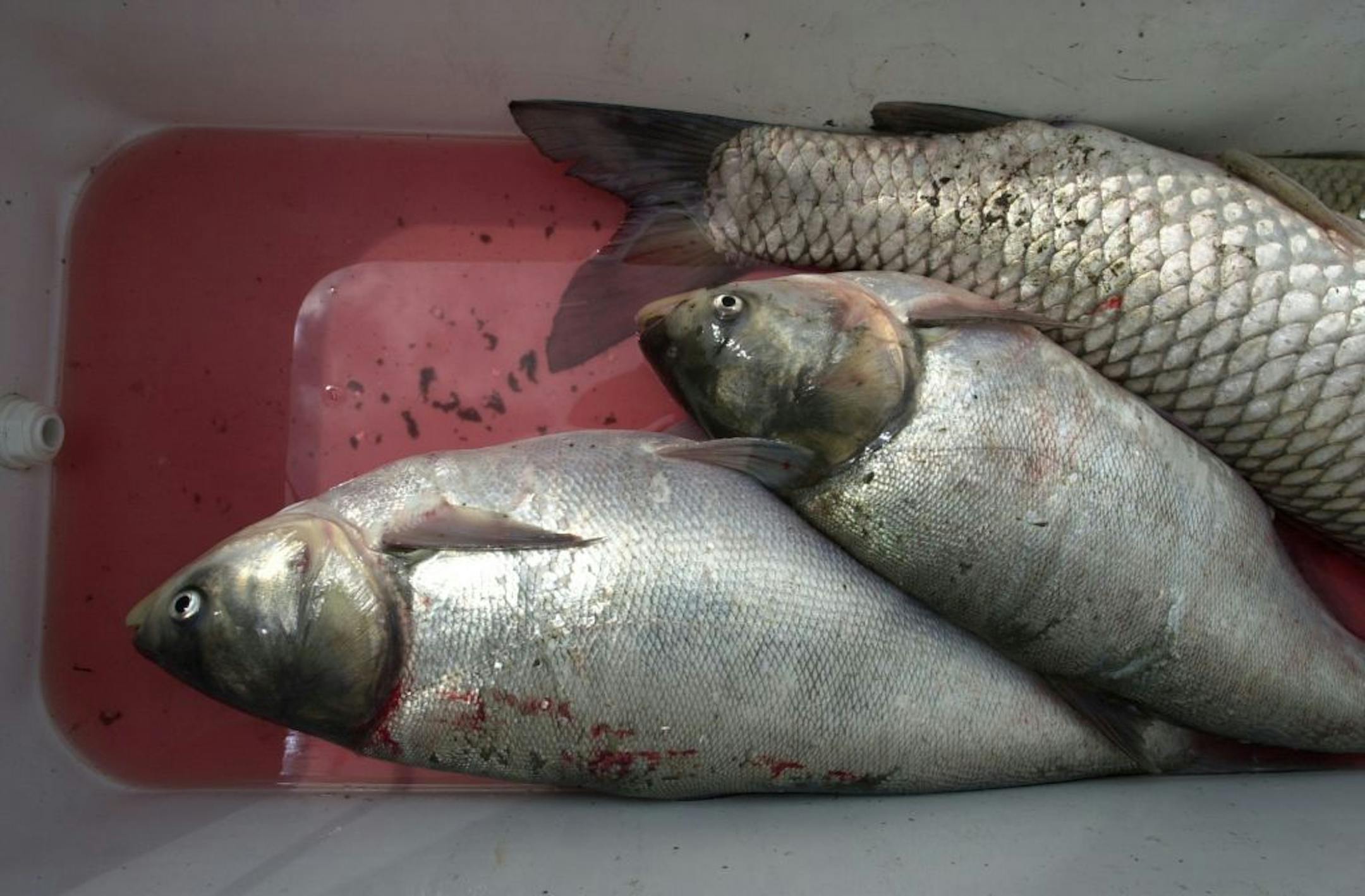
A barrier of noise and bubbles at the Ford Dam near Fort Snelling, costing at least $12 million, is the best option to stop the spread of invasive Asian carp to Minnesota's northern lakes, state officials announced Thursday.
And even though there is no certainty that the barrier will work, the risk from the spread of the voracious fish to Minnesota's lakes is so great that officials from the Department of Natural Resources said they want to start construction next fall and will seek funding from the Legislature this year.
"The long and the short of it is that any type of technology would have be considered experimental," said Steve Hirsch, the DNR's director of water and ecological services.
The recommendations were based on an engineering analysis that ruled out an electric barrier like those used in other rivers and in Chicago's shipping canal. Though an electric barrier probably would work better than sound and bubbles, it's not practical at the Ford Dam, Hirsch said. It would be a safety risk for boaters who use the lock, and electricity could damage the lock's mechanism. For those reasons, the Army Corps of Engineers would not permit the construction of such a barrier, DNR officials said.
The decision to recommend the noise-and-bubbles barrier is a significant step. The state has been wrestling for years with strategies to stop the carp, which have devastated long stretches of the Mississippi and Missouri rivers in the south, and which are now threatening the Great Lakes. A few of the fish have been found in the Mississippi and the St. Croix in Minnesota, but not in sufficient numbers to represent a population large enough to breed.
The Legislature already has provided $7.5 million from the state's 2008 Legacy Amendment for research and planning for a barrier, and has funded a $16 million upgrade to the Coon Rapids Dam that would also be a barrier -- but which also would not be foolproof.
The best and least expensive solution would be to close the upper lock and dam at St. Anthony Falls in Minneapolis, officials said, but that is also the most politically difficult: Doing so would require an act of Congress.
"This only reinforces the need to close the upper St. Anthony lock and dam," said Trevor Russell, program director for the Friends of the Mississippi River, a state advocacy group. "We are running out of options and we are running out of time."


