

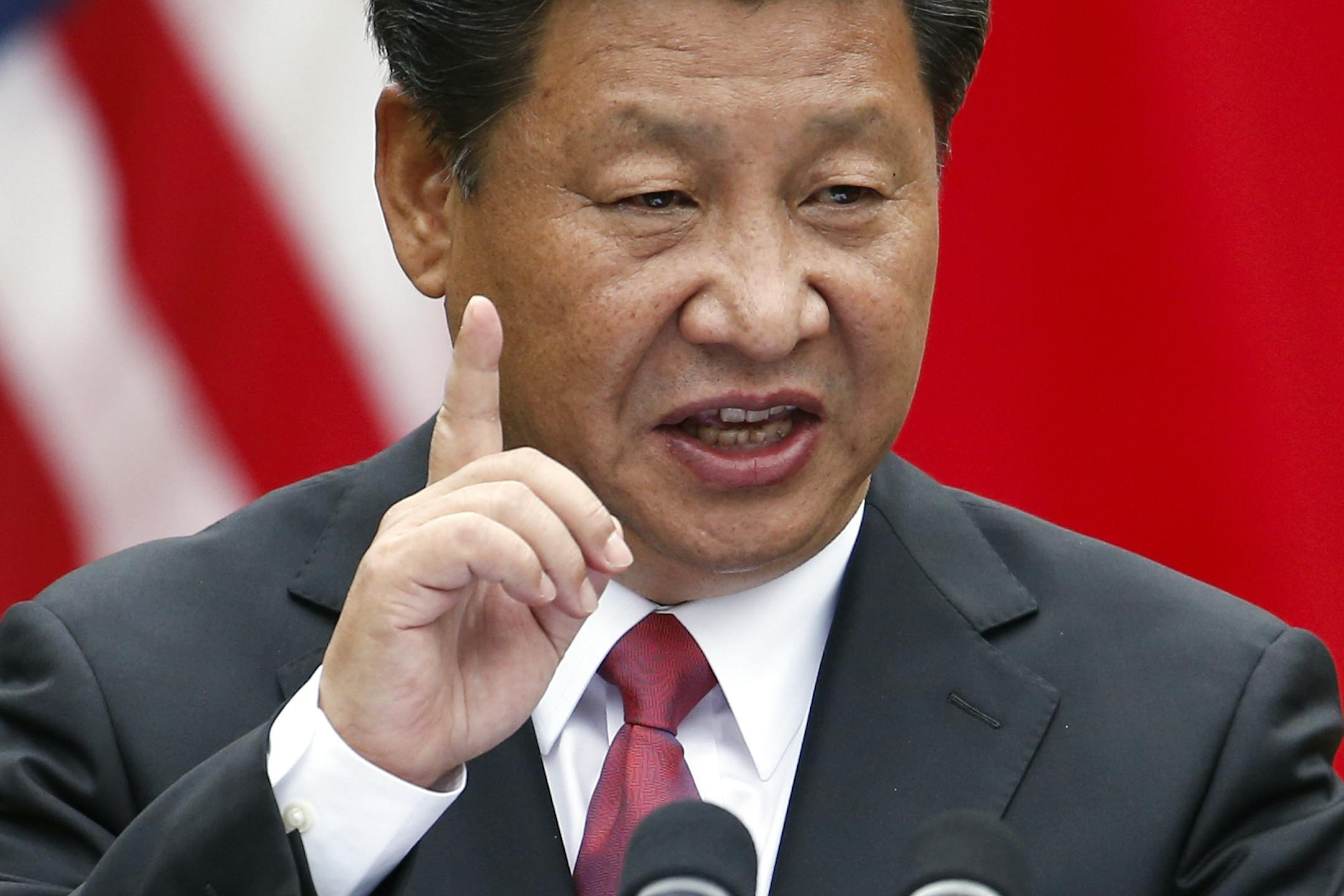
The visit to Washington last week of President Xi Jinping, the leader of the world's second-biggest power, illustrated Lyndon Johnson's saying that politicians need to be able to "walk and chew gum at the same time."
The meetings that Xi, the most powerful Chinese leader in decades, held with President Obama almost seemed like a distraction, given the focus on Islamic terrorists, tragedy and dysfunction in the Middle East and the maneuvering of President Vladimir Putin of Russia.
Those all are dire, immediate challenges for the U.S. But for the next generation, the relations between what are likely to be the only two superpowers may be the most important geopolitical issue.
It won't be easy. The Chinese are certain the U.S. wants to contain and isolate them, and sabotage the ruling Communist Party and its mixed economic model. And they believe the U.S. is determined to dominate their Asian backyard.
The U.S. sees an increasingly assertive China that is cracking down on human and political rights, waging cyberattacks on America's public and private enterprises, aggressively threatening neighbors in the South China Sea and manipulating its currency for economic advantage.
Robert Blackwill, a former U.S. ambassador to India who could be a policymaker in any future Republican administration, wants the U.S. to adopt a more confrontational posture. He sees China as a threat to America's economic interests as it amasses military might "capable of both defeating local adversaries and deterring the United States from coming to their defense in a crisis." At stake, he argues, is "the balance of power in Asia."
Several Asian countries want the U.S. to serve as a check on China's power. But they aren't eager for a confrontation that they would watch from the sidelines. Most now do more trade with China than with the U.S.
One China expert, former Prime Minister Kevin Rudd of Australia, says that though there are differences, both sides tend to exaggerate them. The Chinese, for example, have hugely increased military spending, but the U.S. still spends four times more. "There is no serious prospect of China reaching military parity with the United States before midcentury, if at all," Rudd, who is president of the Asia Society, wrote this year in a paper for Harvard University's John F. Kennedy School of Government.


