

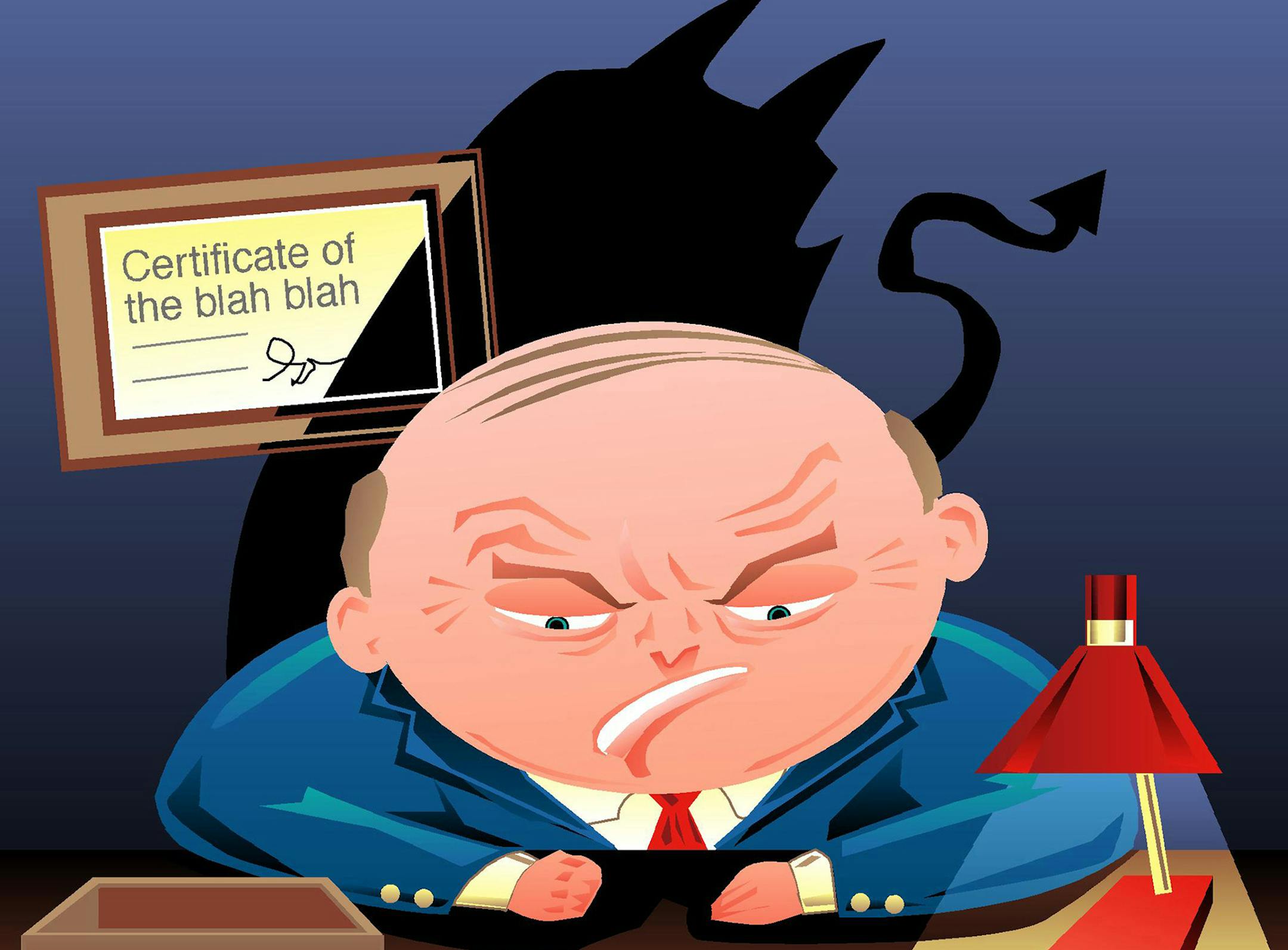
The last week was not a good one for bosses acting like bad boys, and it was all their own fault.
First came AOL chief Tim Armstrong, who made a very poor decision (since reversed) to drastically change his company's 401(k) policy. Armstrong justified the decision as a cost-cutting measure driven by two recent situations in which female employees had "distressed babies" requiring intensive care after birth, setting off a firestorm of criticism both for the policy change and for the highly insensitive comments. This is the same CEO who famously and impulsively fired someone for taking his photo while he was on a conference call with 1,000 employees — and the audio was leaked to the world.
Locally, it was discovered (after a lengthy process) that the former director of emergency preparedness in Minneapolis, Rocco Forte, had created a "poisonous" workplace atmosphere that led to his employment separation. E-mails show that he gave preferential treatment to a female subordinate with whom he was simultaneously pursuing an inappropriate workplace relationship. A number of these e-mails also reveal that Forte engaged in bully-like behavior and demeanor, commenting on a subordinate's family troubles as a weakness ripe for exploiting, for example.
Both Armstrong and Forte appear to have relished being "bad boy" managers — tough, uncompromising leaders who "get things done," with little regard for others, especially women. This approach may appear to have limited benefits for an organization in terms of achieving goals in difficult circumstances. But overall, it presents legal and public-perception nightmares.
In many employment discrimination and harassment lawsuits, it is usually supervisors and subordinates who are the focus of whether they acted contrary to the employer's best interests. When the boss is the focus, the employer is in a double bind, legally and perception-wise.
While neither Armstrong nor Forte are the subjects of legal action under these recent revelations, their bad behavior certainly is cause for concern for what it may signal.
In employment harassment lawsuits, the main legal focus is essentially on whom the alleged harasser is, in terms of whether any legal responsibility exists for the employer. This legal responsibility is referred to as "liability," and the law recognizes several kinds of liability. The type of liability will have a corresponding effect on the alleged victim's claims and the employer's defenses, assuming that all of the other necessary legal elements for the claim have been established.
One type of liability, "vicarious liability," applies in situations where a supervisor has harassed a subordinate. The employer can be found to be vicariously liable, or indirectly responsible, when it has failed to take prompt corrective action. Just last summer, the U.S. Supreme Court narrowed the scope of vicarious liability in Vance vs. Ball State University. Now, in order for an employer to be held vicariously liable for a "supervisor's" harassment, the person must be empowered by the employer to take tangible employment actions against the alleged victim of harassment.


