
Bird flu hits second Minnesota turkey farm

Regulators have quarantined a farm in Lac qui Parle County, where the disease wiped out a flock of 66,000 birds.

March 28, 2015 at 1:35AM
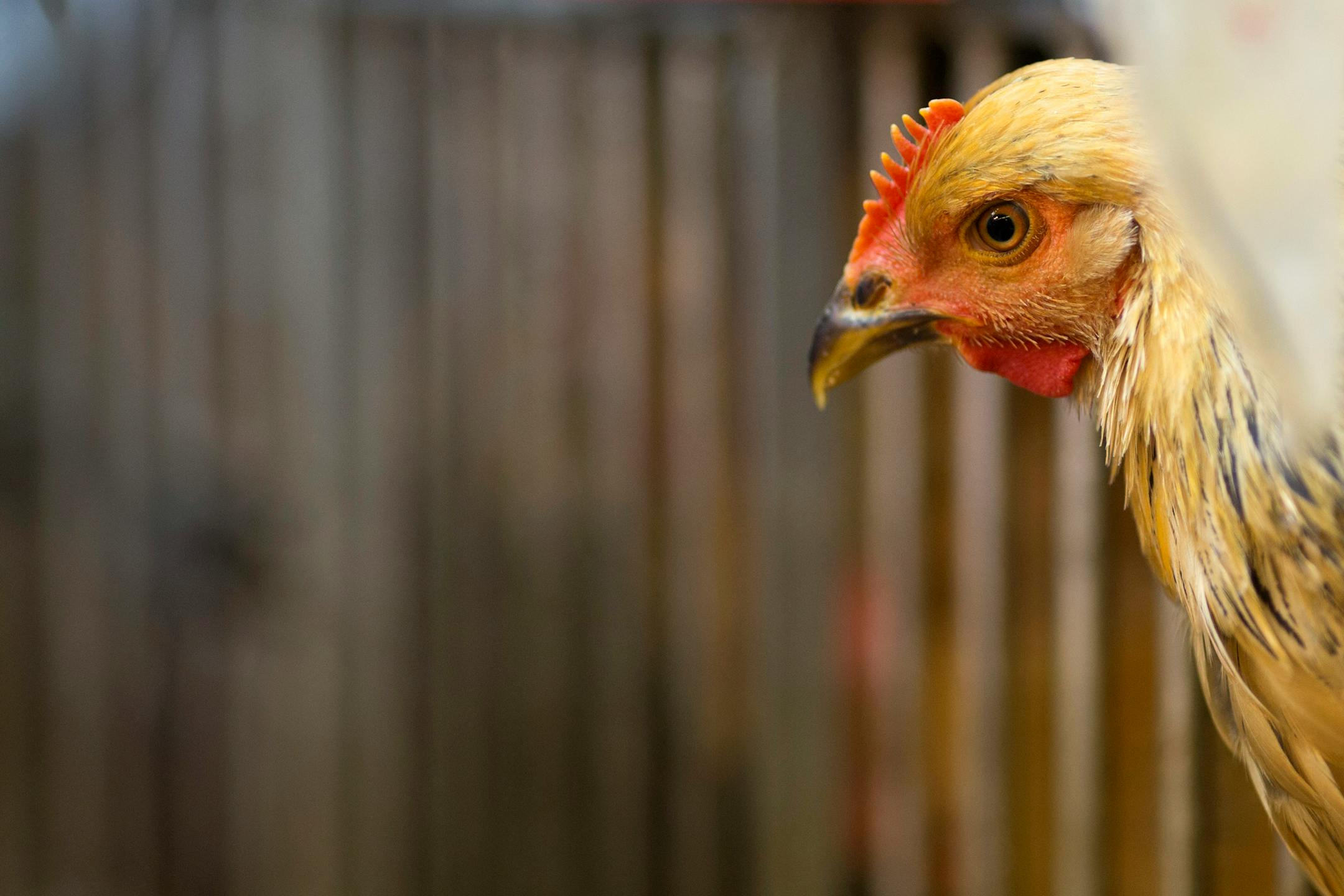
A live chicken sits in a cage at the Kowloon City Market in Hong Kong, China, on Thursday, April 11, 2013. The Hang Seng Index rose 0.8 percent to 22,220.65 as of 1:14 p.m. in Hong Kong, headed for its longest winning streak since March 27. The gauge is close to erasing last week�s loss prompted by the outbreak of a new strain of bird flu in China. Photographer: Jerome Favre/Bloomberg
Regulators have quarantined a farm in Lac qui Parle County. 2014 file photo of an avian flu outbreak in Asia. (Evan Ramstad — Bloomberg/The Minnesota Star Tribune)

In another blow to Minnesota's turkey industry, avian flu has struck a second western Minnesota farm, this one a 66,000-bird operation.

The U.S. Department of Agriculture confirmed Friday that highly pathogenic H5N2 bird flu has been detected at a commercial turkey farm in Lac qui Parle County.

Earlier this month, the same strain of bird flu ravaged a flock of 15,000 birds at a turkey breeding operation in Pope County.

Minnesota is the nation's largest turkey producer, and bird flu has caused dozens of countries to suspend turkey exports from the state and several others.

The flu quickly killed all 22,000 birds in one of three turkey barns at the Lac qui Parle farm, said Bill Hartmann, state veterinarian for the Minnesota Board of Animal Health. "This is a very lethal virus to turkeys." The 44,000 birds in the other two barns were euthanized to prevent spread of the flu.

There are no other commercial turkey operations in a roughly 12 mile radius around the infected Lac qui Parle farm, Hartmann said. "There are just back yard flocks."

State officials do not believe the virus spread from the earlier Minnesota outbreak. "There is no apparent connection between this flock and the one in Pope County," Hartmann said.

The highly pathogenic bird flu is believed to be spread by migratory wild birds who carry the virus, but don't appear to get sick themselves.

The bird flu has also been reported recently in Arkansas and Missouri, and earlier this year in several Western states.

The federal Centers for Disease Control considers the bird flu to pose a low risk to human health; no infections from it have been detected. However, workers at turkey farms exposed to the virus have a higher risk of contracting it.

The state health department will monitor workers from the Lac qui Parle farm, said Ed Ehlinger, the department's commissioner. Workers at the previously afflicted Pope County farm have also been monitored and have shown no signs of illness, Ehlinger said.

Minnesota has at least 450 turkey farmers who raise about 45 million birds annually. Most of their production is for the U.S. market, and Austin-based Hormel Foods Corp. is particularly reliant on Minnesota turkey for its Jennie-O products.

But about 12 percent of Minnesota turkey production — mostly dark meat — is exported.

Mexico is one of the biggest export markets for Minnesota turkey. The country has had a partial ban on Minnesota exports, said Dave Frederickson, commissioner of the Minnesota Department of Agriculture.

But after the second outbreak in Minnesota, "I fully expect [Mexico] to be back to 100 percent," he said. "It will indeed affect our exports."

Mike Hughlett • 612-673-7003

about the writer

about the writer

Mike Hughlett

Reporter

Mike Hughlett covers energy and other topics for the Minnesota Star Tribune, where he has worked since 2010. Before that he was a reporter at newspapers in Chicago, St. Paul, New Orleans and Duluth.

See Moreicon

More from Minnesota Star Tribune

See More
card image
Provided/Sahan Journal

Family members and a lawyer say they have been blocked from access to the bedside of Bonfilia Sanchez Dominguez, while her husband was detained and shipped to Texas within 24 hours.

card image