

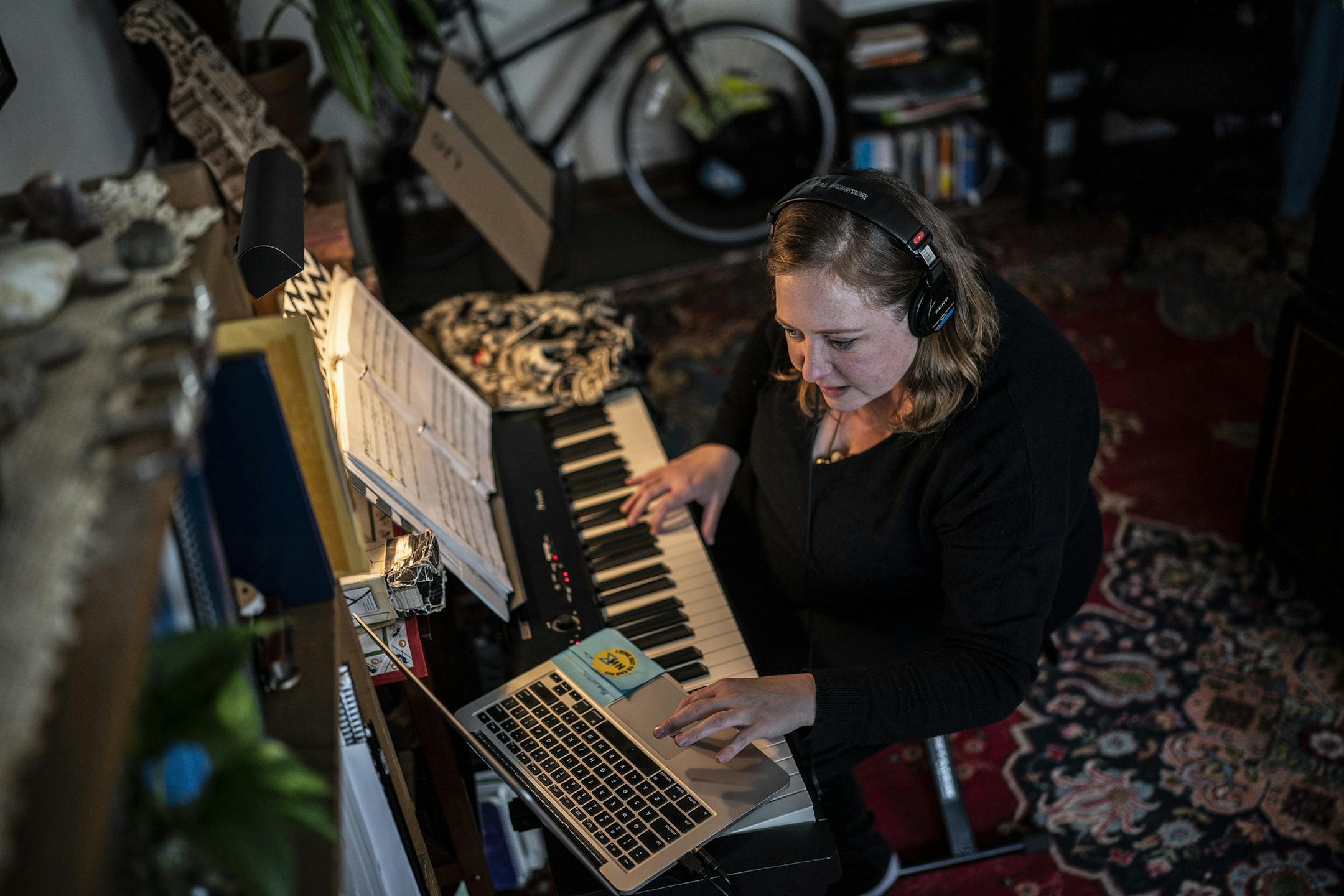
Alyssa Anderson adjusted the camera, set up a light, readied her laptop, checked her levels and pressed "Record." Then, finally, she sang.
"A este sol peregrino, sol peregrino."
The venue: her Minneapolis apartment. The audience: an iPad taped to a stand better suited to other tasks.
Since the pandemic, this is how Anderson, a mezzo-soprano, has made music — alone in her apartment, acting as her own sound engineer, stealing takes between passing garbage trucks.
"I'm glad to have the work," she said. "But I'll be really glad when this stuff is happening in person and not in my living room."
More and more, Anderson is booking gigs beyond her apartment walls. This month, she and five other vaccinated singers from the choir Border CrosSing recorded at Central Presbyterian Church in St. Paul. In July, for the first time in more than a year, she'll perform for a live audience.
"It's going to be glorious," she said.
But the return to live music has been slow. When the pandemic hit, freelance soloists and musicians — who work contract-to-contract, weekend-to-weekend — watched months' worth of performances evaporate. Because the virus spreads via exhaled droplets and particles, classical singers in particular have grappled with the worst of it, some struggling to pay rent, others contemplating new careers.


