

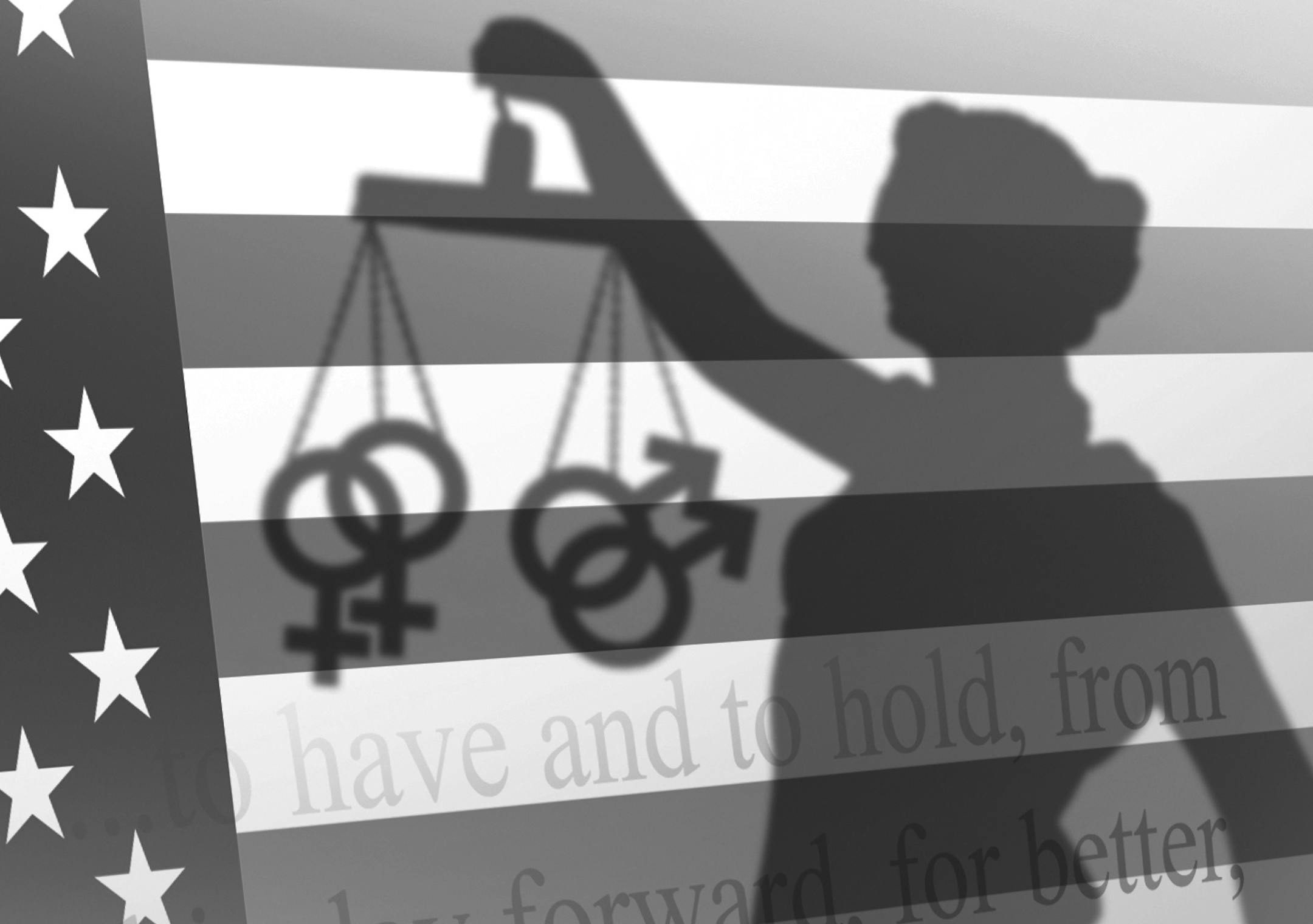
Even though I've been warning about a mounting confrontation between the state of Alabama and the federal courts on gay marriage for the last month, I have to admit that I find the latest development pretty shocking. In a 134-page opinion, issued on the eve of the King vs. Burwell argument when legal attention was elsewhere, the Alabama Supreme Court has flatly ordered state probate judges not to issue marriage licenses despite a federal district court order making it clear they were obligated to do so.
The opinion not only asserts the state courts' right to interpret the Constitution independent of the lower federal courts, but also lambastes the reasoning of the U.S. Supreme Court's landmark same-sex-marriage opinion in U.S. vs. Windsor as nothing more than a "legal proxy for invalidating laws that federal judges do not like."
Legally speaking, the Alabama Supreme Court is coming close to full revolt.
The background is detailed, but what you need to know now is that after federal district Judge Callie Granade invalidated the Alabama law restricting marriage to one man and one woman, elected Alabama Chief Justice Roy Moore advised defiance. Some state probate judges listened to Granade; others to Moore. Granade then ordered a specific Alabama probate judge named Don Davis to issue marriage licenses to same-sex couples. She made it clear that she was willing to issue similar orders to other probate judges if they resisted her order, too.
Davis listened to Granade — he was, after all, under a direct injunction from a federal court — and it seemed possible that other judges would follow suit. In fact, many did not. One judge, along with advocacy groups opposing gay marriage, went to the state Supreme Court and asked it to declare that the probate judges shouldn't follow the federal court's ruling. (Davis, hoping to avoid being given contrary orders by two different courts, asked to be exempted from the Alabama court's judgment. The court agreed, but implied that Davis might be obligated to stop issuing all future licenses.)
Moore recused himself from the ruling by his own court, probably because he's been burned in the past by resisting federal court orders. The Alabama court, however, had no qualms. It voted 7-1 to instruct the state's probate judges not to issue same-sex marriage licenses.
The court's reasoning is noteworthy in several ways. First, the court spent some 50 pages justifying its decision to take the case at all. Even though the court's holding on its own standing is doubtful, it can't be challenged in any court, because whether the Alabama court can hear a case is a matter of Alabama law on which the court's word is final. A federal court reviewing this decision will have to take this aspect of the court's decision on its own terms.
Then, the court explained why it could defy the federal district court: State courts have an independent right to interpret the Constitution differently from the lower federal courts. The Alabama court formally conceded that the U.S. Supreme Court could overrule it. But because the lower federal courts don't directly review state court judgments, the state courts can't be bound.


