

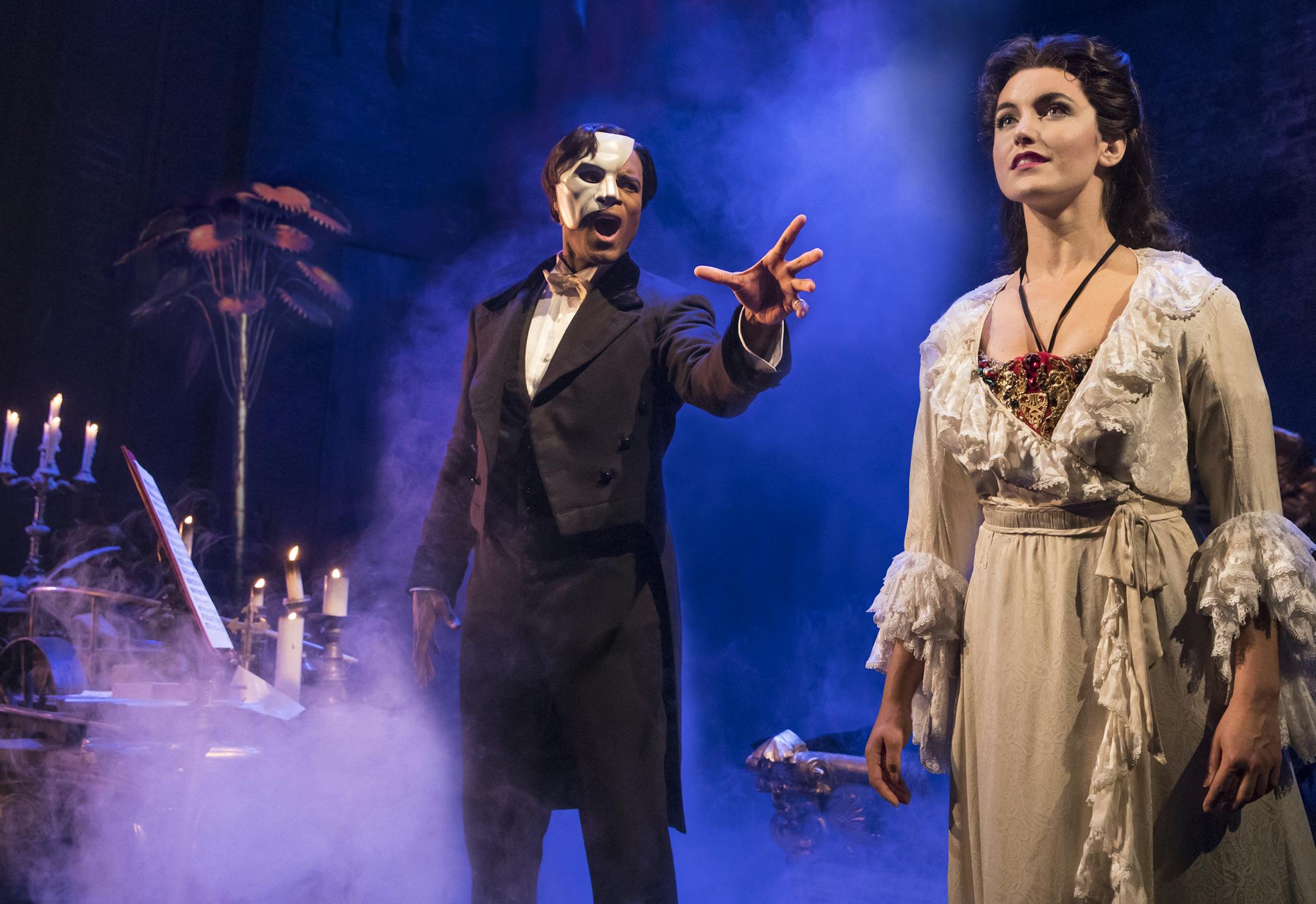
"The Phantom of the Opera" opened Friday at the Orpheum Theatre in Minneapolis with well-earned oohs and aahs over performances and pyrotechnics.
Actors Derrick Davis and Eva Tavares were captivating as the mysterious and misunderstood title character and as Christine Daaé, the beautiful singer through whom the deformed but brilliant Phantom realizes his artistic expression as well as a measure of normalcy.
Theirs was a performance to savor, full of magnetism, mystery and alluring drama, especially on the title song, but also on "The Point of No Return." (Davis, a Broadway favorite who played both the hero and the villain in "The Lion King," rotated out of the production on Sunday, succeeded by Quentin Oliver Lee.)
Director Laurence Connor's staging was seamless, with nary a glitch from Paul Brown's cylindrical set that opened and closed like a flower to reveal the musical's various milieus. Music director Jamie Johns' tip-top orchestra delivered the score of this Andrew Lloyd Webber juggernaut with subtlety and joy, alongside Maria Bjornson's telling and often gorgeous costumes and Mick Potter's immersive sound design.
But the crashing chandelier in "Phantom" lands at a moment when much is being re-examined in the culture. The title character — an "Angel of Music" who demonstrates his dominion over the Paris Opera house with a hanging or two — could be viewed as a hostage-taker, and Christine as his shell-shocked Stockholm Syndrome victim.
If the musical survives into the future, it's because the objectionable elements have been somewhat ironed out by Connor, whose staging is less histrionic and more human than Harold Prince's original.
Christine is a fatherless young woman, and she has dreams of success that would honor her dad. The show becomes more about her, and what she has survived, even as the Phantom overcomes his own childhood as a captive exhibited in a cage.
"Phantom" is cut from a deeply held archetype — the Beauty and the Beast — that pervades the culture, one in which a princess is key to the transformation of a frog, or hunchback or whatever pock-marked or hideous figure the creature may be.


