

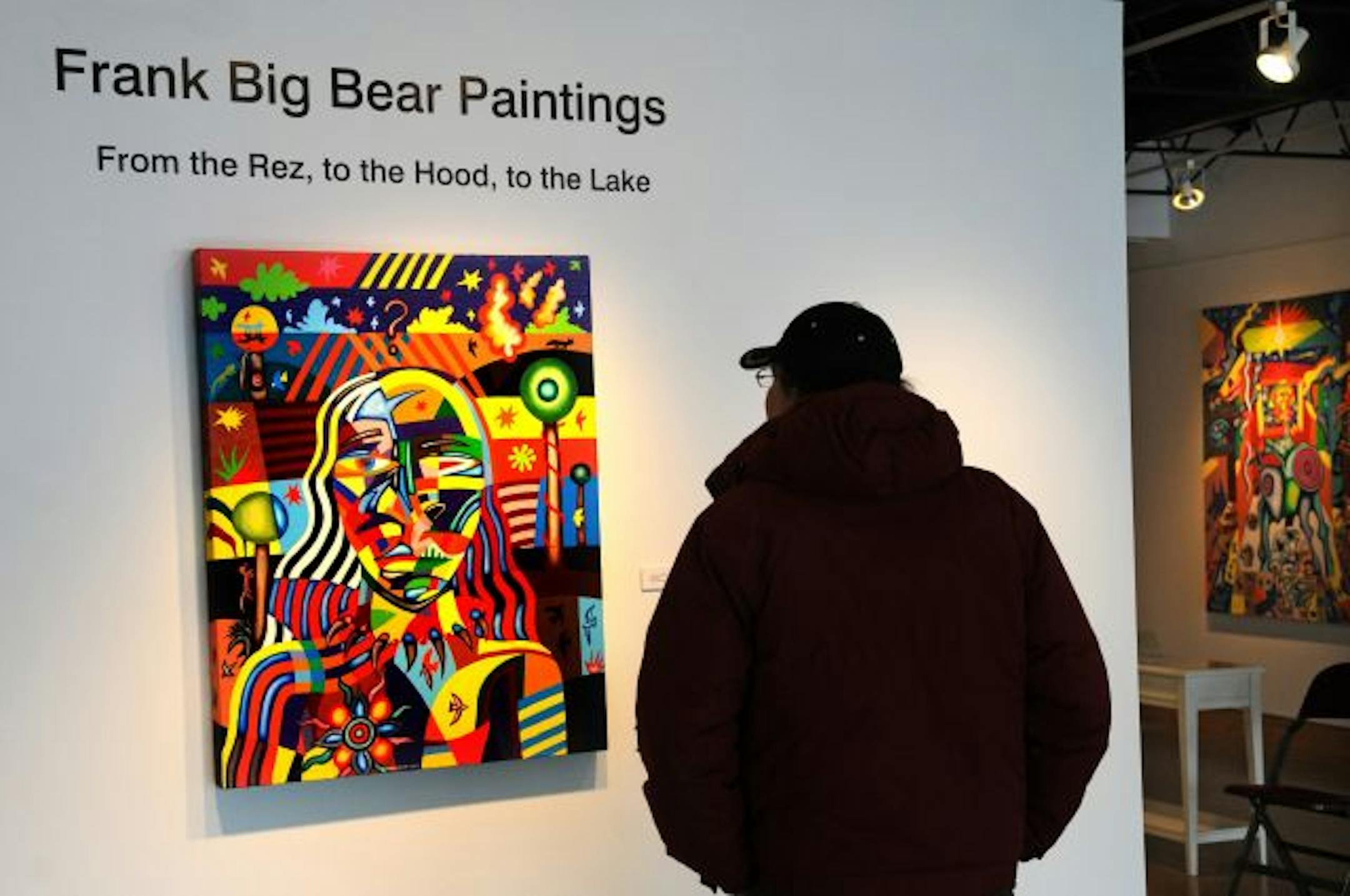
For more than a decade Frank Big Bear was the artist/poet of E. Franklin Avenue, the guy with the amazing colored pencils whose intricate drawings captured the shabby street's decay, the drink and drugs and hard times that so often burdened its people. There was never hard-luck whining in the drawings, just keen-eyed attention to the way life might play out if you were an urban Indian living in a hardscrabble neighborhood, as Big Bear was.
But Franklin Avenue has changed and so has Big Bear's new work, which is on view in "From the Rez, to the Hood, to the Lake" at All My Relations Gallery through Feb. 28. Some of the differences are artful -- bolder colors, bigger canvases, a switch from pencil to paint. Others are more personal. Instead of observing what's outside his window, Big Bear has turned to what's on his mind.
Most of the show's 15 paintings are stylized portraits in bright Pop hues and mosaic patterns that dazzle the eye with curvaceous stripes and ornamental ribbons of rainbow colors. As if consciously testing his own prowess, the artist has taken on such 20th-century masters as Picasso and Matisse without compromising his independent vision. The new work also includes references to his family and to the North Woods and Lake Superior, near which he settled last year.
Gallery as development tool
As one of Minnesota's leading American Indian talents, Big Bear was the right choice to inaugurate All My Relations, a spacious new gallery in a sunny E. Franklin storefront. The gallery is the successor to Ancient Traders Gallery, which closed last February after 11 years as the Twin Cities' chief showcase of American Indian art. The new gallery plans to showcase American Indian artists from the Upper Midwest, and is organizing a June 11-12 arts festival that will showcase native artists and performers.
"While we value traditional work, we want to concentrate on contemporary American Indian fine art from this region," said gallery coordinator Elizabeth Day.
The gallery is part of a continuing effort to use arts programming as a tool to change perceptions of the neighborhood, said Justin Huenemann, director of the Native American Community Development Institute (NACDI). Huenemann's organization has offices in the gallery's building and oversaw renovation of the property, which previously housed a shelter-meal operation. The organization also placed a sculpture in the building's parking lot and installed a native-owned coffeeshop in the building to increase drop-in appeal.
"We want to create a neighborhood aesthetic and an American Indian identity here, and we are able to do it because we own a half-mile strip of Franklin Avenue," Huenemann said, referring to an assortment of American Indian organizations that have invested in the area.


