

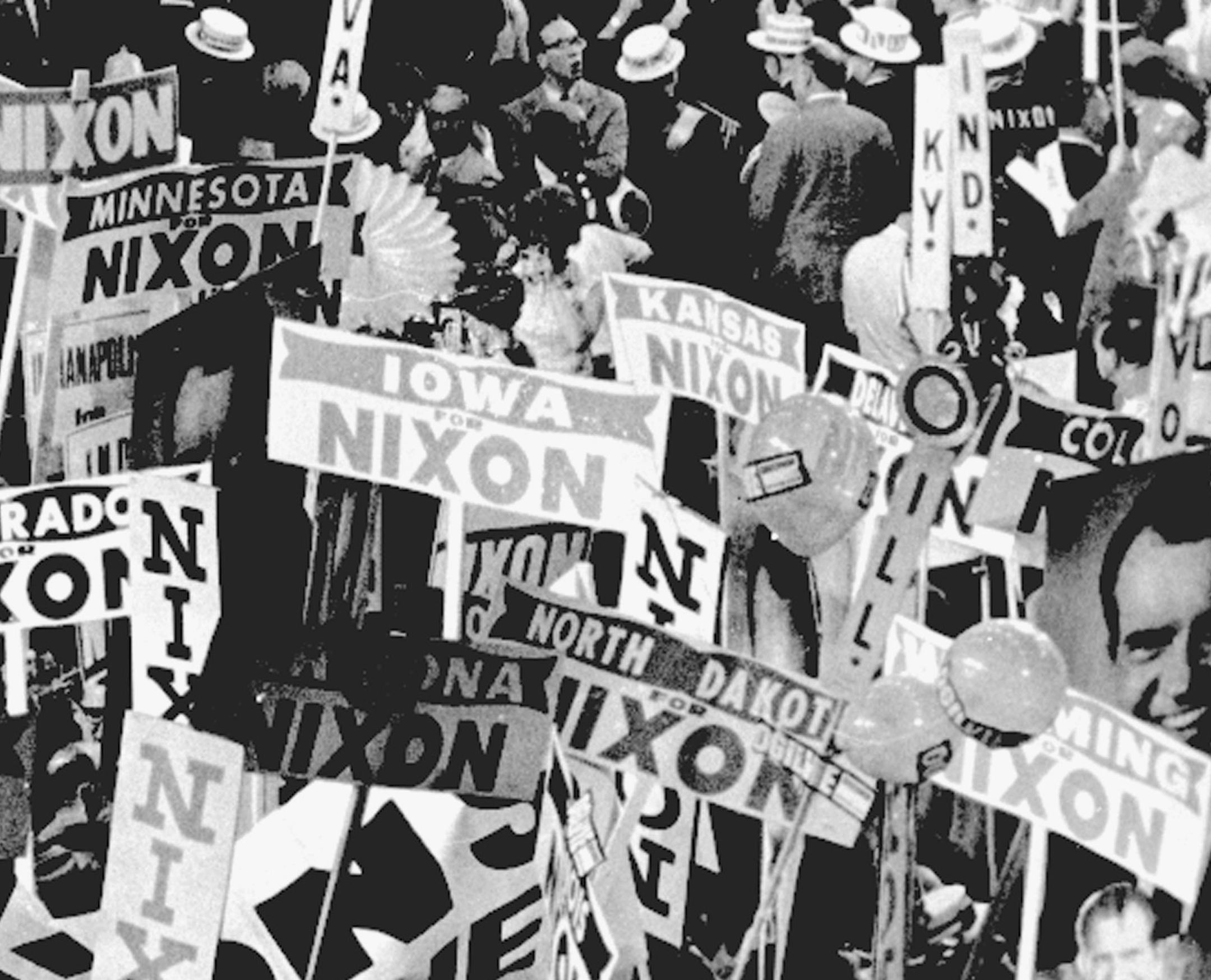
Both parties have their go-to greats. Just as JFK is evoked by Democratic candidates, Republican presidential prospects routinely refer to Ronald Reagan. So it's striking that after decades in image exile, Richard Nixon was cited as an influence for newly minted GOP nominee Donald Trump.
Campaign manager Paul Manafort said as much in Monday's New York Times. Nixon's 1968 acceptance speech, he said, "is pretty much on line with a lot of the issues that are going on today."
Manafort's candor, while welcome, wasn't necessarily needed. Trump's adoption of Nixon's "silent majority" phrase and claim of being the "law-and-order candidate" during his acceptance speech were clear manifestations of Manafort looking to Nixon's legacy.
And Trump's unsubtle usurpation of Nixon's themes seemed to be acknowledged by the candidate himself. "I think what Nixon understood is that when the world is falling apart, people want a strong leader whose highest priority is protecting America first," Trump told the New York Times. "The '60s were bad, really bad. And it's really bad now. Americans feel like it's chaos again."
And if they needed any reminder, Trump and Rudy Giuliani amplified (loudly) the message at the Cleveland convention.
Americans probably didn't need prodding in 1968, either. But Nixon nonetheless told delegates in words with eerie echoes that "[a]s we look in America we see cities enveloped in smoke and flames. We hear sirens in the night. We see Americans dying on distant battlefields abroad. We see Americans hating each other, fighting each other, killing each other at home."
And if the speech didn't reach them, campaign ads did.
"It is time for an honest look at order in the United States," Nixon said in an ad called "The First Civil Right." He continued: "Dissent is a necessary ingredient of change. But in a system of government that provides for peaceful change, there is no cause that justifies resort to violence. Let us recognize that the first civil right of every American is to be free from domestic violence. So I pledge to you that we shall have order in the United States."


