

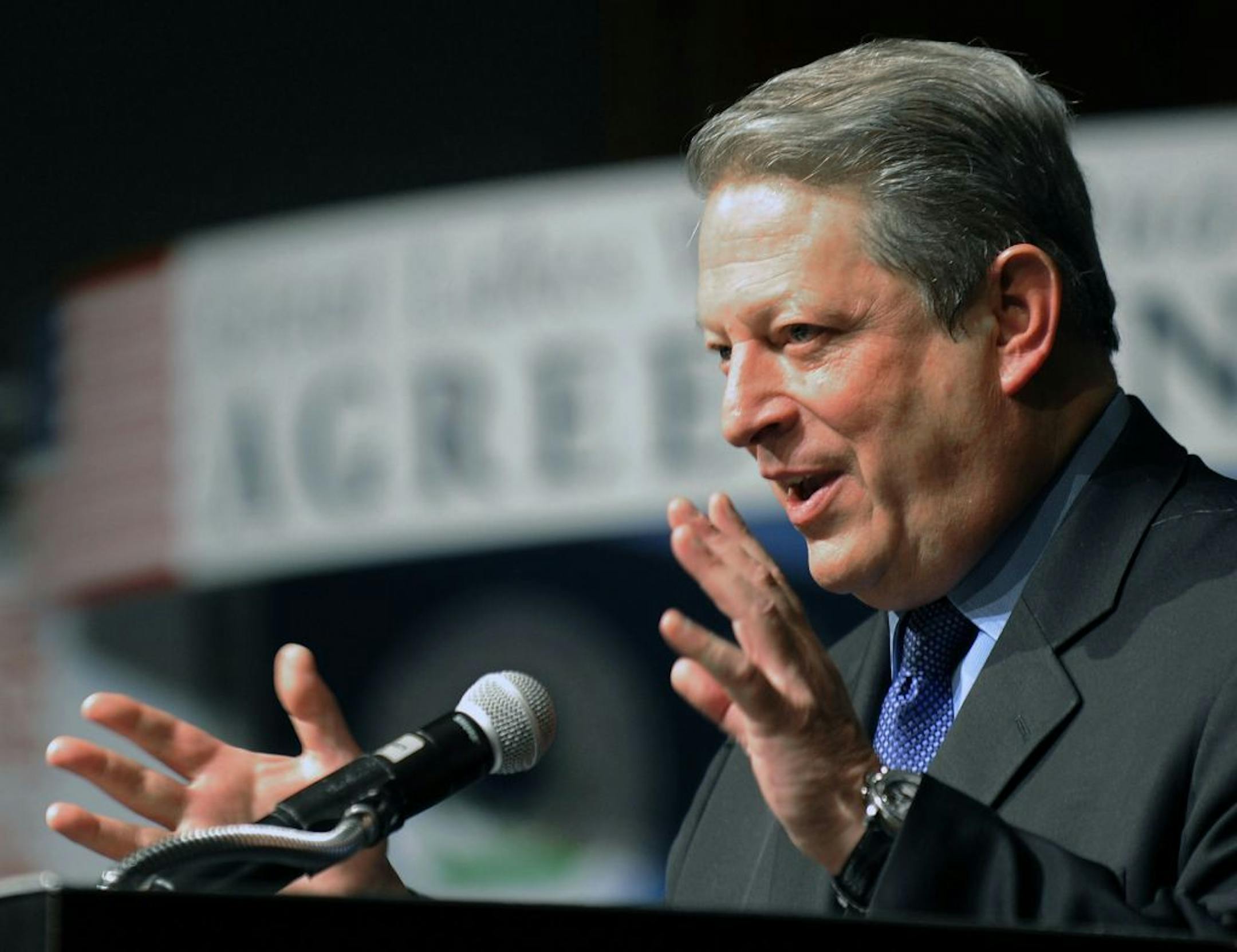
Former Vice President Al Gore is coming to town this week to predict the future. Or more accurately, to promote "The Future," his new book on how the world is changing and what we can do to avoid disaster.
Gore, who splits his time overseeing his business interests at Generation Investment Management and serving as chairman of the nonprofit Climate Reality Project, uses the book to focus on what he calls an unprecedented era in the history of technology.
"We are seeing multiple revolutionary changes taking place simultaneously, and this is the first time that's ever happened," he said by phone, rattling off a list that ran from artificial intelligence to genetic engineering. "With the scientific revolution speeding up so rapidly, the implications of technology and science for the rest of us are really very powerful and profound."
Since starring in the Oscar-winning documentary "An Inconvenient Truth," Gore has grown into quite the busy public intellectual. Prior to arriving in Minneapolis, he shared his thoughts on a range of topics.
Gore on warnings vs. predictions: "I write in the book that these times are pregnant with the fraternal twins of opportunity and peril," he said. "We face tremendous opportunities that we need to seize, but there are also dangers that we need to avoid."
On rampant mechanization: He is concerned with what he calls "robosourcing" — replacing workers with robots. It's something he considers a bigger danger to the workforce than outsourcing. "Unlike earlier technological changes that created new jobs — albeit, ones that required learning new skills — robosourcing eliminates jobs," he said.
On democracy and capitalism: He believes that the systems needed to make change do exist, but they need to be changed first. "We have two powerful tools with which to shape the future: democracy and capitalism," he said. "And yet, both are in need of reforms."
On fixing systems: "Our democracy has been hacked," he said. "It no longer operates the way our founders intended it to. And our markets are distorted by short-term thinking and seriously flawed measurements of value. We need to make reforms so that both democracy and capitalism can be as productive in shaping a bright future as we need them to be. We as Americans need to retake control of our democracy and demand the reform of our markets."


