
Yamaha perfecting robot racer that could lead to industrial uses

Researchers who want to leave one of the world's fastest motorcyclists in their robot's dust failed in two attempts, but they aren't ready to give up.

December 9, 2017 at 5:30AM
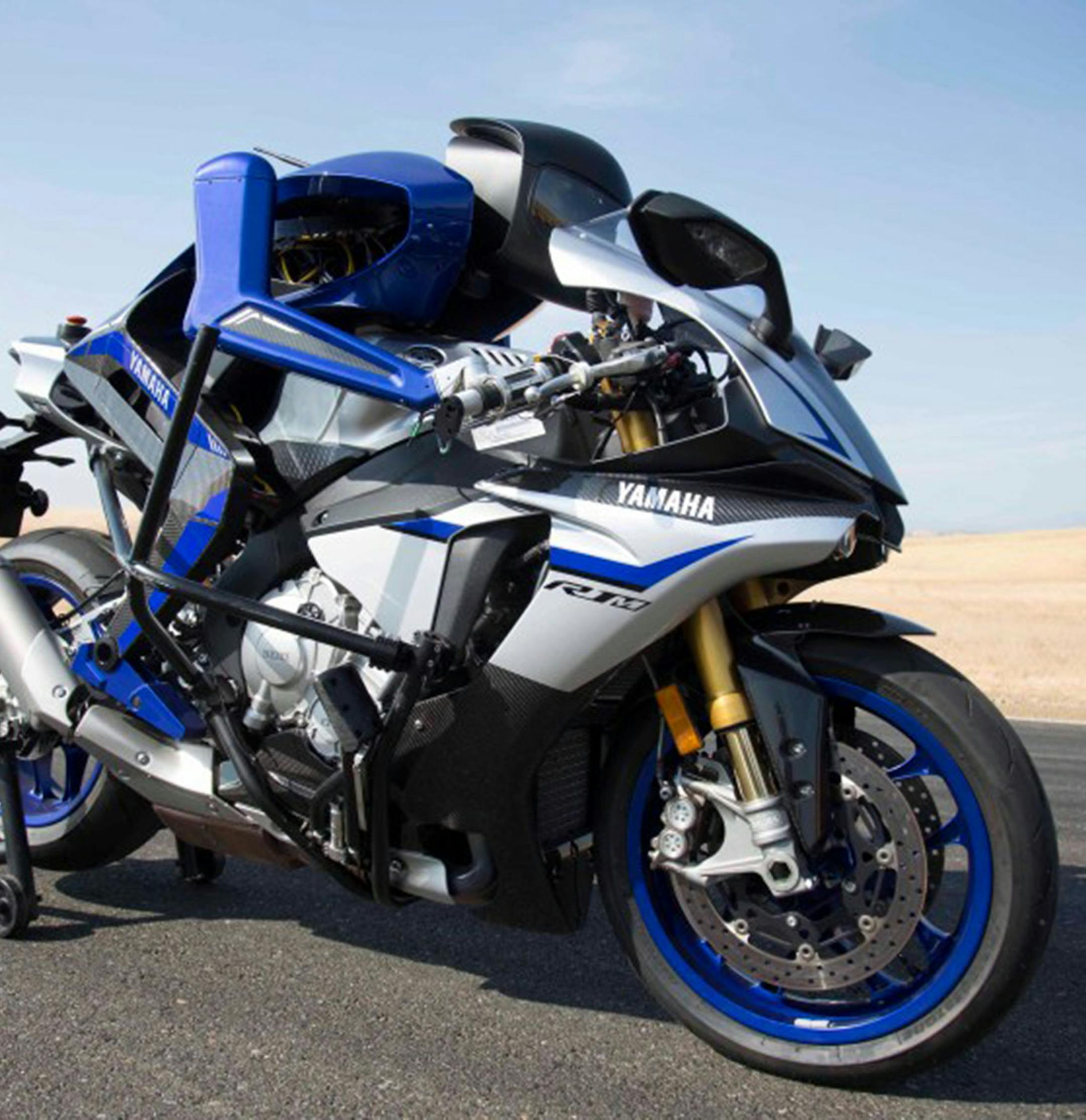
Motobot 2.0, a joint research project of SRI International and Yamaha Motor Ventures in Menlo Park, is shown in a promotional image. The 2-year-old Motobot project, which in its second iteration recently achieved speeds higher than 200 kilometers per hour (124 mph), employs a humanoid robot on an unmodified Yamaha YZF-R1M to test ways to increase performance and speed while boosting ridership safety. (SRI International)
Motobot 2.0 has passed 124 mph, but can’t beat a human racer. (The Minnesota Star Tribune)

Researchers who want to leave one of the world's fastest motorcyclists in their robot's dust failed in two attempts, but they aren't ready to give up.

Since late 2014, Menlo Park, Calif.-based SRI International's robotics division has partnered with Yamaha Motor Co. to perfect Motobot, a humanoid robot that controls an unmodified Yamaha YZF-R1M and transmits data to boost its performance, maneuverability and speed. The goal is to create smoother rides and increase rider safety.

The Yamaha YZF-R1M happens to be the same motorcycle used by Valentino Rossi, a nine-time Grand Prix world champion from Italy whose lap time the SRI/Yamaha team has been trying to beat. The joint venture failed twice by about 30 seconds, most recently in October.

With Motobot 2.0, the second iteration, the team did manage to exceed 124 mph, roughly 30 mph faster than the first version.

Why is speed so important?

"The higher the speed, the greater the requirement on sensing, computing, positioning and more," said Hiroshi Saijo, CEO and managing director at Yamaha Motor Ventures and Laboratory Silicon Valley. "In short, the higher the speed, the greater the technical challenge. We wanted to establish the comprehensive capabilities of professional test riders."

He said Yamaha plans to continue collaborating with SRI researchers, though what that next joint project will be is yet to be determined.

Beyond improving future Yamaha motorcycles, SRI and the local Yamaha team said they hope the research will lead to robots integrating with other vehicles, such as farming and mining equipment.

Brian Foster, SRI's Motobot project manager, said deploying robots on existing unmodified vehicles is far less expensive than creating autonomous vehicles, particularly important in developing nations.

Saijo said such robots could also improve the health and safety of workers by keeping them out of some hazardous industrial zones.

"A key role for robotics is to keep humans away from dangerous or contaminated areas," Saijo said. "There are many labor-intensive industrial uses … where humans are at risk."

about the writer

about the writer

Kevin Kelly, Mercury News

More from Business

See More
card image
Fairview Health Services

The school is changing an elective course while still working with the Eden Prairie-based health care giant after students raised concerns.

This transmission electron microscope image shows SARS-CoV-2, the virus that causes COVID-19, isolated from a patient in the U.S., emerging from the surface of cells cultured in the lab. (NIAID/TNS) ORG XMIT: 1659810
card image