

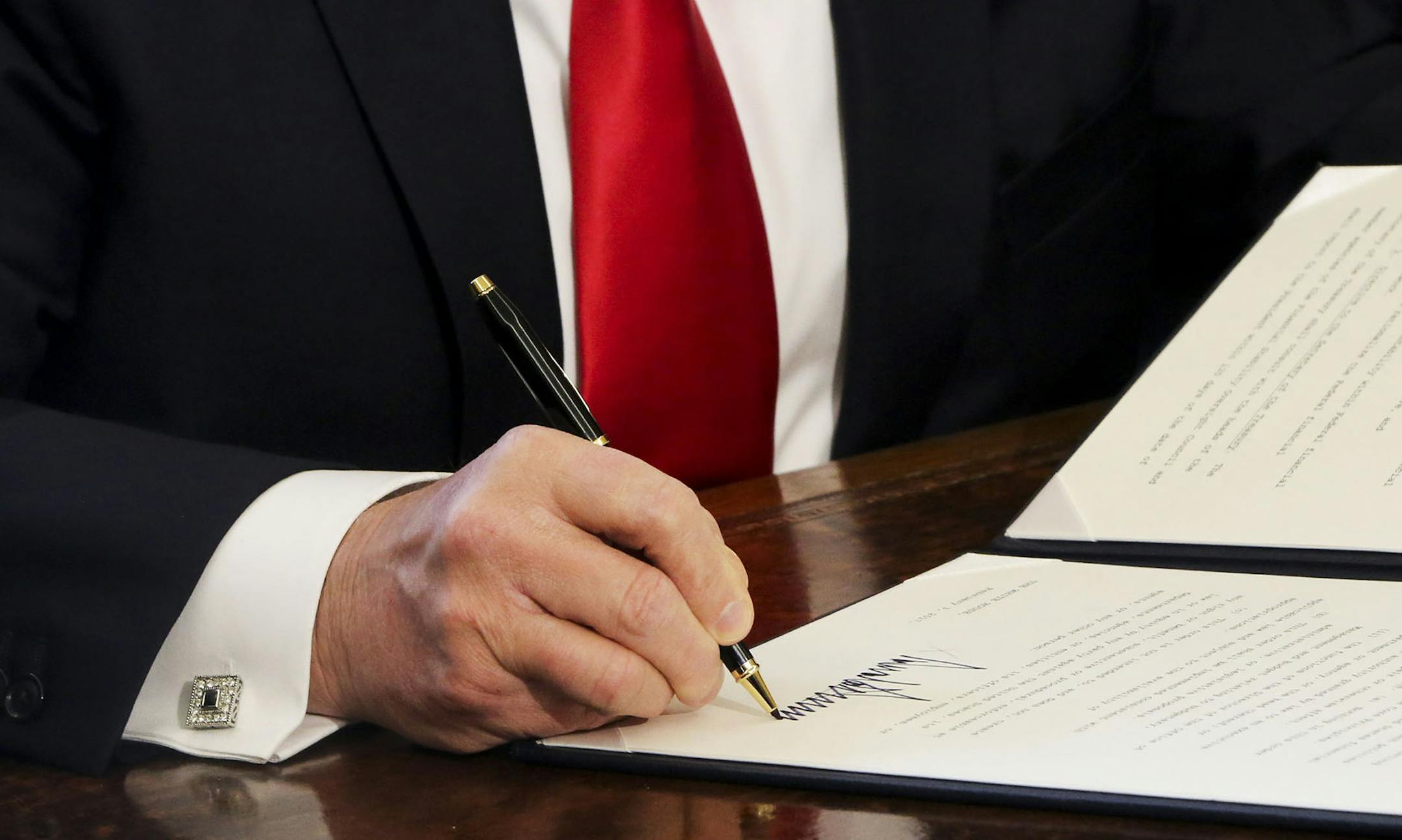
President Trump's recent flurry of executive orders mandates that for every new regulation issued by any agency, two must be eliminated. This comes on top of a federal hiring freeze and vows to reduce administrative bloat and otherwise force the government bureaucracy to conform to the kinds of expectations that govern private business.
While Trump sees himself as an outsider president bringing new ideas to Washington, these particular ideas would be painfully familiar to his predecessors. For the past century, presidents of both parties have sought to rein in the federal bureaucracy. Most have failed to make it more efficient. Not even antigovernment crusader Ronald Reagan was able to lessen the regulatory burden in any significant way.
Can Trump triumph where so many stumbled? He's already buckling to pressure on the hiring freeze. And if history is any guide, his only chance at success depends on something he's avoided so far: the hard work of building a bipartisan consensus across all branches of government. Here's what he's up against.
Reform efforts arguably began with President Theodore Roosevelt, who made his feelings known with this quip: "Our executive government machinery should be at least as well-planned, economical, and efficient as the best machinery of the great business organizations, which at present is not the case."
Roosevelt's campaign for efficiency and accountability gave rise to the banal-sounding Committee on Department Methods, which sought to impose order on the burgeoning federal bureaucracy. Like many of its successors, it largely failed, even if it helped establish the idea that the president, as much as Congress, had the power to review and reform the federal bureaucracy.
Future presidents followed Roosevelt's lead, setting up other committees and commissions aimed at streamlining the federal government. Congress stood in the way of many reforms, refusing to withdraw money from pet projects or agencies. But the individual bureaucracies also proved remarkably resistant to seeing their power diminished.
When President Warren Harding sought to streamline government in the 1920s, Secretary of Commerce Herbert Hoover took the lead. His proposals included a far more expansive role for his own department, all in the name of efficiency. Understandably irked, other cabinet officers fiercely resisted. Nothing came of it.
Hoover was more successful in retirement, when President Harry Truman asked him to chair what would become the Hoover Commission. "Red Tape himself dwells in the civil service," Hoover declared in 1949. "The result is an accumulation of waste and dead wood."


