

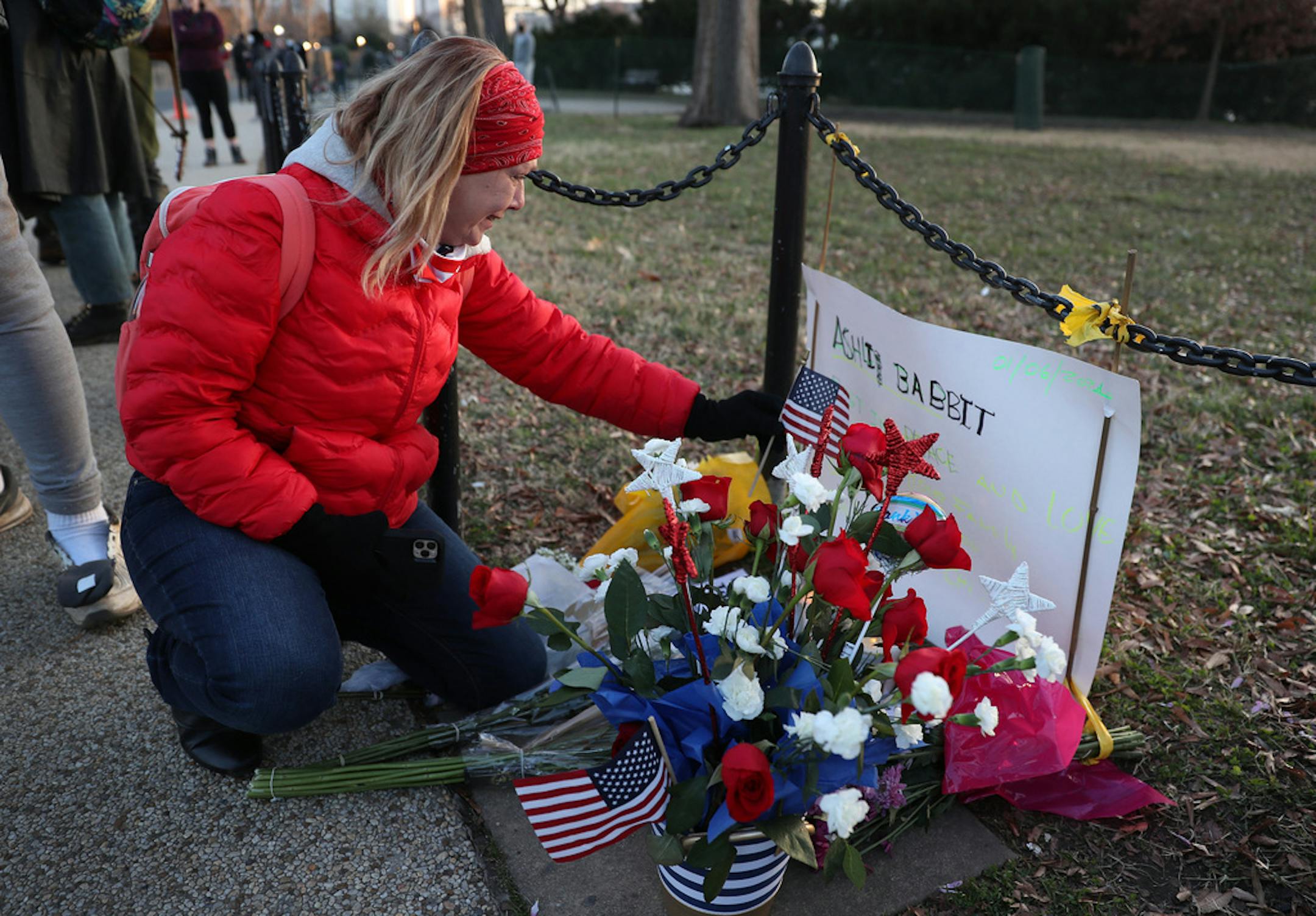
The U.S. Justice Department has reached an agreement to settle the wrongful death case brought by the family of Ashli Babbitt, who was fatally shot by police in the Jan. 6, 2021, Capitol riot, lawyers for both sides told a federal judge Friday.
“We have reached a settlement in principle,” Justice Department civil attorney Joseph Gonzalez told U.S. District Judge Ana C. Reyes of Washington, D.C., who is hearing the family’s $30 million lawsuit against the government.
No final deal has been signed and terms have not been disclosed, said Robert Sticht, a lawyer for the conservative group Judicial Watch, which is representing Babbitt’s family.
Gonzalez said that he expected it would take at least a week to finalize terms and at least a month for payment to be issued once a settlement is approved by all sides.
Babbitt’s family filed suit in June 2024, saying she had been “ambushed” by police, and the case had been set for trial in July 2026 before the Justice Department changed course after President Trump returned to office. The settlement would come as Trump has cast Babbitt as a martyr, and sought to rewrite the history of the assault on the Capitol as a heroic act of collective patriotism, not a violent effort to overturn an election. Five people died in or immediately after the violence, during which more than 140 officers were assaulted.
Babbitt, a 35-year-old California native and Air Force veteran, was fatally wounded in the neck at about 2:44 p.m., while trying to climb through a smashed glass panel of the barricaded Speaker’s Lobby doors deep inside the Capitol, where rioters had reached a final security perimeter outside the House chamber.

The Justice Department found that there was insufficient evidence to prove Babbitt’s civil rights had been violated and that it was reasonable for the officer to believe he was firing in self-defense or in defense of fleeing lawmakers, who were forced to evacuate from a session to certify Trump’s 2020 election loss to Joe Biden.
A Capitol Police investigation cleared the officer involved, saying his actions at the height of the riot “potentially saved members and staff from serious injury and possible death from a large crowd of rioters who forced their way into the U.S. Capitol and to the House Chamber where members and staff were steps away.”


