

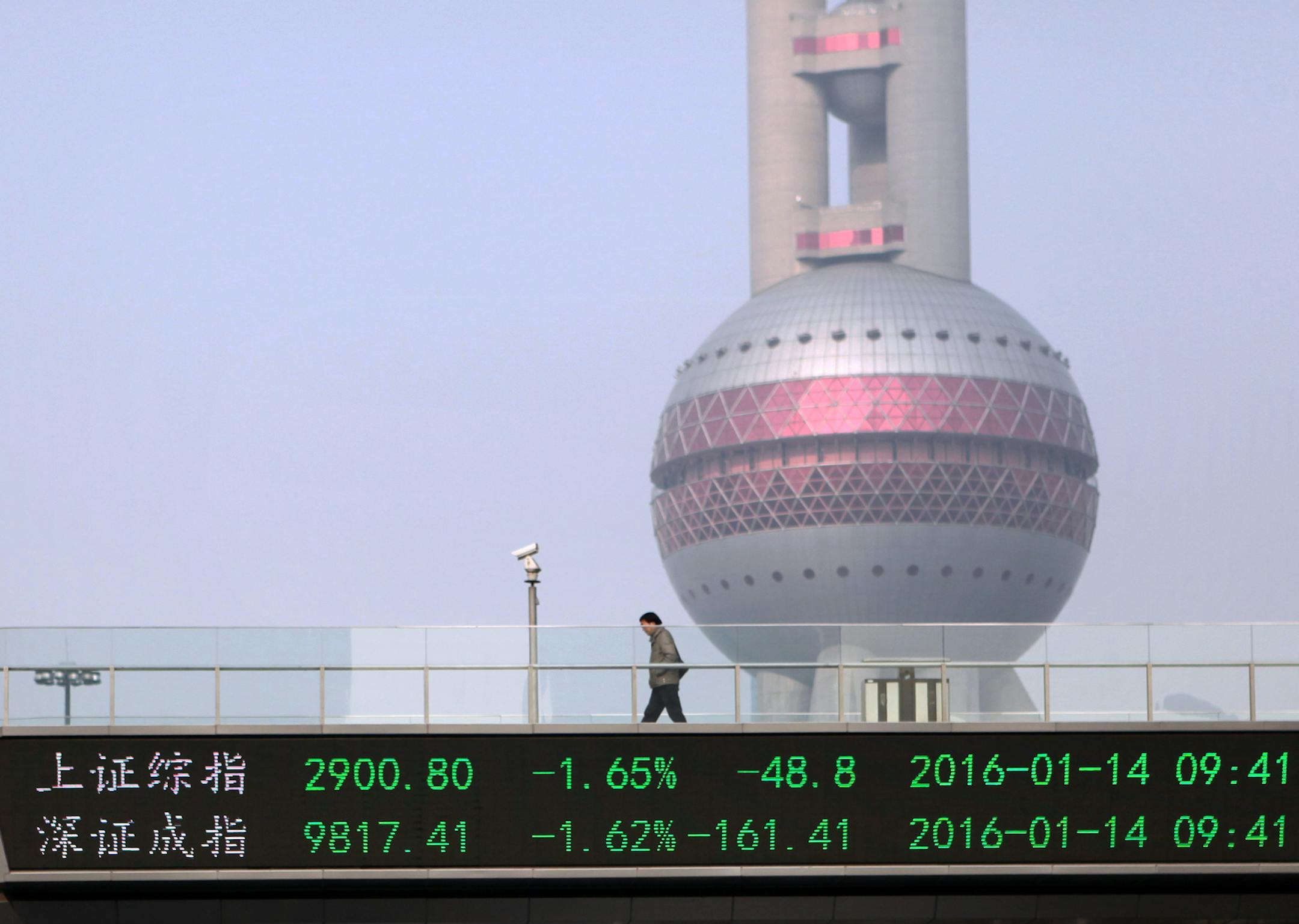
Capital flight from China may deal another blow to global financial markets, raising U.S. interest rates above where they would otherwise be at a sensitive time.
Massive amounts of capital are leaving China, driven variously by fears of a slowdown, of a falling yuan and of a corruption crackdown, with some estimates putting the figure for 2015 at or above $1 trillion.
As capital leaves, China's foreign exchange reserve managers must either sell some of the $3.3 trillion in assets they have stockpiled or allow the yuan to weaken. As a weakening yuan, while helping exports, can become a self-fulfilling spiral, China has resisted allowing market forces to play their role.
"It's ridiculous. It's impossible," Han Jun, deputy director of the office of the Chinese Communist Party's Leading Group on Financial and Economic Affairs, said last week.
"China still maintains a huge capital inflow," Han added.
China's resolve to support the yuan implies further selling of U.S. assets, particularly Treasuries but also corporate and other types of debt. As bonds are sold, it will press yields higher than where they would otherwise settle.
That's not to say U.S. interest rates will go up; the overall impact of China is clearly deflationary. Instead, the normal boost the economy might get from falling Treasury yields will be blunted. Treasuries, on some measures, had their strongest opening week of a year ever in 2016, while stocks had their weakest. Yet Chinese selling may actually have capped bond price gains as well as the fall in yields.
This also underscores the extent to which the Federal Reserve, which raised interest rates for the first time in a decade in December, faces challenges to its control over yields, which are its principal means to steer the economy.
"In my view, the downside risks relate mostly to the influence of the rest of the world on our economy," Atlanta Federal Reserve President Dennis Lockhart said on Monday.


