

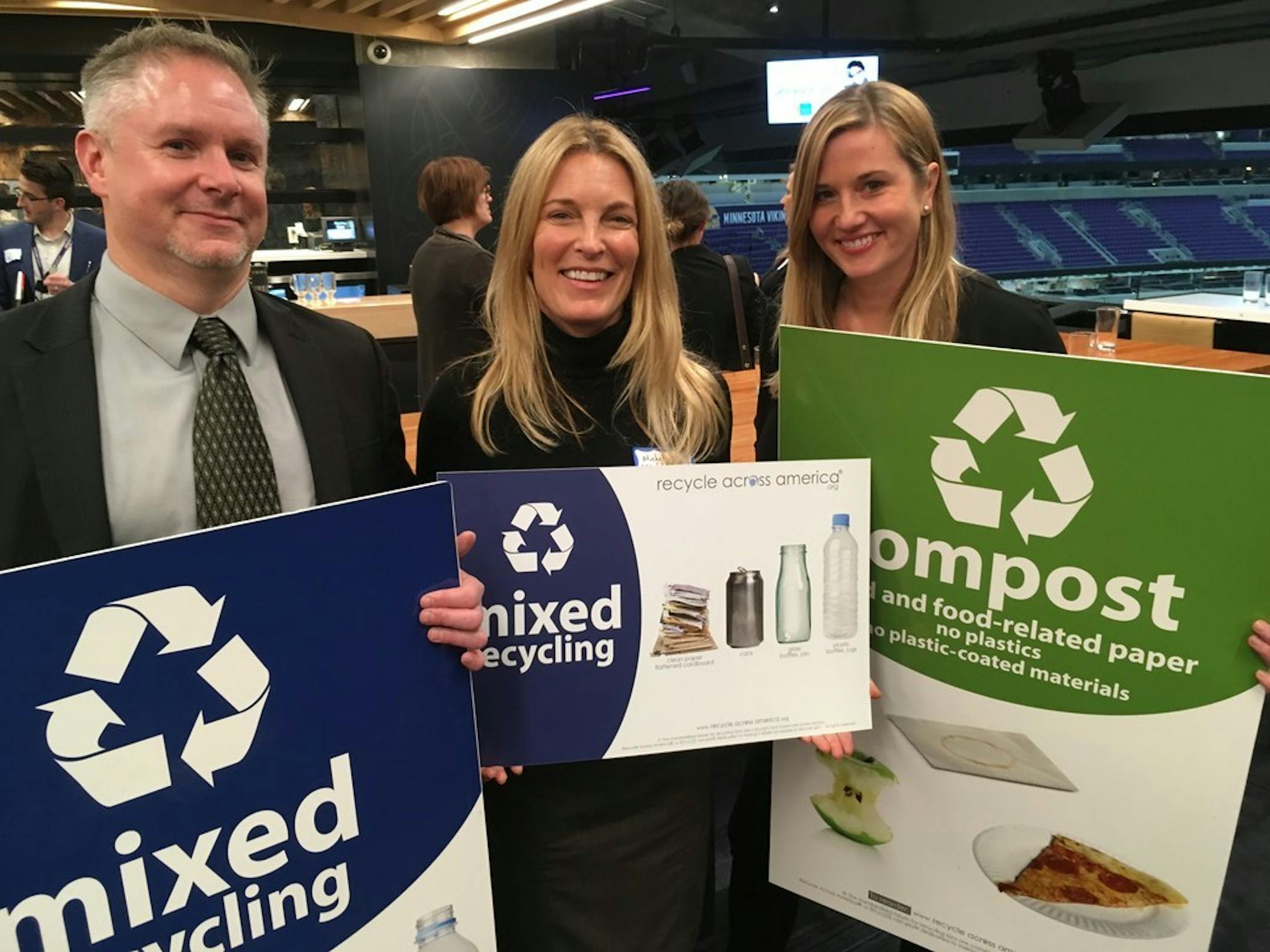
CEO Mitch Hedlund, center, of Recycle Across America consulted at U.S. Bank Stadium in November with Best Buy procurement executive Brent Ostrowski and Megan Dobratz of Native Sustainability, an environmental consultant.
More than 90 percent of the 69 tons of gameday waste at the Super Bowl in Minneapolis this month was recycled, a record, according to the Minnesota Sports Facilities Authority that owns U.S. Bank Stadium, and its game-day partners.
Nearly 63 tons of gameday waste were recovered through recycling or donation for reuse (62 percent) and composting (29 percent).
The company that manages the stadium said it's made dramatic strides over two seasons of operation at the publicly financed Vikings stadium.
"In our first season, we produced a waste diversion rate of 20 percent [and] over the course of our second season our team increased that diversion rate to 91 percent," Patrick Talty, general manager for SMG at USB stadium, said in a press release. "Developing a successful and long-term zero-waste program has always been our goal. The diversion improvement we have seen to date is rare in the world of facility management and is a testament to the dedication of all of our stadium partners."
CEO Michelle "Mitch Hedlund" of Recycle Across America was brought in as a recycling consultant at USB stadium last year. http://www.startribune.com/recycling-nonprofit-is-making-an-impact-with-local-businesses/458360613/
"U.S. Bank Stadium's journey to the zero-waste threshold has been demanding, and we couldn't have gotten here without the commitment of our stadium partners," said Michael Vekich, a retired accountant who is chair of the Minnesota Sports Facilities Authority. "We look forward to sharing our experiences with other facilities who are interested in this important sustainability program."
Increasingly, government and businesses are recycling and composting for environmental and economical reasons; to lower waste-disposal costs, reuse or sell recyclables as feedstock to manufacturers, and compost as fertilizer, as well as slowing landfill growth and cutting carbon emissions.


