

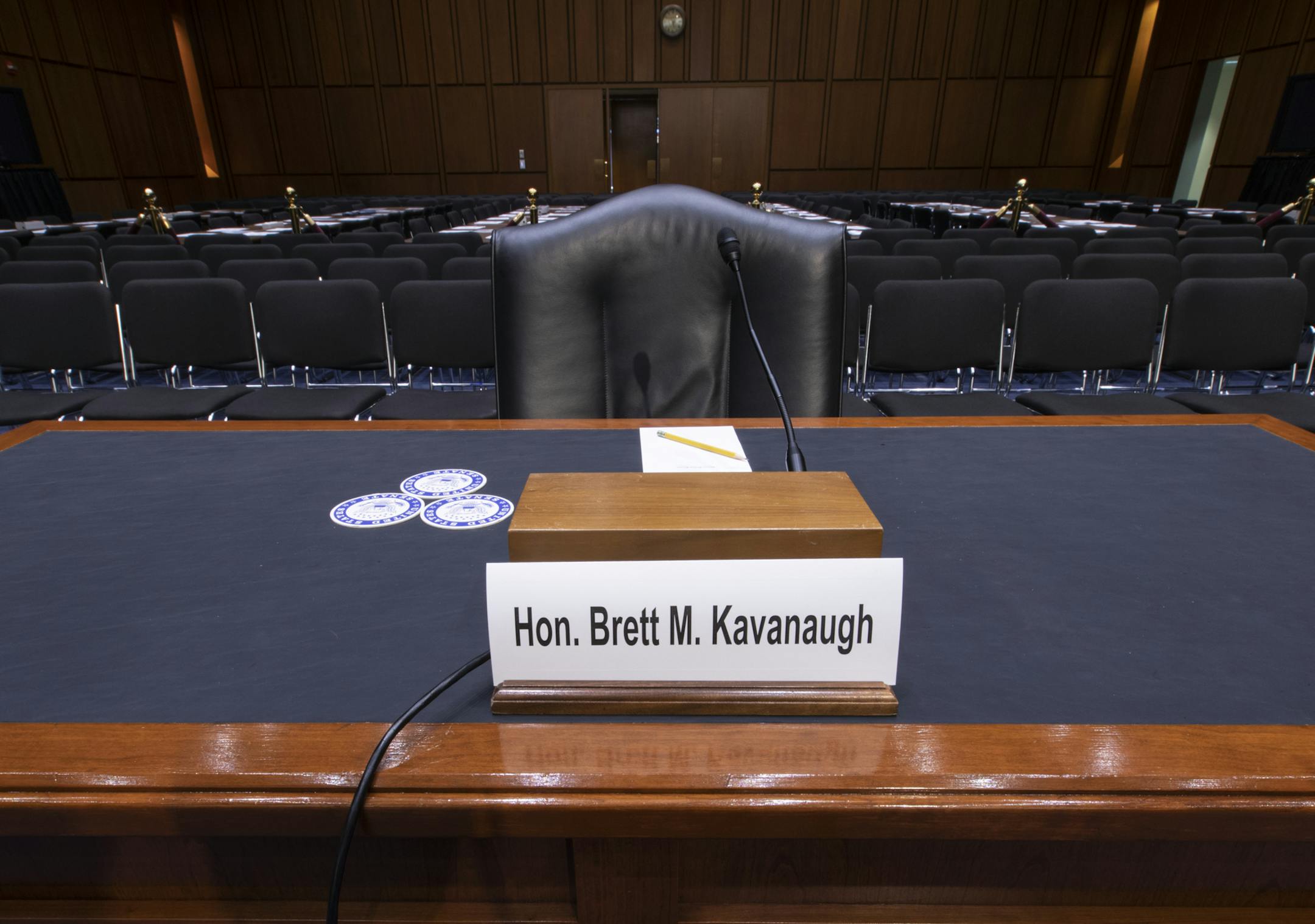
Senate Judiciary Committee members, take heed: You are not running a criminal trial. You are carrying out your constitutional duty to provide "advice and consent" regarding Brett Kavanaugh's nomination to the Supreme Court.
The appointments clause vests the Senate with this "check" on the president "to prevent the appointment of unfit characters," as Alexander Hamilton put it in Federalist No. 76. Until the Senate hears directly from Kavanaugh and his accusers, no one can decide whether the nominee is an "unfit character."
We do not know whether, at a party in Maryland sometime in the early 1980s, a 17-year-old Kavanaugh sexually assaulted 15-year-old Christine Blasey Ford. Nor can we know the truth behind similar allegations that may emerge, such as the accusation from Deborah Ramirez, a Yale University classmate who said Sunday that Kavanaugh exposed himself and caused her to touch his genitals without her consent during a drinking party in college. Kavanaugh denies both allegations. (Full disclosure: I worked for the Justice Department from 2001 to 2003 at the same time that Kavanaugh served in the White House Counsel's Office.)
We do know that the Senate must defend its institutional independence in the performance of its constitutional duty. The Senate should understand that it, and only it, can decide how much these allegations should affect Kavanaugh's confirmation. When senators judge the credibility of the nominee and the witnesses against him, they will not be choosing between guilt or innocence. They will be deciding whether to approve Kavanaugh's appointment.
Performing its responsibility to confirm "fit characters" requires the Senate to treat Kavanaugh, Ford and perhaps others with fairness. Fairness requires senators to address three issues.
First, the appointments clause does not establish who carries the burden of proof. But every fair process known to our legal system requires the accuser to prove allegations. Straying from such a standard would only encourage character assassination of all nominees. Consider a legal system in which husbands, fathers, brothers and sons go to jail, lose their jobs or are expelled from school based solely on unproven allegations of sexual harassment.
That is why Ford's testimony is a sine qua non of any fair process. Although Sen. Dianne Feinstein of California, the ranking Democrat on the Judiciary Committee, renewed her demand Sunday that the committee delay its hearing until the FBI conducts an investigation, it is difficult to see how more investigation would help ascertain the truth. No other named witnesses have publicly stated that either incident occurred.
To be sure, the White House does ask the FBI to conduct background investigations when it evaluates a nominee for executive or judicial office. FBI agents do not make judgments on innocence or guilt; they are only providing information. The FBI would normally encounter allegations such as Ford's and Ramirez's during its initial investigation, as with Anita Hill's in 1991, and would follow up by interviewing relevant witnesses. Committee staff regularly requests the FBI to follow up on questions raised in a background file.


