

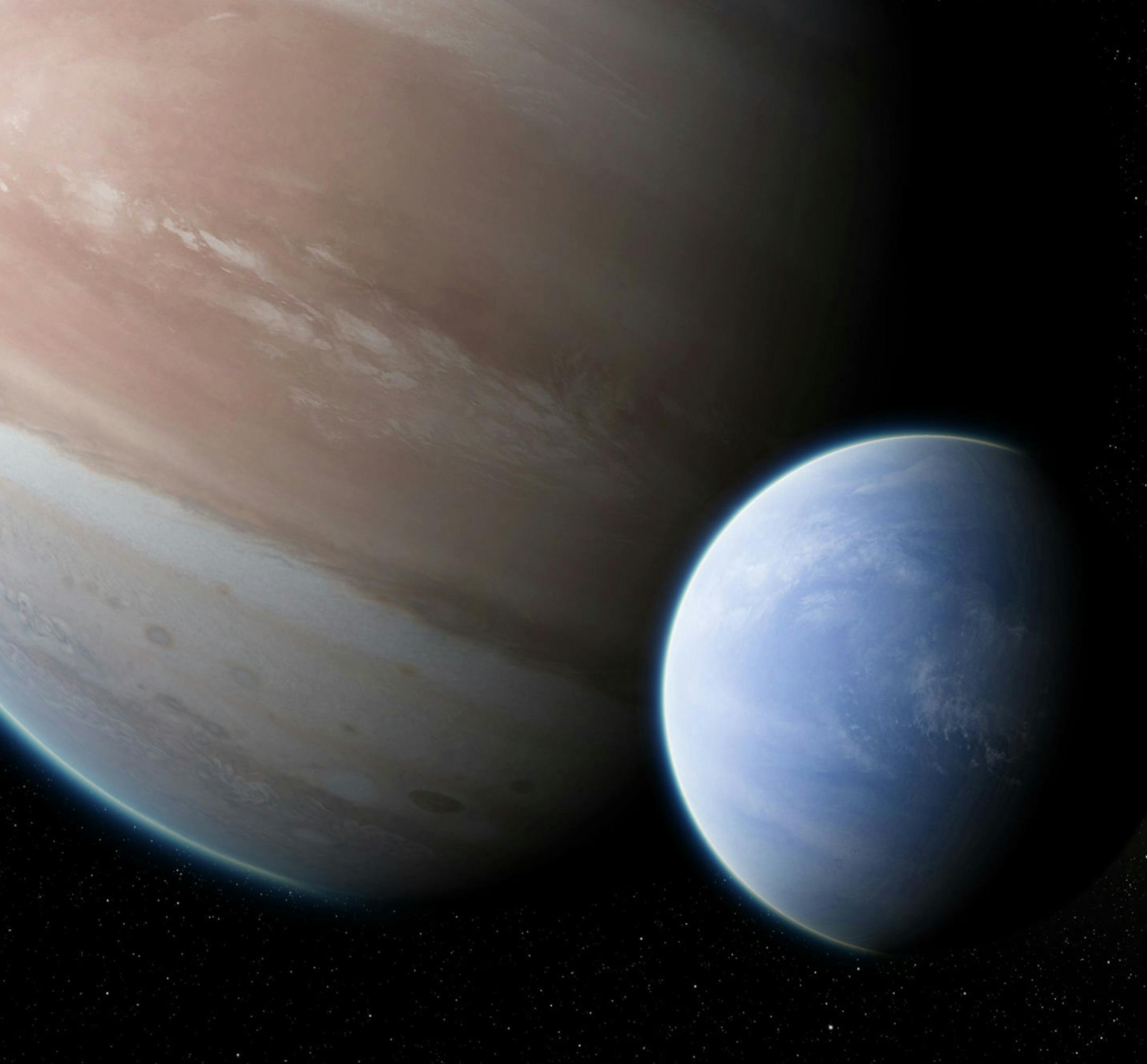
In flickering light of a distant sun, scientists may have discovered the first moon outside our solar system.
Writing in the journal Science Advances, two Columbia University astronomers using the Kepler and Hubble space telescopes said they've found signs of a large gassy "exomoon" orbiting an even larger exoplanet around a star 8,000 light-years away.
It's an "extraordinary" find that "defies easy explanation" said co-author Alex Teachey — nothing like it exists in our solar system. He and colleague David Kipping noted that studies are required to confirm it.
Planetary scientist Kip Hodges, a deputy editor at Science Advances who was not involved in the study, said, "If this finding stands up to further observational scrutiny, it represents a major milestone."
Kipping and Teachey discovered the candidate moon among 300 exoplanets in Kepler's catalog. An aging sun-like star in the constellation Cygnus is known to host a gas giant planet called Kepler 1625b. Yet there were weird signatures in this star system.
The star's light appeared to fade more than an hour before its Jupiter-like planet transited. And it remained dim for a while after the planet's passing. It looked like Kepler 1625b was orbited by a second body the size of Neptune — roughly four times the diameter of Earth. "A moon is an excellent explanation to the data," Kipping said.


