

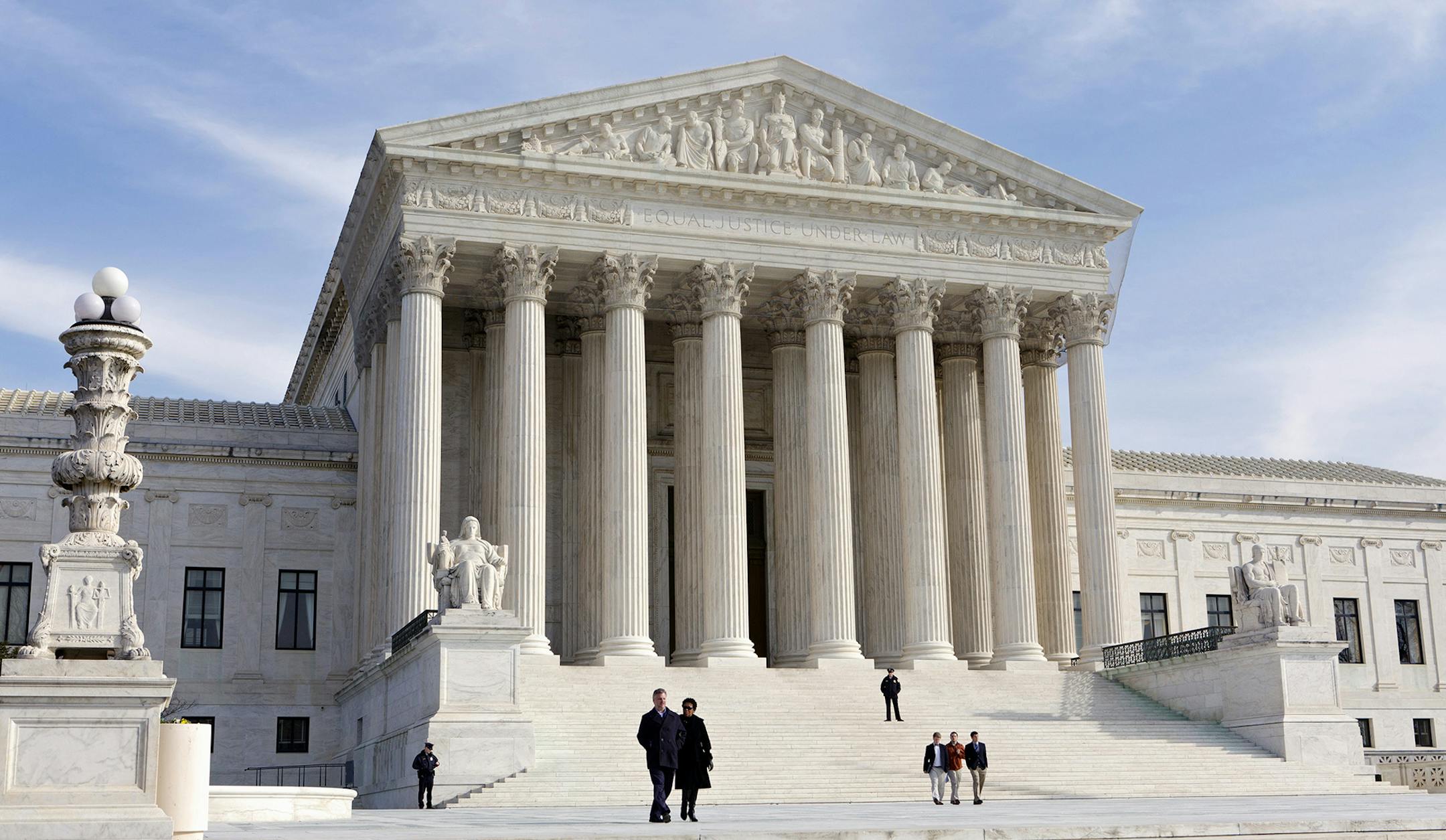
Former state Rep. Allen Quist's June 27 letter ("Supreme Court rulings: More has been lost than gained") could be taken more seriously if his concern had been expressed when the U.S. Supreme Court in recent years overturned the decisions of our democratically elected officials in implementing the Voting Rights Act to protect minority voters or in regulating the manner in which wealthy people direct their campaign contributions. As it is, ideological folks from both the left and the right become indignant only when they disagree with the conclusion reached by five or more of the nine justices who exercise the power conveyed to them by the Constitution.
The rule of law is indeed a foundation of our American society. It is worth discussing. We should, however, in our discussions recall that our "rule of law" in the United States once included slavery and, due to the Supreme Court, a legal principle of "separate but equal."
The rule of law promotes order, which is absolutely essential. It may or may not promote justice.
Michael Fargione, Eden Prairie
GAY-RIGHTS TIMELINE
A disrespectful Star Tribune leaves out role of AIDS crisis
I was shocked and dismayed that the June 28 article "How we got here" did not include the AIDS epidemic as a pivotal point in the gay-rights movement. When AIDS struck in the 1980s, it became very clear who our gay neighbors, family members, priests, artists, politicians, celebrities and co-workers were, as one by one they were taken by this terrible disease. By leaving out an entire decade in its timeline, the Star Tribune disrespected those who died and those who cared and fought for them.
The history of how slowly our government agencies, whose job it is to protect us from disease, reacted to this epidemic is truly shameful. Though this was a terrible and dark time for the gay community, it has to be represented in any history of the gay-rights movement. Thankfully, AIDS is now treated as a chronic disease; however, it is still incurable, and new cases continue to be diagnosed.
Julie Konrardy, Minneapolis
BICYCLISTS
Manifestos and road-sharing aside, the jerks are out there
I want to respond to the bicycling "manifesto" published June 27 on the Opinion Exchange page. I am not a "car-addicted" person. I have been an avid bicyclist for decades. I rode 3,600 miles across the United States. I city-commute 1,000 to 1,500 miles per year and ride open roads 1,000-plus miles per year. I have observed a lot of bicyclists' behavior.
Recently, I rode 400 miles with the League of Illinois Bicyclists. Their motto is: "Same rights, same rules." Here in Minnesota, bicyclists love to lecture society that they have the same rights as automobiles but seldom follow the same rules. "Bike-jerks" (Opinion Exchange, June 19) is an apt description for about 30 to 50 percent of Twin Cities bicyclists.
Bicycle jerks blast past without warning. It is rude and dangerous. If jerks ever do give a passing warning, "on your left" really means "get out of my way." Bicycle jerks ride on busy Lyndale Avenue (instead of the quieter Bryant) and block six to 12 cars until the cars can pass.


