

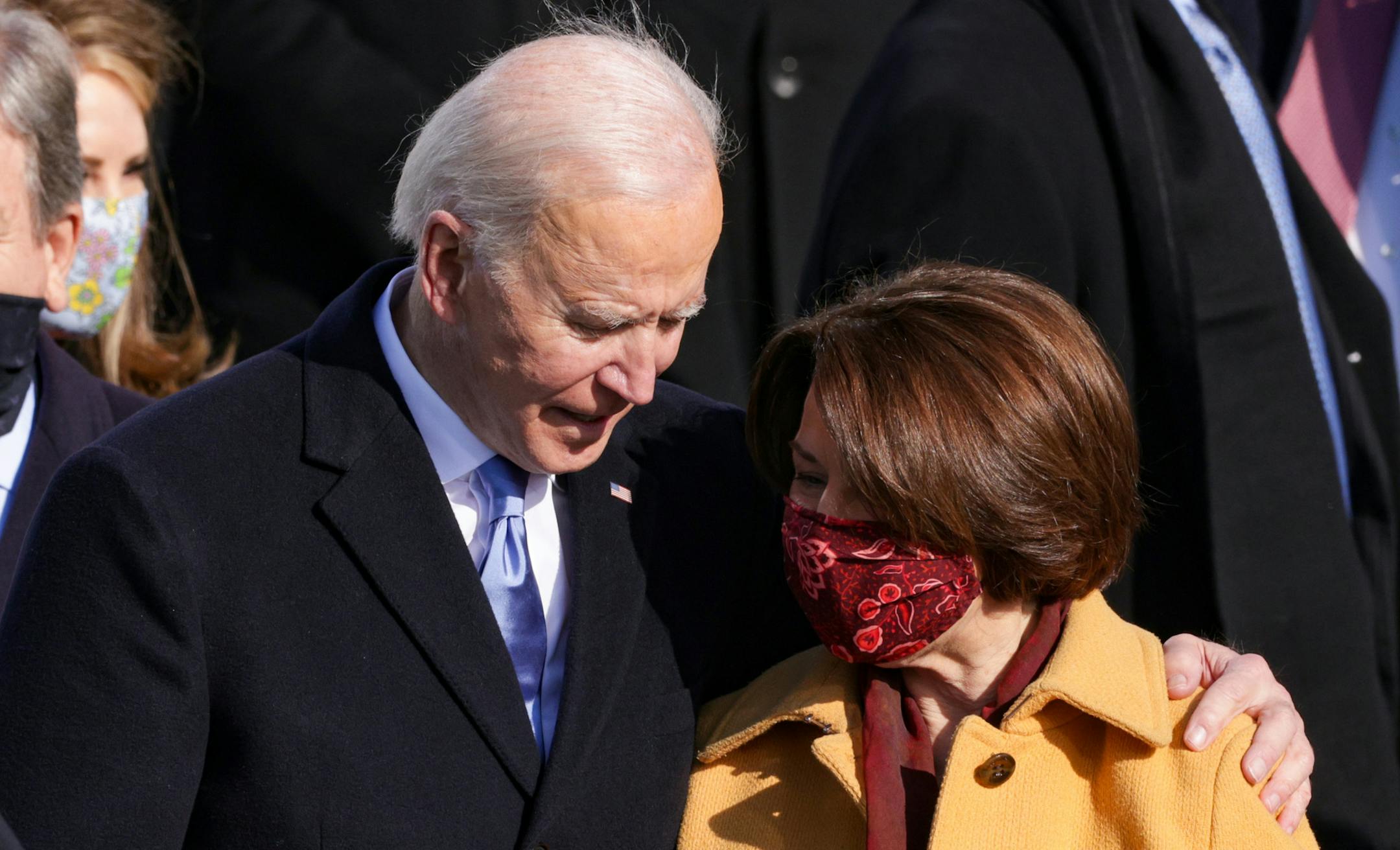
Kudos to our own Sen. Amy Klobuchar and her counterpart, Sen. Roy Blunt, R-Mo., and their staffs for their parts in the behind-the-scenes planning as well as their on-camera emceeing of Inauguration Day festivities. The pomp and pageantry were not diminished for lack of citizen audience, and I humbly suggest that future planners consider switching out the evening's typical balls, which most of us cannot attend, for the concert we experienced this year: an array of music, poetry and inspiring stories that included lesser-knowns as well as "stars." Highlighting people from all over the country, it really made us regular folks feel much more a part of things as we watched (and at times sang along) from our homes.
Truly, some higher powers were at play, sprinkling a few snowflakes on Washington, D.C., so that jokes could be made about Klobuchar bringing along weather from her (our) home state. And I think our nation's collective prayers for a peaceful day may have contributed to that morning's strikingly calming sunrise. From my vantage point, it was a lustrous mix of rosy pink and soft blue, segmented by pale gray-white clouds streaming across the eastern sky. It certainly seemed scripted to match the later performances of Bon Jovi ("Here Comes the Sun") and John Legend's rendition of "Feeling Good," with lyrics: "It's a new dawn, a new day, a new life for me."
Lisa Wersal, Vadnais Heights
WATER QUALITY
An argument against mining can be drawn from 3M's situation
The Jan. 17 article covering the ongoing fight to remediate Washington County groundwater ("Discord over clean-water plan") is a clear example of why prolonged water quality should be a heavy weighting factor when assessing proposals for copper-nickel mines. The proposed PolyMet copper-nickel mine, for example, would be in the St. Louis River Watershed. Any runoff from the mine — which would contain poisonous substances like arsenic, lead and sulfuric acid — would find its way south to Duluth, possibly sideswiping Cloquet and Jay Cooke State Park on the way.
According to the Minnesota Pollution Control Agency, 3M stopped disposing PFAS wastes at its Washington County sites in the early 1970s. Fifty years later, 150 square miles of groundwater are still contaminated with PFAS and 170,000 Minnesotans are still at risk of developing a whole mess of health problems. The population of Duluth's metropolitan statistical area alone is around 280,000 people, and the heavy metals that would leach from the PolyMet mine would put all of them at risk for multiple cancers, decreased immune response, and physical and mental developmental delays in children.
Is this really something we're willing to risk? It took decades and a massive lawsuit payout to even start assessing ways to get PFAS out of Washington County's groundwater. What will it take to clear Cloquet and Duluth of the poisons of copper-nickel mining? How many lawsuits? How much money? How many people sick, or dead before their time?
The best course of action would be to not build the mine at all.
Kelsey Murphy, Shoreview
ELECTION INTEGRITY
GOP official in southern Minn. continues to hawk bad wares
I am disappointed to see Nicollet County GOP Chair Kim Spears continue to repeat utterly false claims about the election ("In flipped county, voters wary about the future," Jan. 17).
I was a DFL observer for the Nicollet County portion of the mandatory recount in the state House race between Jeff Brand and Susan Akland. A Republican observer stood a few feet way from me the whole time. We could see every vote clearly and agreed on every count, and they matched the machine counts with only a single error over hundreds or thousands of votes (which added a vote to the DFL candidate, by the way, so it wasn't a vote stolen from the Republican candidate).


