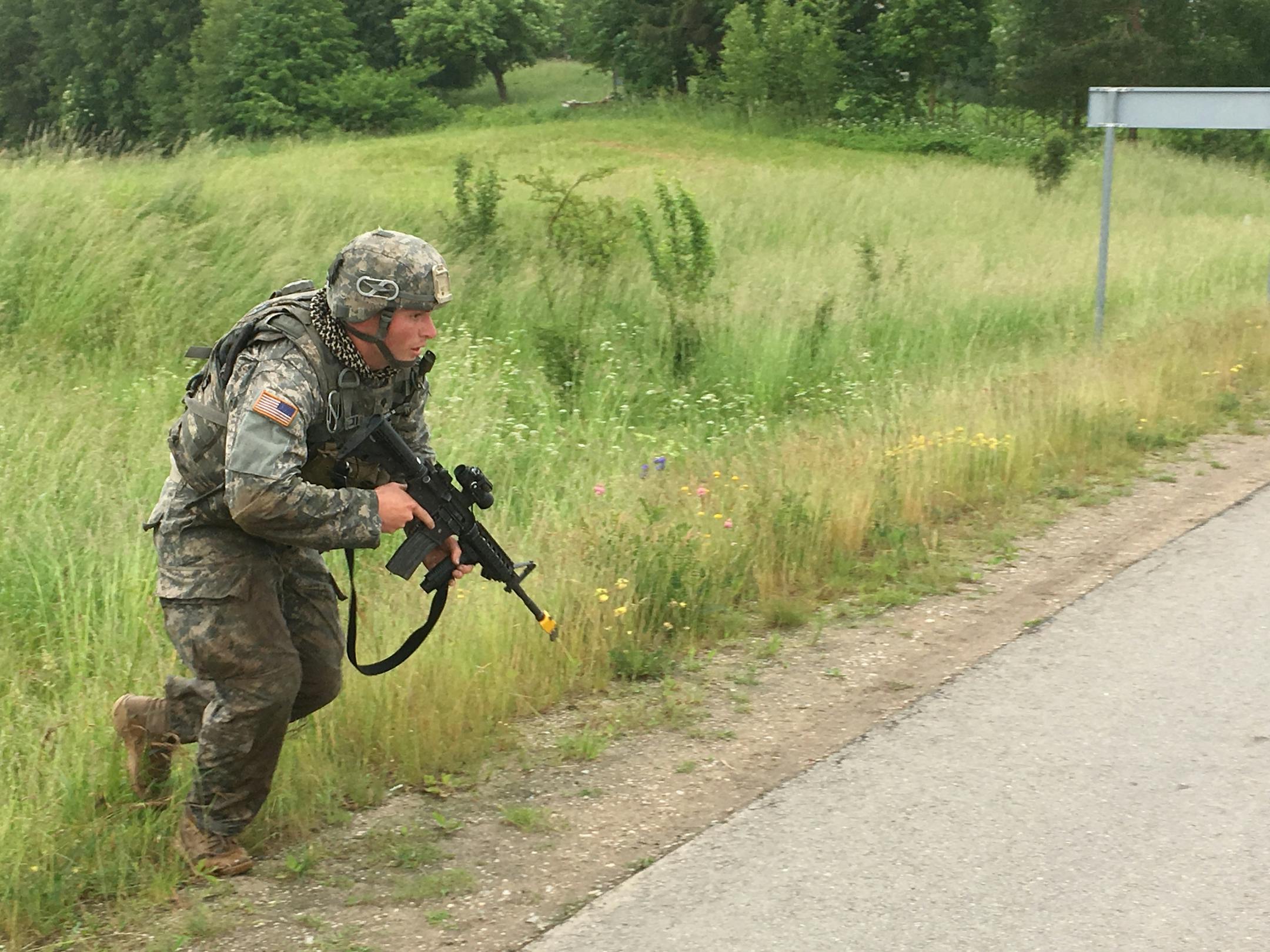
SUWALKI GAP, LITHUANIA — On a raw, rainy June morning — through forests, farm fields and familiar summer bugs — Minnesota National Guard soldiers began a major military-training exercise.
The location was Lithuania, not Camp Ripley, and the geopolitical context was the risk that an invasion by a resurgent Russia could cut off Baltic nations from the rest of Europe, a concern that became more than an abstraction in Eastern Europe after Russia illegally cleaved Crimea and destabilized eastern Ukraine.
The war-gaming took place on the geopolitically strategic Suwalki Gap, a 60-mile border between Poland and Lithuania that divides Russia-backed Belarus to the east and Kaliningrad, a rump Russian territory, to the west.
The exercise was "an opportunity to actually operate on the ground that we might actually fight on, that we might actually have to come to the defense of our partners, as opposed to being at Camp Ripley or even being at some other European training range," said Maj. Gen. Neal Loidolt, deputy adjutant general of the Minnesota Guard. Loidolt spoke from a Soviet-era airfield in Kazlu Ruda in southern Lithuania, where troops took to Black Hawk and Chinook helicopters in an air-assault exercise.
Across portions of Poland, Lithuania, Latvia and Estonia, forces from 19 NATO nations (and NATO partner Finland) took part in an exercise called Saber Strike 17. The goal was to improve coordination and readiness within Baltic nations and to show U.S. Army Europe's operational speed and reach.
That speed was impressively implemented from the moment Minnesota National Guard equipment arrived in the Baltic Sea port of Klaipeda. An ambitious goal was set to get across the country to the Pabrade Training Area in eastern Lithuania in just 72 hours. It took the Guard just under 71. "To get all of our equipment here that rapidly and move it across the whole country of Lithuania was just exciting and exceptional for our soldiers," said Lt. Col. Jason Benson.
The convoy's trek may have seemed familiar. "There's so many times that we drove from the port and you would sit and say, 'This could be outside of Alexandria, or this could be up in Grand Rapids,' " said Benson, who is the county engineer for Cass County in North Dakota. More crucially, Benson added, despite linguistic and cultural differences, there were military similarities. That was a common theme in dozens of discussions with soldiers not just from the Minnesota Guard but from other participating nations, too.
"Within the National Guard, frequently you'll hear people say, 'It's best not to exchange business cards the day of a tornado or the worst day of the flood,' " Loidolt said. "You can take that analogy and play it here: Let's not try to figure out what our communications problems are, let's not try to figure out what challenges you have in tactics and procedures, on the first day we fight the enemy. It's best to figure it out now when you can work out the kinks in what's going on, and so that's really what Saber Strike does."