
Preliminary Southwest LRT station designs released

Metro Transit is releasing basic plans for suburban light-rail stations; proposals to be fine-tuned in 2015.

December 10, 2014 at 11:49PM
A passenger walks on the platform of Metro Green Line's westbound Victoria Street station in St. Paul on Monday, December 8, 2014. ] LEILA NAVIDI leila.navidi@startribune.com /
The Metro Green Line stations have received good reviews and could serve as a model for stations along the Southwest extension of the line. (The Minnesota Star Tribune)

No one wants to spend too much time at a light-rail transit station waiting for a train.

But transit experts agree that smart station design is critical to encourage use of the light-rail system in the Twin Cities. The process of honing what the 17 stations along the Southwest LRT Green Line extension will look like began in earnest last week, when preliminary renderings of four prototypes were released to the public.

The $1.7 billion Green Line extension will link downtown Minneapolis to Eden Prairie, with stations slated for St. Louis Park, Hopkins and Minnetonka. Passenger service is expected to begin in 2019.

Last week, members of the Southwest LRT Corridor Management Committee learned that stations for the new line will not be as personalized as some of their forerunners. The prototypes for the new line look much like the stations built for the Central Corridor Green Line, which links the downtowns of Minneapolis and St. Paul.

That is because designers have learned from experience, explained Mark Furhmann, Metro Transit's program director for the Southwest LRT project.

When the Hiawatha Blue Line opened in 2004, individual architects were hired to design each station. "The whole philosophy was to design community-based stations that would be reflective of the community itself, its setting and its surroundings," he said.

But after 10 years and nearly 10 million passengers, routine maintenance and repair of the Blue Line's distinctive stations proved to be challenging and costly, Fuhrmann said.

A bid for benches

When the Green Line opened last June, the stations were much more consistent, though enhanced with public art projects. Fuhrmann's personal favorite is the Victoria Street station in St. Paul, which is adorned with sculpted images based on photos of residents from the Rondo neighborhood, which was largely wiped out in the 1960s to make way for Interstate Hwy. 94.
Metro Transit is generally pleased with the Central Corridor Green Line's stations, although Fuhrmann said he's heard that passengers would like more benches. While many of the stations have leaning rails, "people really prefer to take a load off if they can sit down," he said. He noted that no seating will permit lying down, one way to mitigate long-term lingerers.

Elton Elperin, a chief architect at the global architectural firm AECOM, said transit stations must "first and foremost" provide shelter to passengers and functionality. Information about fares and schedules is important, too.

Elperin has worked on a number of big transit projects nationwide, including one linking the Long Island Railroad to Grand Central Station in New York City, and the Red and Purple light-rail lines in Maryland.

He says a station's durability is also essential, especially with Minnesota's harsh and unpredictable weather. "All of the transit authorities I've worked for are strapped for money and they're using materials that are tough and functional," he said. Architects must take into account a station's life cycle — he usually designs stations to last 100 years.

But Elperin said stations also should be attractive. "It should look good from a distance, and up close."

$3 million per station

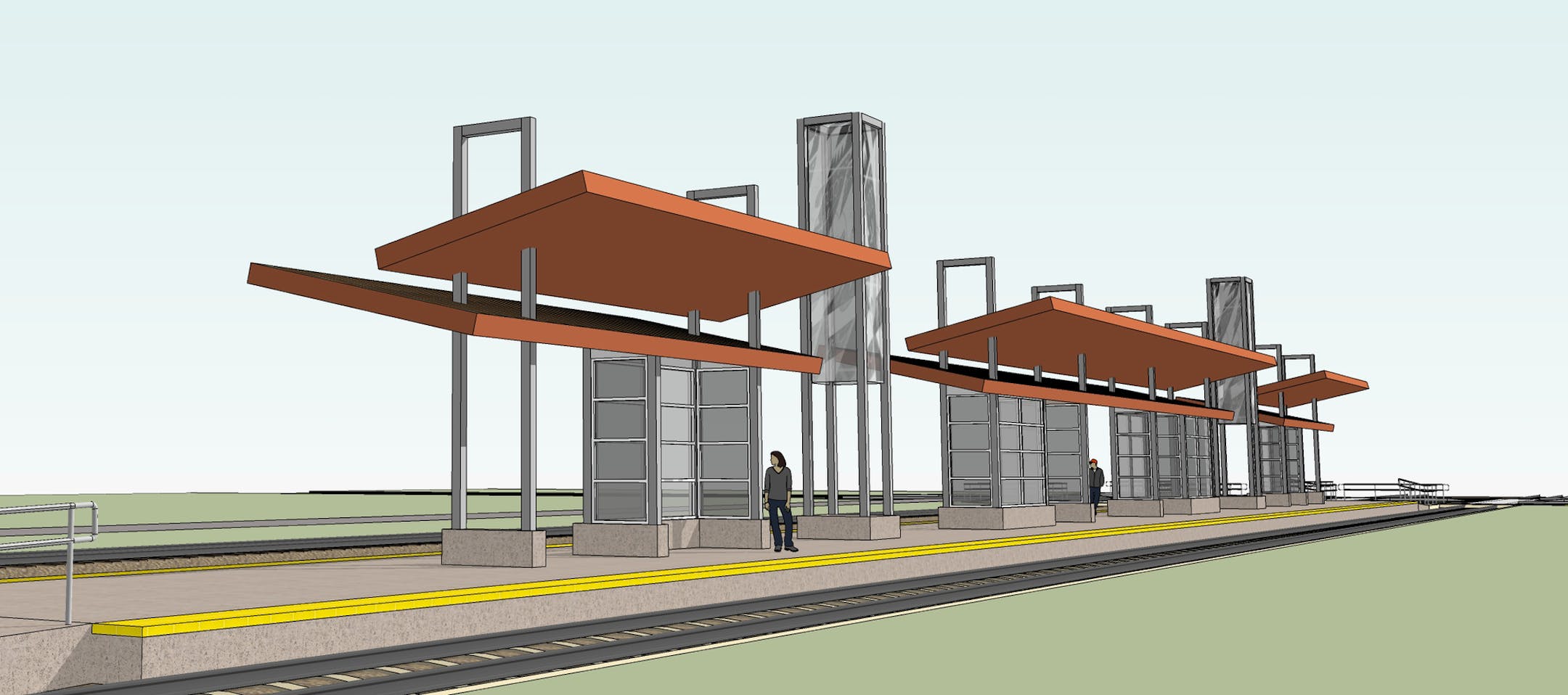
Each station along the Southwest line is expected to cost about $3 million, or $51 million total, and any artistic enhancements will be extra. The four prototypes begin with a base design and grow increasingly elaborate depending on the location of the station and the anticipated amount of passenger traffic.

The public will be invited to weigh in throughout 2015, with plans expected to be firmed up by year's end.

The renderings prompted immediate commentary last week from the Management Committee, an advisory group of government officials.

Minnetonka Mayor Terry Schneider said the stations should take into account Minnesota's harsh weather by providing better shelter from the wind and elements. Edina Mayor James Hovland agreed: "If you have to park a ways away and walk to the station, then stand in the elements, people might not take the train, and we want people to take the train."

Posted schedules and announcements of impending trains are crucial to attracting and keeping transit passengers, said Yingling Fan, an associate professor at the University of Minnesota's Humphrey School of Public Affairs. Fan recently conducted a study of 800 public transit passengers in the Twin Cities that found that the perceived waiting time for the train or bus was longer than the actual time spent waiting.

If people feel like they're spending a lot of time waiting for transit, they may be less likely to consistently use it, she said.

Janet Moore • 612-673-7752

The "Landmark" model, one of four prototypes for the 17 planned Southwest LRT stations.
This is one of four proposed stations designs. (Metro Transit/The Minnesota Star Tribune)
about the writer

about the writer

Janet Moore

Reporter

Transportation reporter Janet Moore covers trains, planes, automobiles, buses, bikes and pedestrians. Moore has been with the Star Tribune for 21 years, previously covering business news, including the retail, medical device and commercial real estate industries. 

See Moreicon

More from No Section

See More
FILE -- A rent deposit slot at an apartment complex in Tucker, Ga., on July 21, 2020. As an eviction crisis has seemed increasingly likely this summer, everyone in the housing market has made the same plea to Washington: Send money — lots of it — that would keep renters in their homes and landlords afloat. (Melissa Golden/The New York Times) ORG XMIT: XNYT58
Melissa Golden/The New York Times

It’s too soon to tell how much the immigration crackdown is to blame.