

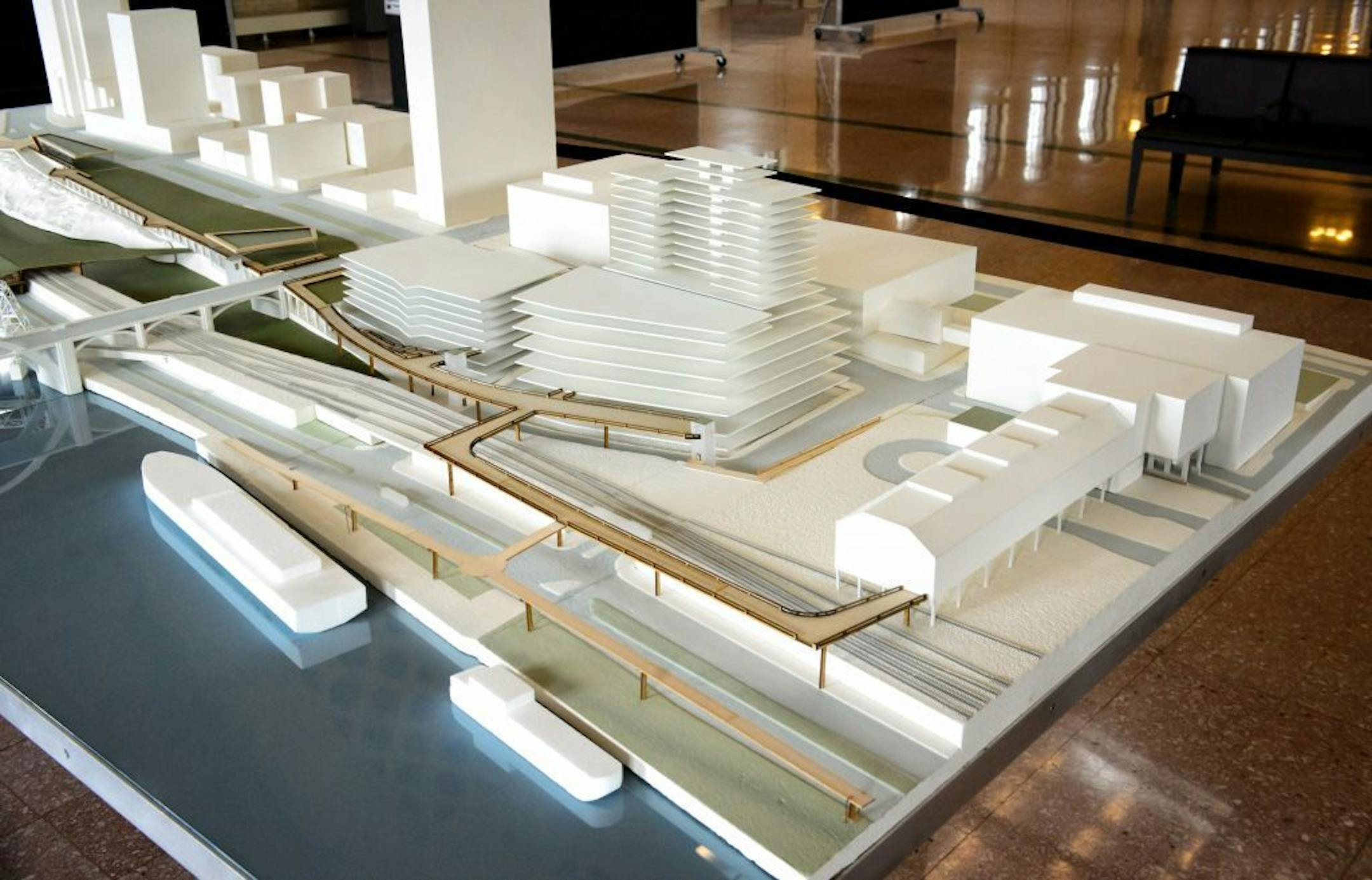
Imagine a time in the not-too-distant future when a couple from Paris can disembark from a Viking River Cruise ship onto a platform at the St. Paul riverfront, walk up a gently rising ramp and stroll a beautiful summer's evening along a promenade connecting dozens of buildings overlooking the Mississippi to the Science Museum of Minnesota, or maybe to a ballgame at CHS Field.
Such is the vision of those tasked with making a reality of St. Paul's River Balcony, an elevated pedestrian path that will better connect downtown St. Paul with its long-ignored riverfront.
On Thursday evening in the concourse of Union Depot, planners unveiled their concept of what the River Balcony might look like and how it would weave together the downtown that rests atop the river bluffs and the flowing waters below.
At an open house that attracted about 100 visitors, planners laid out conceptual drawings, guiding principles and even a large 3-D model of what the River Balcony might look like. While Mayor Chris Coleman and project planners say it is much too early to affix cost estimates or a construction timeline to the project, the work done so far on a master plan will help developers and city officials better meld upcoming riverfront projects into an overall theme, Coleman said.
Besides, he said, it's just fun to dream a little bit about what St. Paul can be. "If this doesn't capture your imagination, then you don't have an imagination," Coleman said.
The River Balcony idea was first envisioned as part of the city's Great River Passage Plan, St. Paul's vision to better connect the river town with its 26 miles of Mississippi River shoreline through use of parks, green space and walkways. Developed jointly by the city and the University of Minnesota's Metropolitan Design Center, the River Balcony seeks to overcome long-standing obstacles in the way of a greater embrace of Old Man River — mainly, steep river bluffs, railroad tracks and the zipping traffic of Shepard Road. The City Council put $100,000 into the planning phase back in April.
In concepts revealed Thursday, the River Balcony would integrate 50 to 60 different pieces into a continuous meander alongside riverfront buildings and parkland downtown.
In much the same way that the city's skyways are a combination of public facilities and private property, the River Balcony would be open to the public all year long, said Lucy Thompson, project manager for the city — "but better," she said, because the River Balcony would be outside and give people several points to safely wander down to the river's edge. Along the way, they would pass restaurants, entertainers, and places to sit and relax. Today, pedestrians can get to the river only at the Science Museum or Jackson Street.


