

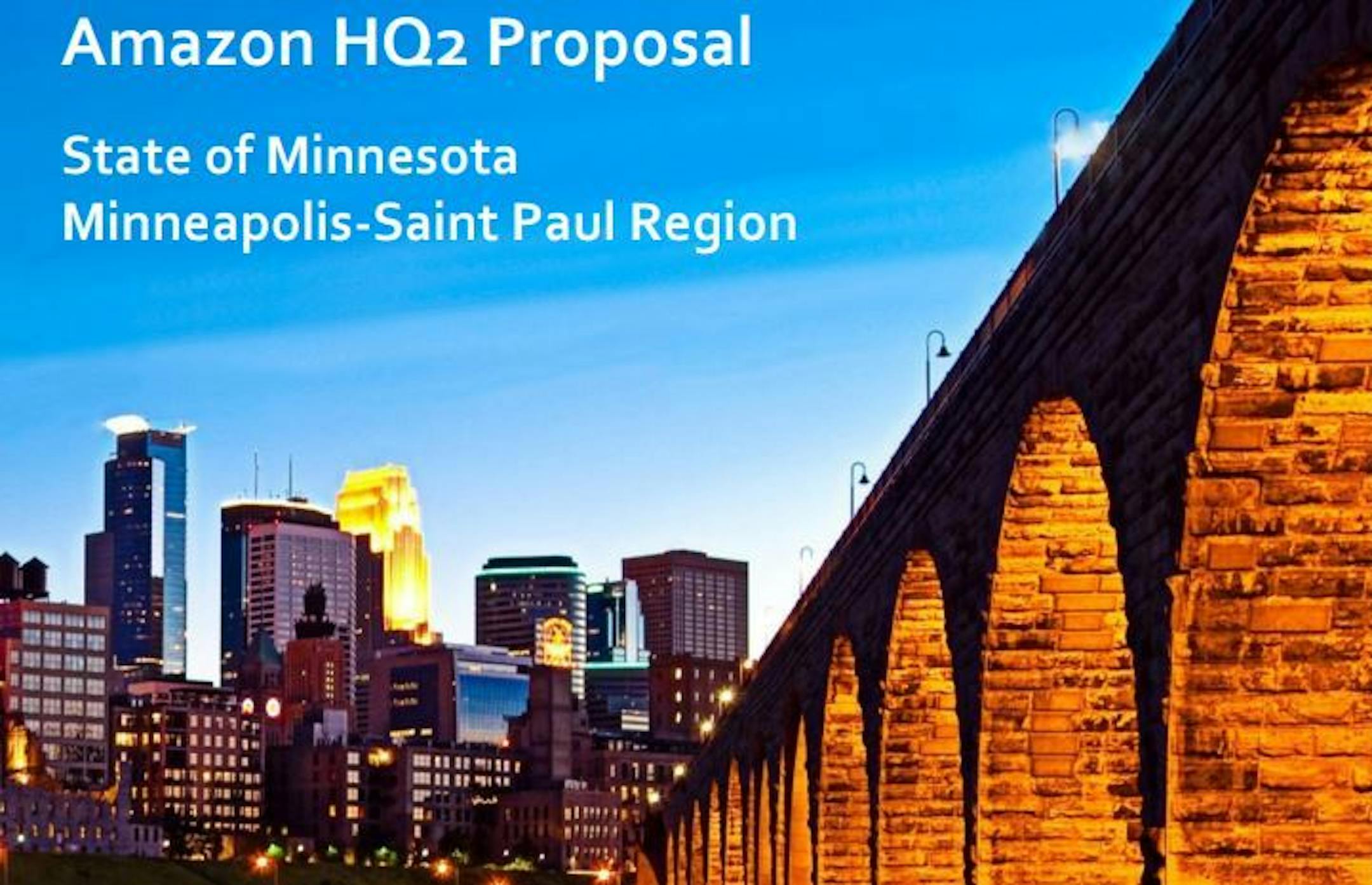
Minnesota development officials on Monday released details of the failed bid presented to Amazon to lure its second headquarters to the Twin Cities.
The 122-page report suggests 18 cities where the project could be located and the prospect of a relatively modest $3 million to $5 million in public subsidies, the key points of which the Star Tribune previously reported.
"Amazon, if you're shopping for a move-in-ready, take-on-the-world location, the Minneapolis St. Paul region is uniquely qualified to work with you and make it happen," the report said. "We have good bones. We have the foundation. We are not new to big changes, big challenges and, most importantly, doing big things."
The report listed a wide range of attributes to appeal to Amazon including the region's talent pool, college and university system and accessibility to other parts of the country via the Minneapolis-St. Paul International Airport.
The Twin Cities didn't make the first cut of 20 finalists in the Amazon search, which drew pitches from more than 200 North American cities. Amazon eventually split the headquarters project between two locations, the Queens area of New York City and Arlington, Va. It dropped the New York location amid local opposition.
While the sites detailed in the report released Monday had been known, the bid showed that some sites had been more thoroughly planned out than others, such as the land surrounding Mall of America, including space that has now been proposed for a massive water park. It also included a 200-acre "Canterbury innovation district" in Shakopee next to the Canterbury Park racetrack.
Other locations included the North Loop and sites in and around downtown Minneapolis such as the former Macy's department store currently under renovation as the Dayton's project and land near the farmers market; a riverfront site in downtown St. Paul that is currently being looked at for a multi-phased, mixed-use development; and the former Twin Cities Army Ammunition Plant site in Arden Hills. Many of the cities' proposals suggested tax-increment financing as an incentive.
In terms of financial incentives, the bid didn't go much beyond an earlier released two-page letter from Shawntera Hardy, the former commissioner of the Department of Employment and Economic Development, that said that Amazon's initial expansion would typically generate a state award of $3 to $5 million from existing DEED programs.


