

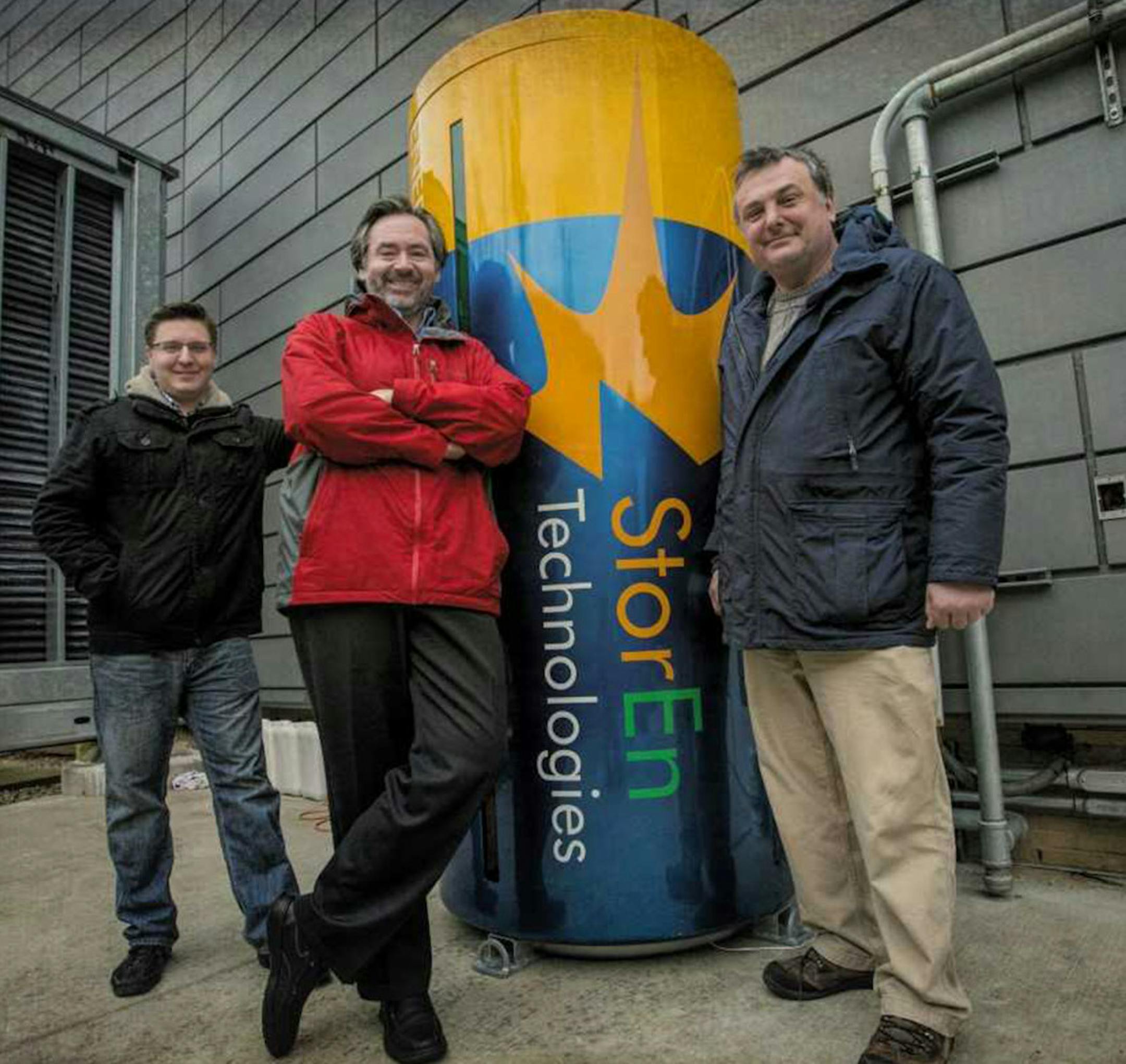
Italian entrepreneurs who migrated to Stony Brook University's energy incubator to form an innovative battery startup are planning to take on the Powerwall of Elon Musk's Tesla Inc.
Their Stony Brook company, StorEn Technologies, is adapting vanadium-flow batteries — typically the size of shipping containers and found in utility or industrial settings — for light commercial or household use.
StorEn's scaled-down battery units — about the size of a large, cylindrical vending machine — could be used as a backup in case of a power outage.
Chief Executive Carlo Brovero said the entrepreneurs joined the Clean Energy Business Incubator Program at Stony Brook in 2016 after considering Northeast incubators from Boston to New York City. They founded StorEn the following year.
The New York State Pollution Prevention Institute at the Rochester Institute of Technology and other partners are testing a StorEn prototype battery at the energy center to "validate" the technology, said David Hamilton, executive director of Stony Brook's program. The testing program is expected to help StorEn raise funds for additional development and marketing.
StorEn has raised $659,824 through a now-closed crowdfunding effort on startengine.com, and Brovero said the company is in talks with additional unnamed investors.
Unlike Tesla's Powerwall, which uses solid-state lithium-ion batteries, StorEn's batteries use liquid electrolytes that contain the metal vanadium in a solution. StorEn's batteries "can easily last 25 years with no decay in capacity," while lithium-ion batteries decay at a much faster rate, Brovero said.
Tesla's warranty on the direct-current Powerwall 2, priced at $6,700 a unit, says it will retain 70 percent of its storage capacity 10 years after the initial installation.


