
In the grip of scandal, these presidents escaped overseas

Like Trump, Nixon and Clinton headed for the Middle East

May 20, 2017 at 12:58AM

TEL AVIV, Israel – As Air Force One approached Ben Gurion International Airport, with a biblical landscape spread out below, the U.S. president aboard likely considered himself imperiled, under siege.

His hosts felt the same way.

For Richard M. Nixon, making the first visit to Israel by a sitting U.S. president, it was less than two months before the slow-grinding wheels of the Watergate scandal would drive him from office, the first president in U.S. history to resign.

In Israel, not even a year had elapsed since a war that had brought the still-young state to the brink of oblivion. It was June 1974, a moment when Nixon and his Israeli hosts sensed the weight of history, the untold dangers of the future, and the nearly unbearable tensions of the present.

As Nixon did on that journey, President Donald Trump leaves behind a White House gripped by scandal.

Trump left Washington Friday afternoon for Riyadh, Saudi Arabia, the first stop on his maiden trip overseas as president. The marathon trip will also take him to Israel, the Vatican, Belgium and Italy. The trip is a key test of the president's diplomatic skills and a chance to add substance to a foreign policy he has described broadly as "America First."

Like Nixon's 1974 itinerary, Trump's trip includes the visit to Saudi Arabia. But Nixon's six-day travels in the region also took him to Syria — now in the midst of a bloody and ruinous six-year war — along with Egypt and Jordan, now the only Arab states to have peace treaties with Israel.

The Israel of today — hyper-modern, bustling, cosmopolitan — bears little resemblance to the near-garrison state in which Nixon landed. But nearly half a century later, many of the same wounds still fester.
Clinton escaped to Holy Land, too

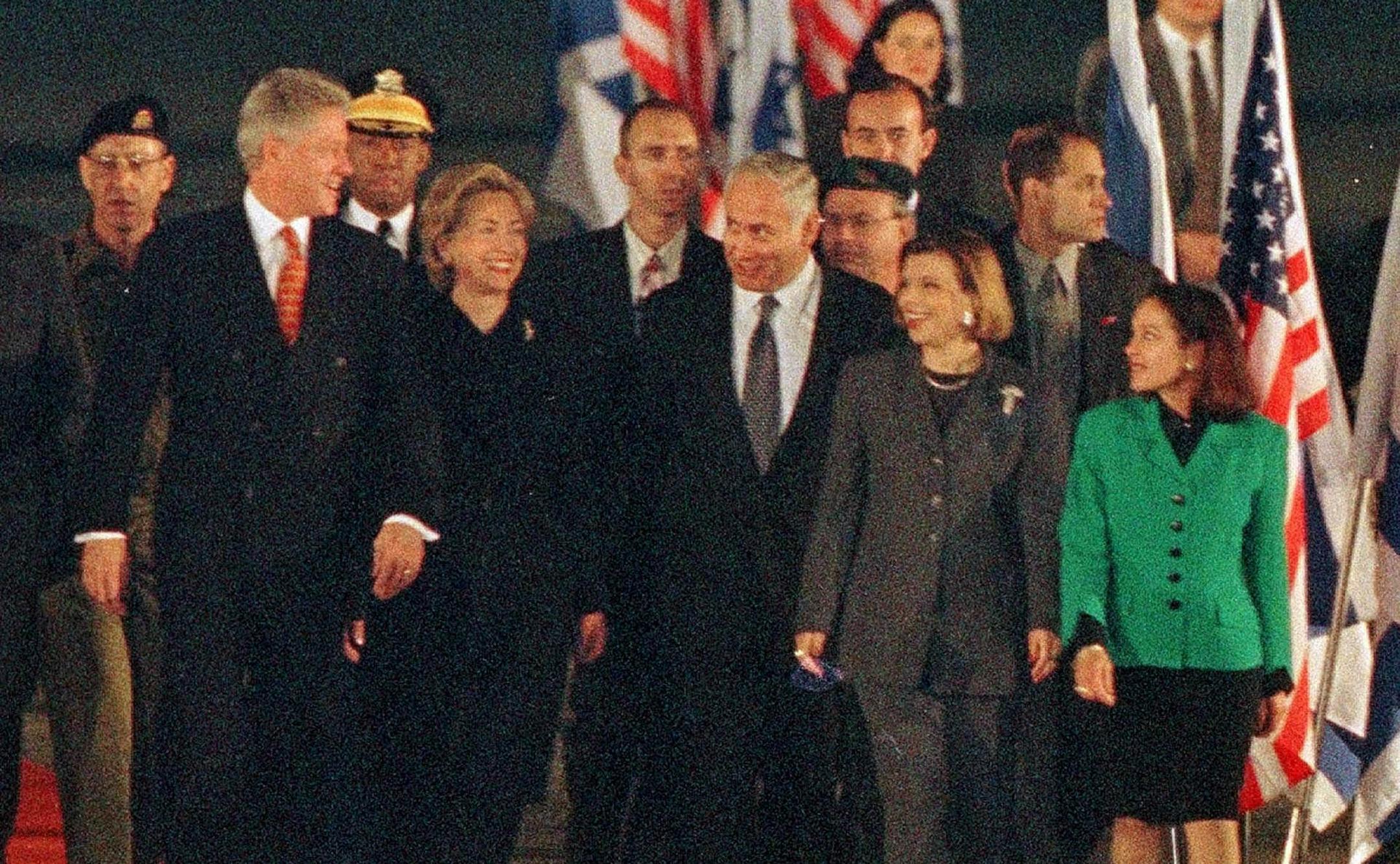
Nixon wouldn't be the only U.S. leader whose sojourn in the Holy Land took place under a political cloud. One of Bill Clinton's four official visits, in December 1998, came only days before the House of Representatives voted articles of impeachment against him for perjuring himself in connection with the Monica Lewinsky affair.

Clinton's presidency survived, though his Mideast peacemaking efforts ultimately foundered.

When Nixon landed, Israel was still reeling from the 1973 war, which Israelis call the Yom Kippur war because it broke out as the country was marking the most sacred day on the Jewish calendar. Israeli forces, caught off guard, were nearly overrun by an Arab army before rallying, with crucial supply aid from Washington.

The price was heavy: Israel suffered 2,500 military fatalities, another 7,500 soldiers were wounded, and its people felt they had gazed into an existential abyss. Amid months of wrenching recriminations over Israel's state of readiness, Israel's elder stateswoman Golda Meir — who grew up in Milwaukee — was forced to step down as prime minister.

"The feeling was of a hangover from the war," said Abraham Rabinovich, a Jerusalem-based journalist. "People were attending funerals and recovering bodies. There was anger — people asked, 'How did this happen?' "

Yitzhak Rabin, himself to fall from an assassin's bullet, was sworn in as prime minister only days before Nixon's visit. Israel was in economic shambles, forced into austerity by war expenditures and the global energy crisis. U.S. aid accounted for 15 percent of Israel's economy.

During Nixon's 24-hour visit, there was delicate diplomacy afoot. The president and U.S. officials were trying to prod Israel to pull back from parts of the Sinai Peninsula, which it would return to Egypt in 1982.

Although contentious, Nixon's agenda was perhaps not as herculean a task as Trump has assigned himself. Earlier this month, after a White House meeting with Palestinian Authority President Mahmoud Abbas, Trump mused he might ­succeed where others had failed.

"It's something that, I think, is frankly maybe not as difficult as people have thought over the years," the president said of Mideast peacemaking.

Clashes over protocol

Then, as now, U.S. and Israeli officials had some clashes over presidential-visit protocol.

The Jerusalem Post reported at the time that Nixon did not want to wear a kippa, or Jewish skullcap, during a visit to the Holocaust memorial Yad Vashem. Planning for Trump's visit also brought arguments over Yad Vashem, including how long to stop there.

While some in Trump's entourage privately fretted about travel's toll on a 70-year-old man, the president may need less physical grit to get through the visit than Nixon did. When the late president visited, he was suffering from phlebitis.

"The entire time that Nixon was here he was in agony, and on the verge of going to the hospital," said historian Michael Oren, a former Israeli ambassador to the U.S. "It was a mess."

Still, Nixon's landmark visit paid some political dividends and paved the way for future journeys by other sitting U.S. presidents: Jimmy Carter, Clinton, George W. Bush, Barack Obama and now Trump. But the clock was running out on Nixon's presidency. He left Israel on June 17, 1974. By Aug. 9, disgraced and defeated, he was boarding a military helicopter on the South Lawn of the White House, bound for his long twilight in California.

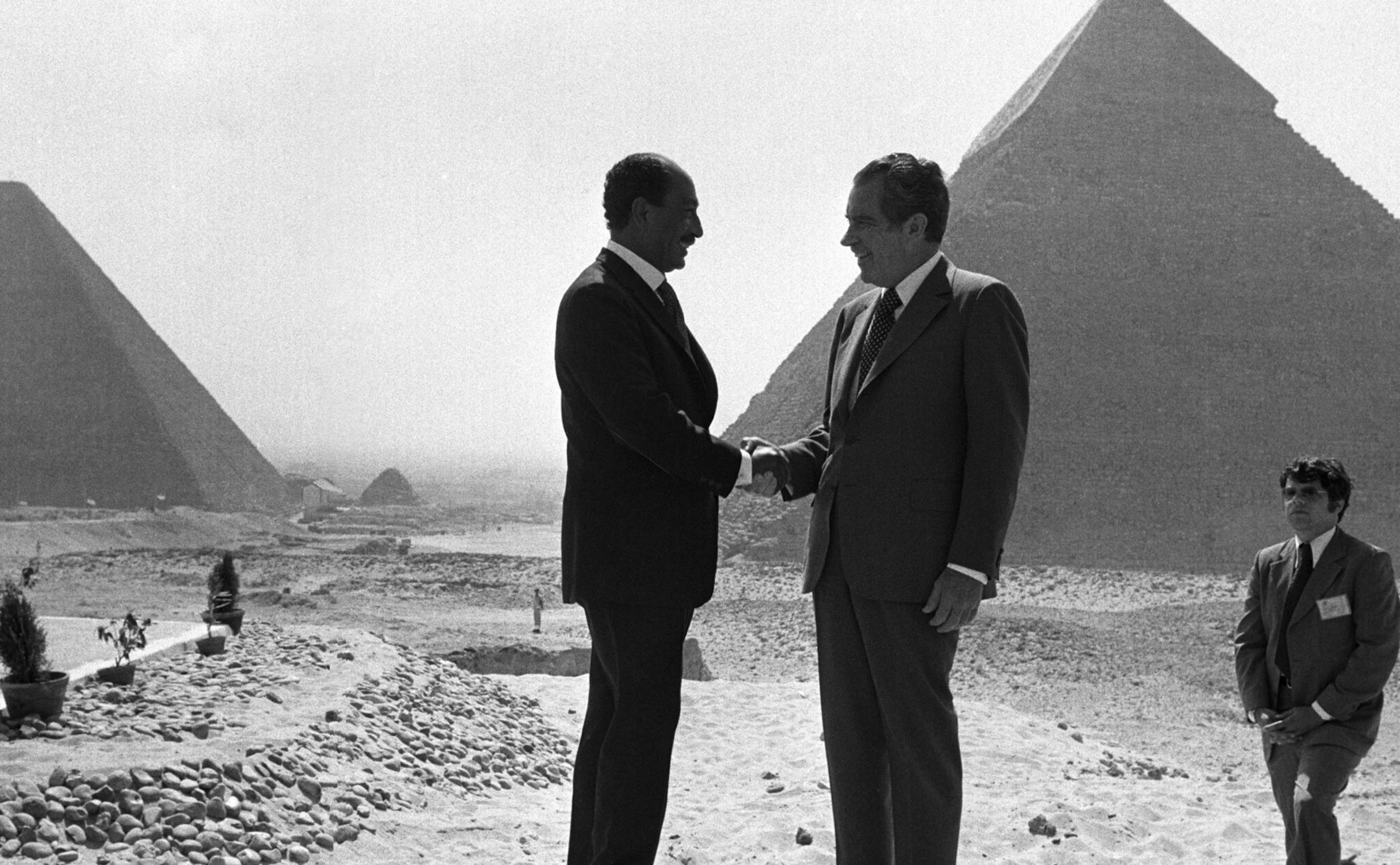
FILE - In this June 14, 1974 file photo taken by Associated Press photographer Horst Faas, Presidents Anwar Sadat and Richard Nixon shake hands for photographers as they pose in front of the pyramids at Giza, near Cairo. Faas, a prize-winning combat photographer who carved out new standards for covering war with a camera and became one of the world's legendary photojournalists in nearly half a century with The Associated Press, died Thursday May 10, 2012. He was 79. (AP Photo/Horst Faas, File) O
FILE - In this June 14, 1974 file photo taken by Associated Press photographer Horst Faas, Presidents Anwar Sadat and Richard Nixon shake hands for photographers as they pose in front of the pyramids at Giza, near Cairo. Faas, a prize-winning combat photographer who carved out new standards for covering war with a camera and became one of the world's legendary photojournalists in nearly half a century with The Associated Press, died Thursday May 10, 2012. He was 79. (AP Photo/Horst Faas, File) ORG XMIT: NYHF136 (The Minnesota Star Tribune)
Left to right, President Bill Clinton, first lady Hillary Rodham Clinton, Israeli Prime Minister Benjamin Netanyahu and his wife Sara walk among Israeli and American flags during a welcoming ceremony at Ben Gurion airport in Tel Aviv Saturday, Dec. 12, 1998. Under an impeachment cloud, President Clinton opened a tough diplomatic mission Saturday aimed at saving the Wye River peace accord from unravelling. Others in photo unidentified.(AP PHOTO/Nati Harnik) ORG XMIT: TLV102
Middle East diplomacy: At top, Egyptian President Anwar Sadat and President Richard Nixon stood at the Giza pyramids near Cairo on June 14, 1974. Above, President Bill Clinton and First Lady Hillary Clinton joined Israeli Prime Minister Benjamin Netanyahu and his wife, Sara, at a welcoming ceremony at Ben Gurion Airport in Tel Aviv on Dec. 12, 1998. Both Nixon and Clinton were mired in scandals back home; Nixon was only weeks from resigning on Aug. 9, 1974. (The Minnesota Star Tribune)
about the writer

about the writer

Joshua Mitnick and Laura King, Tribune Washington Bureau

More from No Section

See More
FILE -- A rent deposit slot at an apartment complex in Tucker, Ga., on July 21, 2020. As an eviction crisis has seemed increasingly likely this summer, everyone in the housing market has made the same plea to Washington: Send money — lots of it — that would keep renters in their homes and landlords afloat. (Melissa Golden/The New York Times) ORG XMIT: XNYT58
Melissa Golden/The New York Times

It’s too soon to tell how much the immigration crackdown is to blame.