

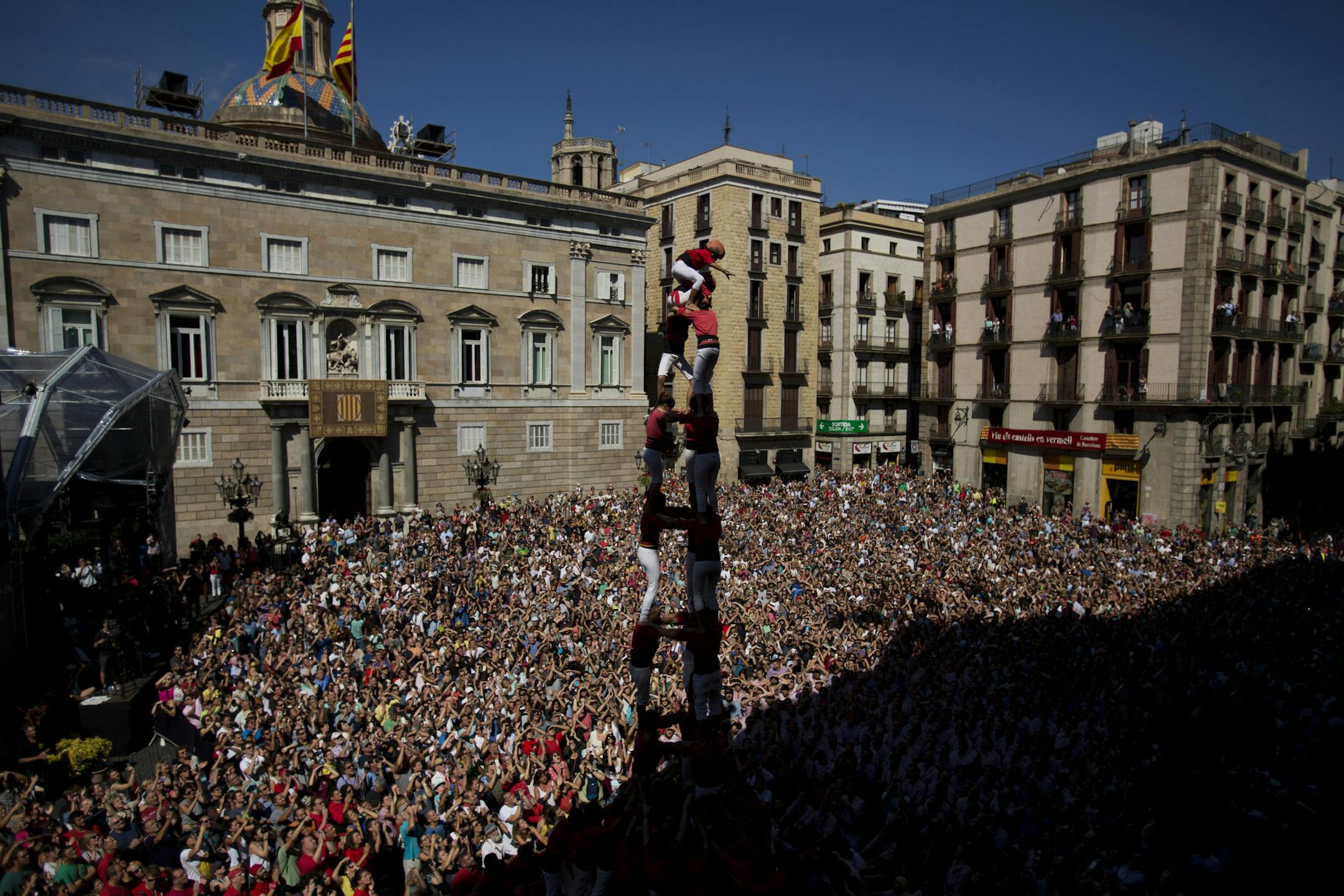
Every year in Catalonia, crowds of people cheer on the rise and fall of human towers that can reach up to 10 levels high. As the audience holds its collective breath, a child climbs to the top of the human structure and, raising his or her hands in the air, signals the completion of a castell.
Human towers, or castells in Catalan, have been a pivotal part of Catalonian culture for more than 200 years. This tradition has been passed down from generation to generation.
"If your family is 'castellera,' they influence you on being part of the same tradition," said Maria Barberà Fabra, communications director for the performing group called Colla Joves Xiquets de Valls. "However, this is not exclusive, so everyone can join a colla (band) if they want, even if their families have never been part of it."
The human towers are formed by castellers standing on the shoulders of one another. A tower is typically six to 10 human stories high.
At the base is the pinya. The next level, the tronc, is formed with the strongest people who stand on top of the pinya. On top of the tronc is the pom de dalt (pom, for short). It's the uppermost level of the tower, made up of children. The smallest children, called enxaneta, climb to the very top.
"When the enxaneta reaches the top from one side and then gets to the other side, the castell is called 'carregal,' and then people start climbing down in the same order they climbed up," 12-year-old casteller Anna Torrell said.
Added Fabra: "The greatest part of human towers is that every person, [regardless of] their age, gender, height or weight, will always have a position in the tower.
"The smallest kids will go at the top of the tower, the biggest ones at the bottom, the strongest ones in the middle. Everyone can be a part of it!"


