

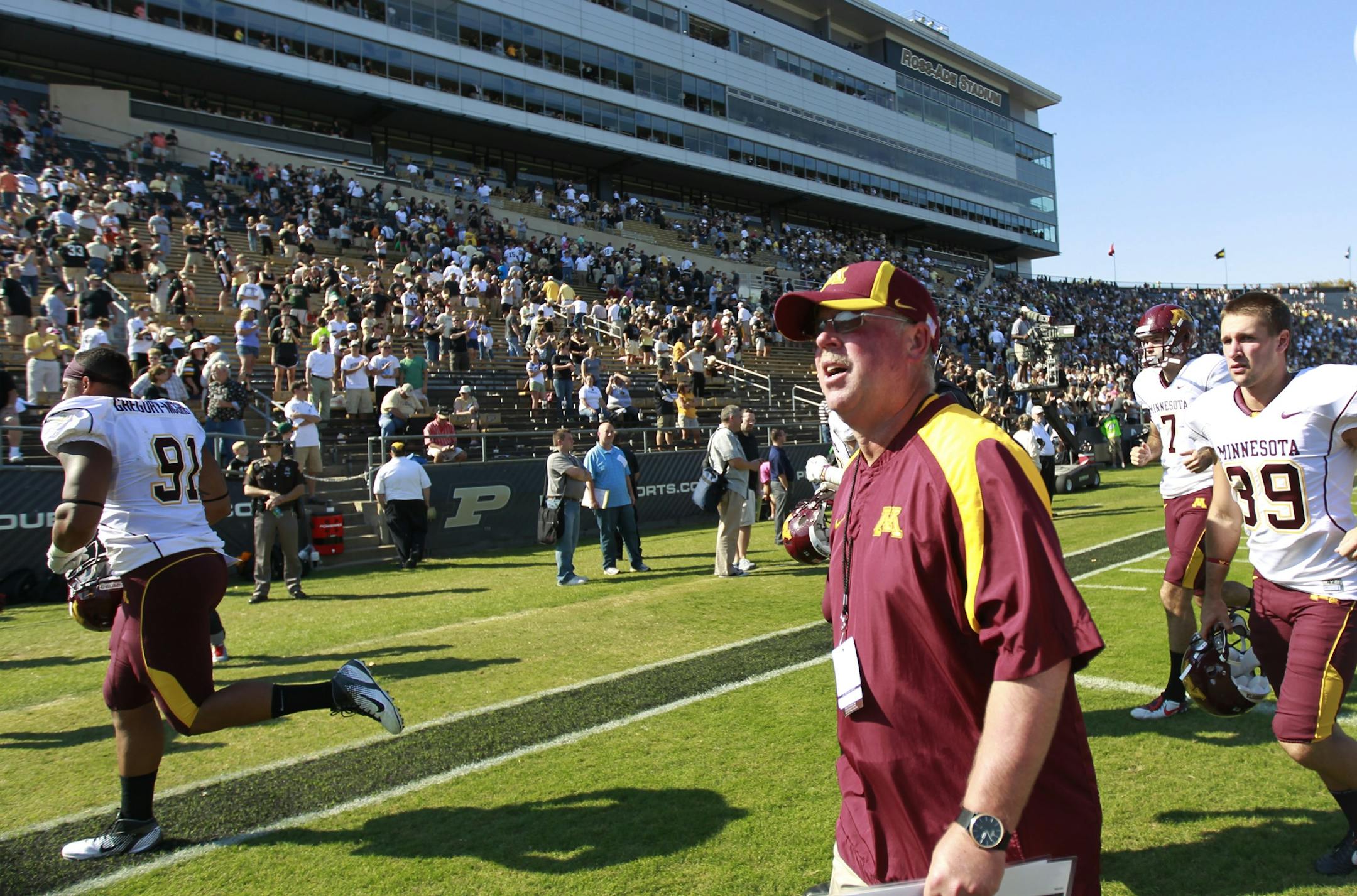
He and his staff have weathered this hurricane before. Jerry Kill knows from experience that a top-to-bottom rebuilding effort is popular in the hypothetical and rewarding in the past tense, but it feels like a pliers-and-blowtorch manicure in the here and now.
"It's frustrating for those kids in there. They go to practice, they work hard to try and get better -- you don't think they're frustrated?" Kill said after the Gophers concluded the first half of the 2011 season with a 1-5 record that actually understates the condition of Minnesota's football program. "I feel bad for them, I really do. I want them to do well. I want so bad to see them make a play right now and have something good happen."
But that's not how football works in the Big Ten, where today's success is secured by your actions four or five years earlier. "When you've got some young players, that's going to happen," Kill said of his team's 69-3 first-half deficit in its first two Big Ten games. "Our biggest job right now is to take care of those kids. Keep them working, keep them positive."
And keep getting experience. The Gophers used 59 different players in Saturday's 45-17 loss to Purdue, 32 of them freshmen or sophomores. Purdue used fewer underclassmen than the Gophers' 18-strong freshman class; Minnesota gave starting assignments to seven freshmen, the Boilermakers only one.
"That's the way life is, and you just try to find out how people react to difficult times," Kill said. "The ones who go off [the wrong way], they'll struggle their whole life. That's people in general -- how you deal with adversity, that's really important. We'll find out who stays in there."
Other than their willingness to compete -- and only the coaches can gauge that with any certainty -- the Gophers didn't have many positives at Purdue, a place where they hoped the talent gap would be less pronounced. Marcus Jones, the Gophers' most promising player so far this season, returned a kickoff for a touchdown. And the pass rush at least annoyed Purdue quarterback Caleb TerBush. Some Gophers felt that had they not sabotaged themselves with three first-quarter turnovers, they would have had a chance to win by the end.
"We made some improvements. I think the D-line got after it today," linebacker Mike Rallis said. "We always want to put pressure on the quarterback. The other stuff will come -- we need to try to keep doing that."
With a schedule that includes Nebraska, Michigan State and Wisconsin over the next five weeks -- combined record: 14-2 -- those discoveries are likely to be made under the worst conditions possible. Which raises an important question for the second half of the season: Should winning another game even be a priority?


