
Don't reroute freight trains, St. Louis Park residents plead

More than 300 people packed City Hall in St. Louis Park, most hoping to convince officials that a plan to move train traffic is a "lose-lose" for the city.

May 14, 2013 at 6:51PM
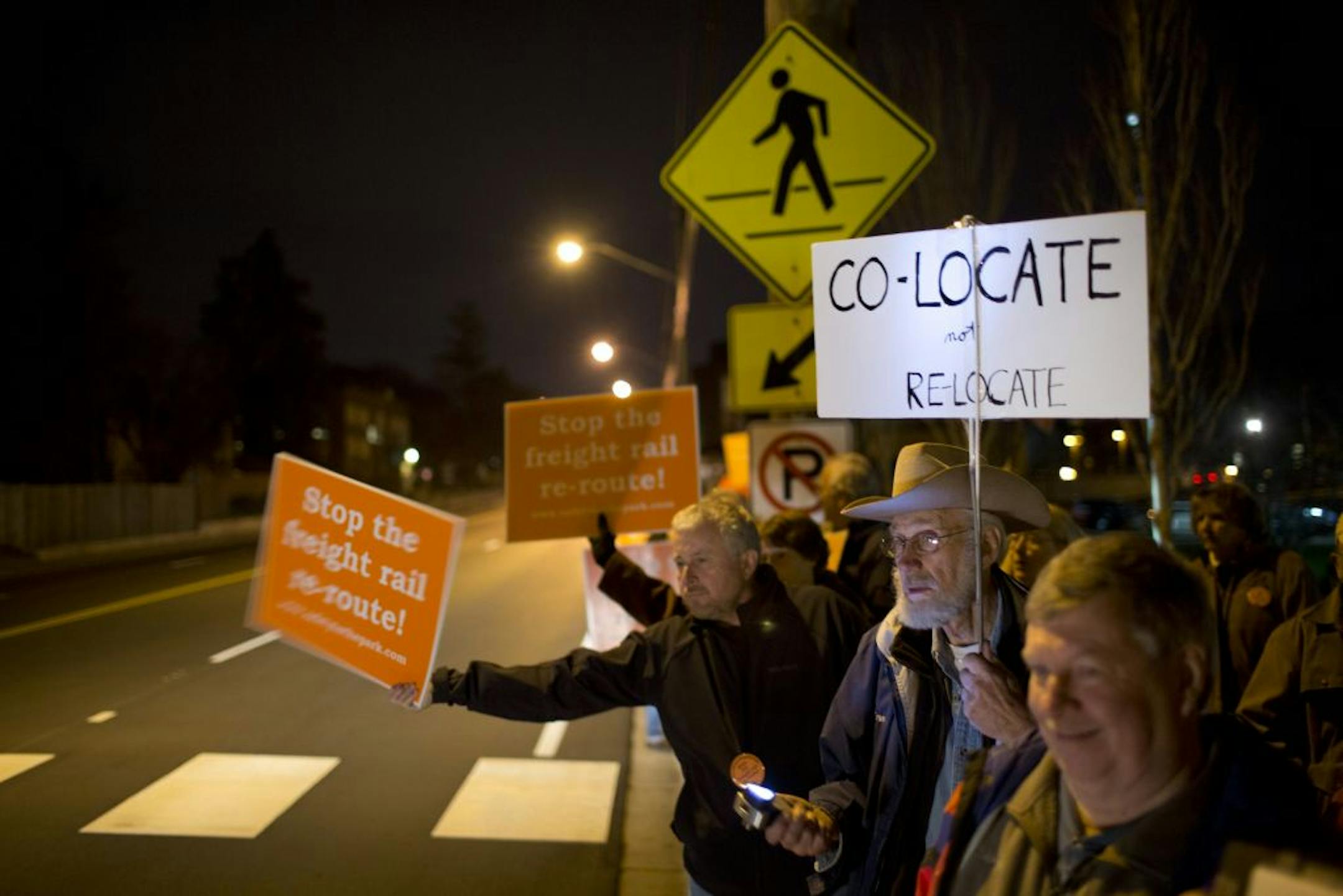
Scores of people demonstrated against a plan to reroute freight trains through their neighborhoods as a public hearing at St. Louis Park's City Hall was set to begin. Some cited safety concerns over the Southwest light-rail rerouting proposal.
Scores of people demonstrated against a plan to reroute freight trains through their neighborhoods as a public hearing at St. Louis Park’s City Hall was set to begin. Some cited safety concerns over the Southwest light-rail rerouting proposal. (Star Tribune/The Minnesota Star Tribune)

With strong words and threats of lawsuits, more than 300 people packed St. Louis Park City Hall on Wednesday, most of them to convince Hennepin County and Metropolitan Council officials not to send freight trains through their neighborhoods.

To make room for a proposed Southwest light-rail line, officials want to reroute freight trains now going through Minneapolis to St. Louis Park instead. More than 100 protesters gathered outside City Hall before Wednesday's meeting -- the second of three public hearings that Hennepin County is holding this month to hear from residents on the possible environmental impacts the Southwest line could have on the five cities it would go through if approved.

"The reason we're all worked up is they haven't been receptive to our concerns," St. Louis Park resident Brian Zachek said. "If it derailed, it would tumble literally on top of us."

Zachek lives about 34 feet from freight train tracks that about two trains use each day. If freight trains that currently go by Minneapolis near the affluent Kenwood neighborhood are rerouted through his neighborhood, he said six to eight more trains would go by a day, increasing noise and safety risks.

While the 15-mile line will go through Minneapolis, St. Louis Park, Hopkins, Minnetonka and Eden Prairie, he said he and his neighbors will shoulder the worst effects of all. "We think it's a bad plan altogether," he said.

More than 25 residents, city and community leaders addressed the three county commissioners -- Jan Callison, Peter McLaughlin and Gail Dorfman -- nearly all speaking against rerouting the trains, calling it "irrational" and "unconscionable."

"I'd like to understand how this will be a win-win for St. Louis Park," said Thom Miller, co-chair of Safety in the Park, a group of residents opposed to the rerouting. He said the county, Met Council and city should expect a lawsuit if the rerouting is approved. "It's not a win-win; it's a lose-lose."

Miller presented a petition with more than 1,500 signatures from those opposed to the plan. Keeping the freight trains in Minneapolis running next to a light-rail line, or co-location, is more feasible and $123 million cheaper, he said.

One of the few people to speak in support of the rerouting, Greg Hannon of St. Louis Park, was booed when he said he thinks other residents have politicized the issue and are just concerned about their property values going down.

"To me this is a simple economic issue," he said. "They're simply trying to protect their investment."

Construction on the $1.25 billion project is slated to start in 2015, with the line opening in 2018. On Wednesday, commissioners didn't respond to comments. But before the meeting, McLaughlin asked for civility during the emotional discussion.

"I know there are strong feelings on both sides of the issue," he said.

Hennepin County will continue to accept feedback until Dec. 11 on the draft environmental impact statement, which was released last month. A final environmental impact statement, which will give more detailed effects on communities and solutions to mitigate problems, will be released by the Met Council.

The decision whether to reroute freight trains rests with the Met Council.

Kelly Smith • 612-673-4141 • Twitter: @kellystrib

about the writer

about the writer

Kelly Smith

News team leader

Kelly Smith is a news editor, supervising a team of reporters covering Minnesota social services, transportation issues and higher education. She previously worked as a news reporter for 16 years.

See Moreicon

More from No Section

See More
FILE -- A rent deposit slot at an apartment complex in Tucker, Ga., on July 21, 2020. As an eviction crisis has seemed increasingly likely this summer, everyone in the housing market has made the same plea to Washington: Send money — lots of it — that would keep renters in their homes and landlords afloat. (Melissa Golden/The New York Times) ORG XMIT: XNYT58
Melissa Golden/The New York Times

It’s too soon to tell how much the immigration crackdown is to blame.