

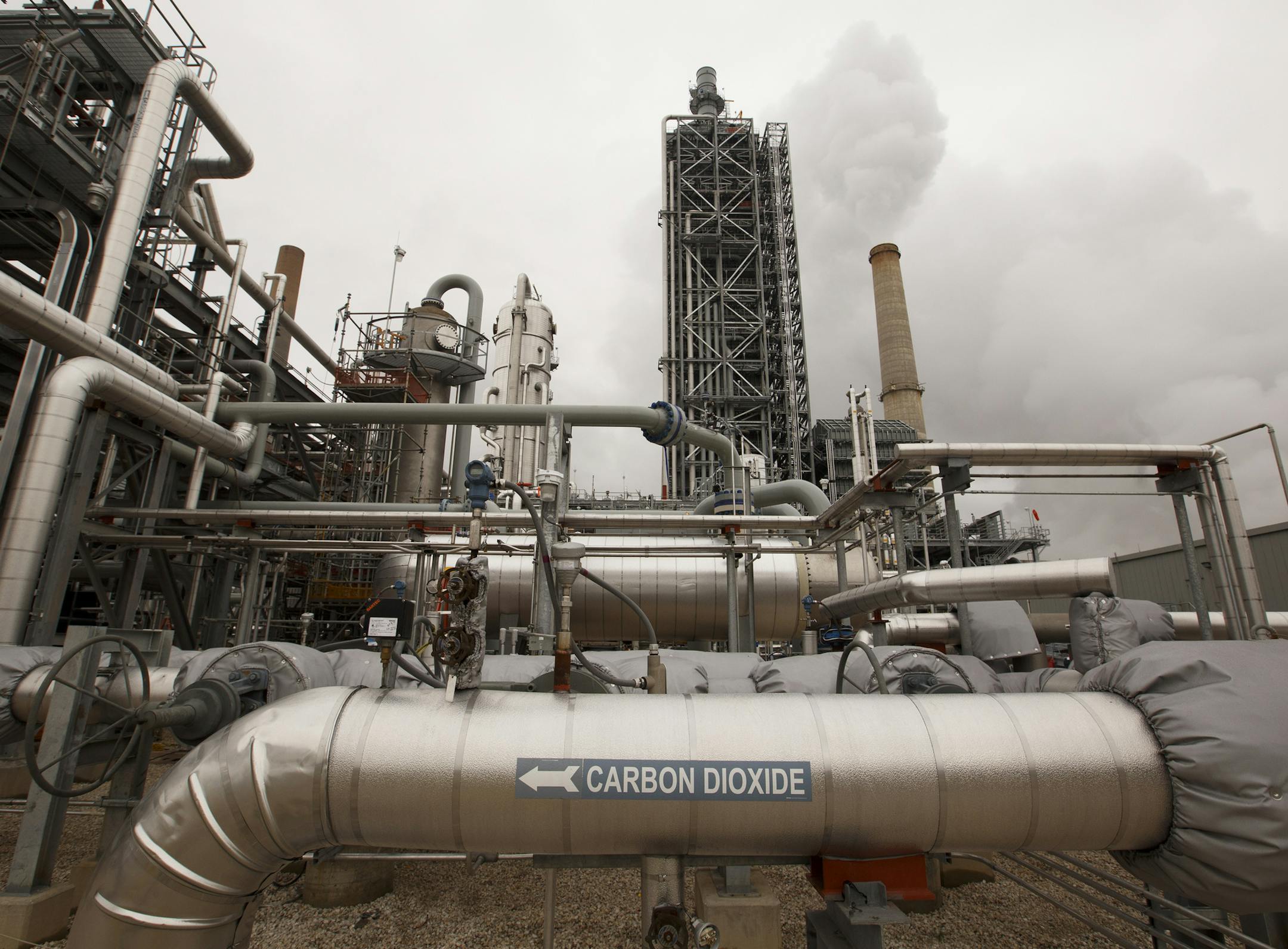
In the age of climate change, carbon dioxide emissions produced by burning fossil fuels present a liability that many investors fear might one day bring down oil companies. But scientists and policymakers are asking what would happen if carbon dioxide had a value the same way oil, gold and coffee do. What if it could be used to produce goods and even fuels — the way plants and trees use carbon dioxide to keep themselves alive?
It's not an entirely new concept. For decades, industries from oil to soft drinks have bought small amounts of carbon dioxide, piped in from underground caverns where it was trapped eons ago. But now the outgoing Obama administration, along with partners from both environmental groups and the oil and gas industry, is hoping to create a much larger market that will not only keep carbon out of the atmosphere but create a new engine for the U.S. economy.
"They need scientific breakthroughs, but this is a very important research direction," Energy Secretary Ernest Moniz said. "It could be building materials, road materials. A holy grail, in a certain sense, would be to use CO2 plus other ingredients like water and sunlight to convert to a hydrocarbon liquid fuel."
Such breakthroughs are likely a long way off, but if they materialize, it could prove vital to the oil and gas industry. Solving the challenges and economics of carbon capture could keep oil, gas and other fossil fuels viable over the long term as international efforts to slow climate change lead to ever tighter restrictions on carbon dioxide emissions that accelerate global warming.
Burning fossil fuels in power plants, factories and other industries is a major source of the carbon dioxide that traps heat in the Earth's atmosphere. For now, even the initial step toward putting carbon dioxide to use — separating it out of the emissions streams rising out of the country's smokestacks — remains prohibitively expensive.
But as engineers work out the kinks, costs are coming down to the point that by 2025 it should be competitive with naturally occurring stockpiles, said Douglas Hollett, principal deputy assistant secretary for fossil energy at the Energy Department. He said carbon capture is on a similar trajectory as earlier energy technologies.
"Think about where solar PV, onshore wind [turbines], LED [light bulbs], and shale wells were not too long ago," he said.
Colorless, odorless and noncombustible, carbon dioxide has a long list of theoretical applications. It can be used to make cement, feed algae, produce the bubbles in a can of soda, and even make fuels like methanol and ethanol. A report by the Energy Department's scientific advisory board last month identified more than two dozen possible applications for carbon dioxide.


