

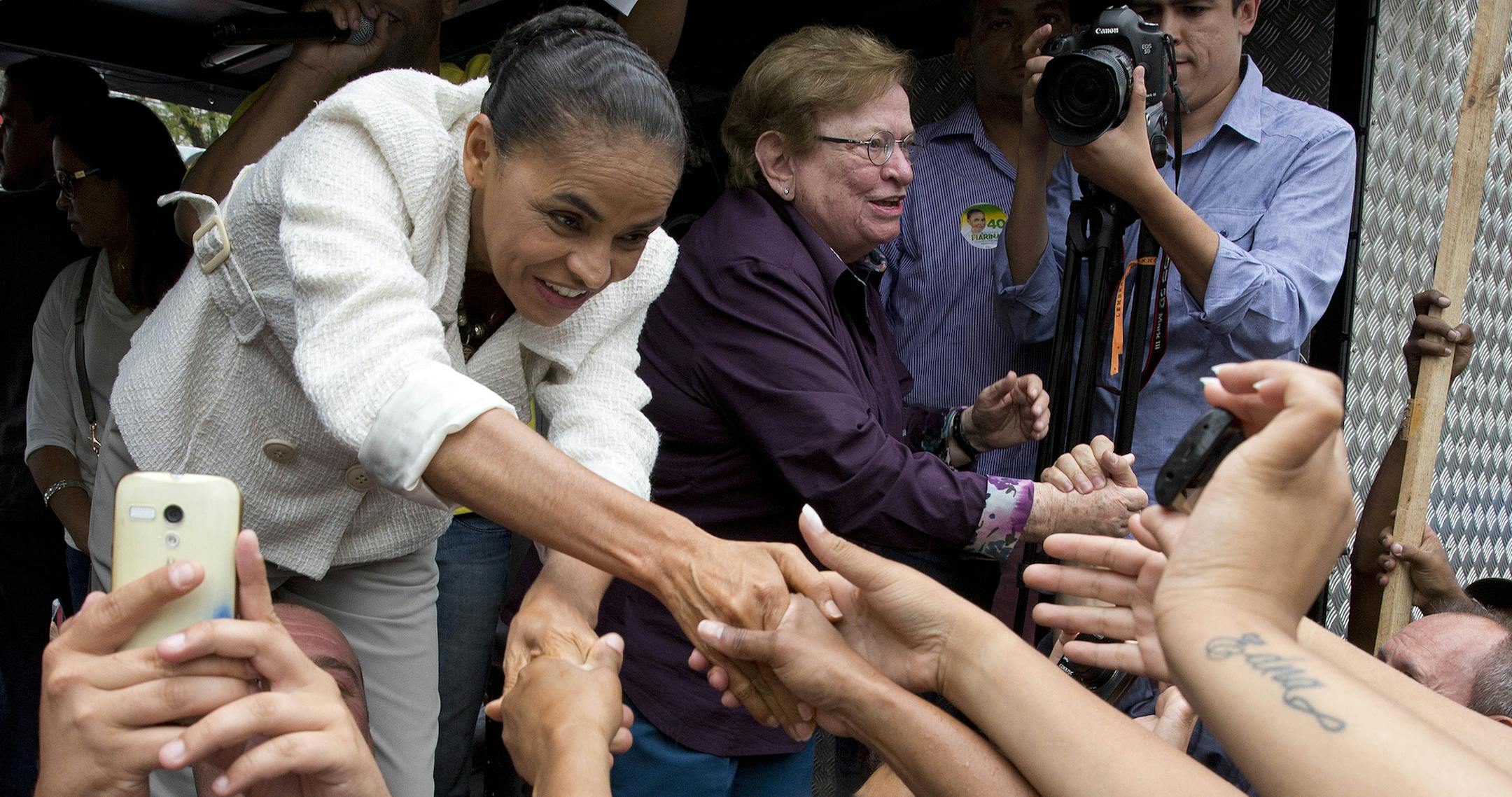
Hope and strong leadership are in short supply these days. But if you want a shot of both as well as a glimpse into a story that resonates worldwide, meet Marina Silva, a woman who rose up from crushing poverty, working as a housekeeper to make ends meet, to become the current front-runner in Brazil's presidential election.
Until mid-August, Silva was not much more than a footnote in Brazil's political life. That is not to say she was not important. Her story had long been an inspiring one to Brazilians. The 56-year-old was born in the Brazilian state of Acre on a rubber tree plantation. Of mixed racial ancestry, she was raised in a family with 11 children, and spent much of her childhood wracked by tropical diseases. By the time she was 16, she had been orphaned. Educated in a convent, she became not only the first person in her family to learn to read and write, but by age 26 she had earned a history degree.
Early in her political career she teamed up with Amazon environmental activist Chico Mendes to fight the destruction of the rain forest. Riding the popularity she achieved for her activism, she was elected to Brazil's Senate in 1994. In this role she fought for the passage of laws and regulations that reversed the trend of the destruction of the Brazilian jungles that are so vital to the global environment that they have been called "the lungs of the planet" because they produce one-fifth of the world's oxygen.
Her work led to her appointment as a minister in the administration of Brazilian President Luiz Inácio Lula da Silva. Her colleagues in the government remember her as focused, effective, knowledgeable and impressive. Ultimately, her passion for the environment produced rifts between her and some who saw her as uncompromising on critical issues of economic development. She resigned from her post in the spring of 2008.
A year later she became the Green Party candidate for president of Brazil and, despite winning roughly one out of five votes in the first round of the elections, did not qualify for the runoff stage. She switched to the Socialist Party in 2013 and earlier this year became their candidate for vice president on a ticket headed by Eduardo Campos. But on Aug. 13, Campos was killed in a plane crash. In the weeks that followed, Silva, his successor, rose so quickly in the polls that while she is seen as likely to finish second to current leader Dilma Rousseff in the Oct. 5 first round of elections, she is thought to have an advantage to defeat Rousseff in the runoff stage.
Brazilian political insiders note that Lula has remained relatively silent on the issue of his preferences, leading one such insider to conclude that Lula, like many Brazilians, has grown disaffected with Rousseff's dour, combative stance and her overall lackluster performance as president.
Much can change and certainly, to some degree, Silva's rise has been fueled by the shock and sympathy that followed Campos's death. But as her impressive career demonstrates, she has been lifted by more than just a twist of fate. This is an extraordinarily formidable woman whose rise offers lessons and resonances that should touch many far beyond Brazil's borders.
First, it must be noted that the one thing that is certain is that the next president of Brazil will again be a woman. Rousseff and Silva lead third-place candidate Aécio Neves by substantial margins and rumors already have him seeking to broker a deal with Silva to announce his support for her immediately after the first-round election results are announced. In a world in which women are still far from being as politically empowered as any sense of equity or justice would dictate, the world's fifth-most populous nation offers the first campaign in memory for the head of state post in a large country where both of the top contenders are women.


