
St. Louis Park startup receives grant to test bracelet to prevent hair pulling

HabitAware received $300,000 federal grant to test non-pharmaceutical approach.

August 16, 2018 at 11:46PM
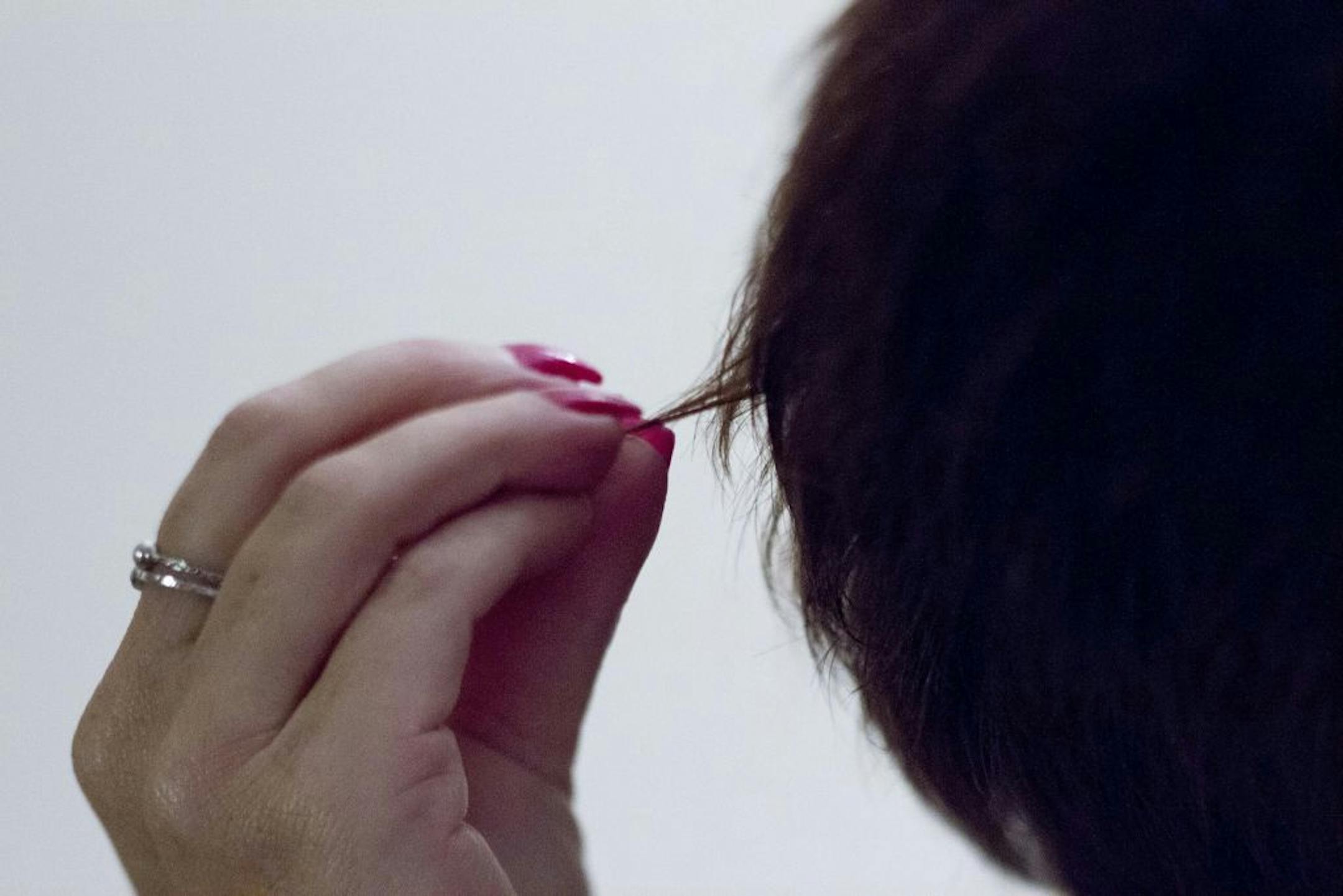
Laurie Piotrowski, who suffers from trichotillomania, hair pulling, shows how she rolls her hair before pulling it out.
A buzzing bracelet created by a St. Louis Park startup seeks to counteract a condition known as trichotillomania — the habitual, often subconscious, urge to pull on hair, eyebrows and eyelashes. (Mct/The Minnesota Star Tribune)

A buzzing bracelet created by a local startup company seeks to counteract a condition known as trichotillomania — the habitual, often subconscious, urge to pull on hair, eyebrows and eyelashes.

HabitAware of St. Louis Park has been selling the bracelet for a year, but this month it received a $300,000 federal grant from the National Institute of Mental Health to improve it and prove that it works.

Sameer Kumar created the company along with his wife, Aneela Idnani Kumar, after he discovered in 2014 that his wife had been living with the condition and hiding it. On one occasion, Sameer grabbed his wife's hand, because she was picking at her eyebrows, and the idea emerged.

" 'I wish I had something that would notify me I was doing it that wasn't you,' " Aneela told her husband, "because it's super annoying" to have someone around you trying to stop the behavior.

As many as one in 50 people have some form of trichotillomania. Often, they are unaware of their hair-pulling habits, so the Kumars created the bracelet to remind them, along with a mobile app to give them alternative activities to occupy their hands.

"Just clenching your fist" is one strategy, Aneela said.

Users first train the so-called Keen awareness bracelets by wearing them while mimicking their hair-pulling motions. The bracelets then learn to respond with a buzz, similar to a text alert, when that motion is repeated.

While the Keen bracelet didn't require the same preliminary research as a new drug or defibrillator, the Kumars wanted to study it to ensure its effectiveness. The grant will allow them to optimize the bracelet, and to conduct a phase 1 study to prove that it helps people reduce their behaviors.

They plan a phase 2 study eventually in which the bracelet is tested to see if it's more effective than conventional treatments such as cognitive behavioral therapy or medication.

Sameer said the bracelet is trained to mimic the specific, repetitive and often unconscious motion of hair-pulling, and to ignore similar but unrelated arm gestures.

Trichotillomania "occurs on a spectrum," he said. "It's different [for everyone] but the research says 75 percent of the episodes occur in this automatic or subconscious way."

HabitAware has already sold thousands of the Keen bracelets, he said.

The research will be led by Douglas Woods, a Marquette University psychologist with expertise in body-focused repetitive behaviors.

about the writer

about the writer

Jeremy Olson

Reporter

Jeremy Olson is a Pulitzer Prize-winning reporter covering health care for the Star Tribune. Trained in investigative and computer-assisted reporting, Olson has covered politics, social services, and family issues.

See Moreicon

More from No Section

See More
FILE -- A rent deposit slot at an apartment complex in Tucker, Ga., on July 21, 2020. As an eviction crisis has seemed increasingly likely this summer, everyone in the housing market has made the same plea to Washington: Send money — lots of it — that would keep renters in their homes and landlords afloat. (Melissa Golden/The New York Times) ORG XMIT: XNYT58
Melissa Golden/The New York Times

It’s too soon to tell how much the immigration crackdown is to blame.