

In its 28th year, the 2009-10 McKnight Visual Artists Fellowship exhibition could be likened to a baseball home opener. It's an anticipated event but doesn't represent the entire season -- or in this case the entire arts community.
The show features the work of four Minnesota artists who receive coveted recognition and a desirable cash prize. As usual the four bodies of work have little in common, but if there is one idea that links the work of Michael Kareken, Aldo Moroni, Carolyn Swiszcz and Piotr Szyhalski, it is their exploration of the abstract construct of time.
Most accessible are Kareken's paintings and drawings of fields of recycled glass bottles, grids of compressed scrap metal and tangles of discarded engines that make obvious his keen eye and technical facility for making the ordinary resonate. Although it depicts refuse, Kareken's work, sporting titles like "Scrap Engines #3," is animated by an elegance that confirms his ability to locate the essence of his subject matter.
In a painting titled "Green Bottles," the viewer is mired in a quicksand of bottles, as if sinking amid a huge recycling container. Deftly using an edge-to-edge style of painting recalling Abstract Expressionism, Kareken sheathes his work with a layer of melancholy and loss that unearths two narratives: the history of these discarded objects and a more political critique of our consumption.
Rise and fall
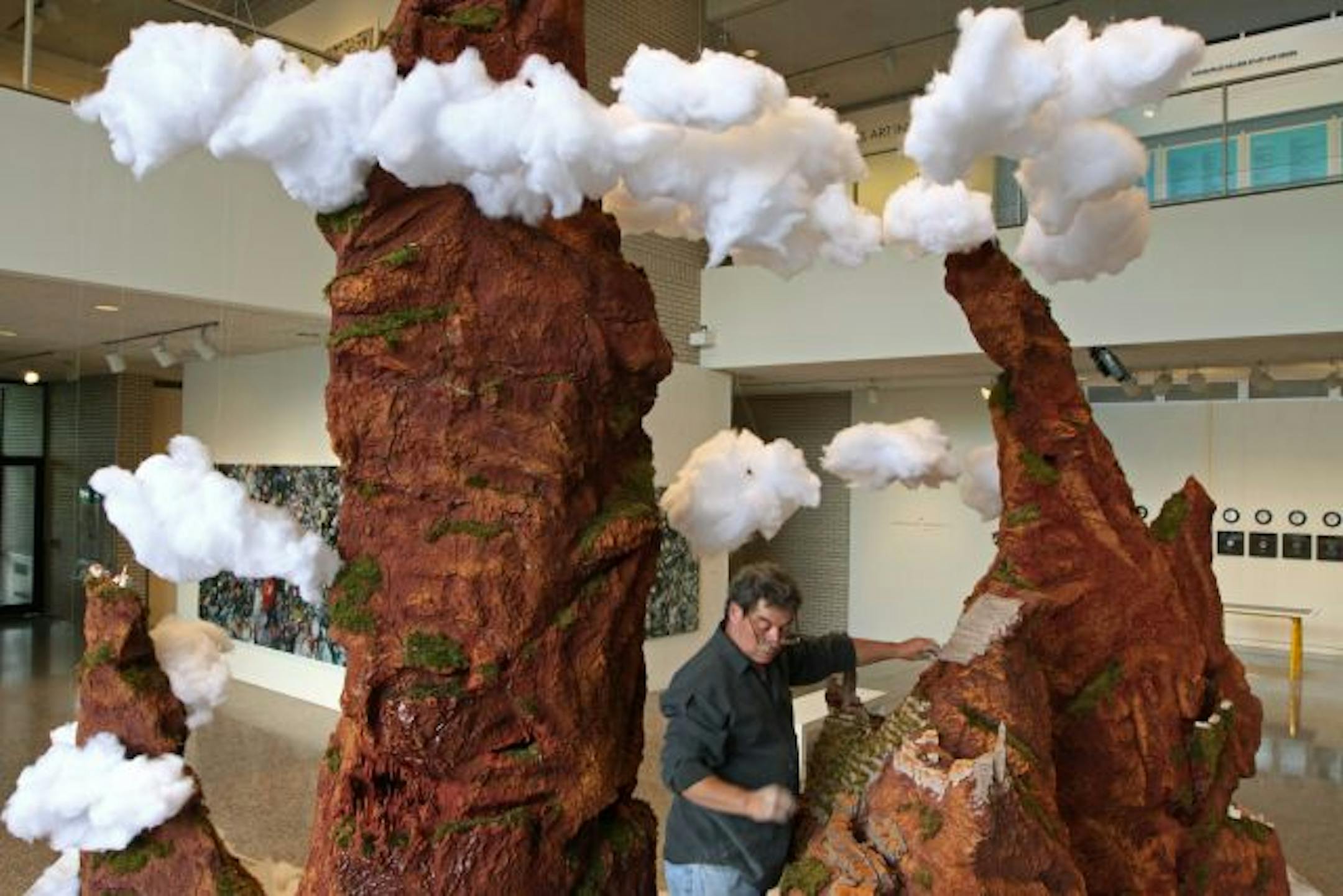
For more than three decades, Moroni has investigated ancient civilizations in his ceramic-based work. His installation projects -- which he calls "mock archaeology" -- are part fact and part fantasy, imaginatively re-creating the rise and fall of societies. In "Fragilearth," the civilization narrative played out through 18-foot sculptural "mountains," spiky flora and puffy clouds suspended from the ceiling has an unexpected twist: Its future demise is not because of a conquering people but due to nature. Suggesting the jagged mountains depicted in ancient Chinese scrolls, the installation is fanciful and imposing.
Moroni, always the activist, works Monday through Friday on "Fragilearth" from 10 a.m. to noon and welcomes the input of visitors so that the project evolves in real time in a communal way. For all of its curb appeal, the installation's base is clumsy, as if the sculptural forms were casually placed on a shelf. But, more important, will Moroni destroy "Fragilearth" in a post-exhibition performance? It's a question that causes Moroni to smile like the Cheshire Cat.
Urban ephemera


