

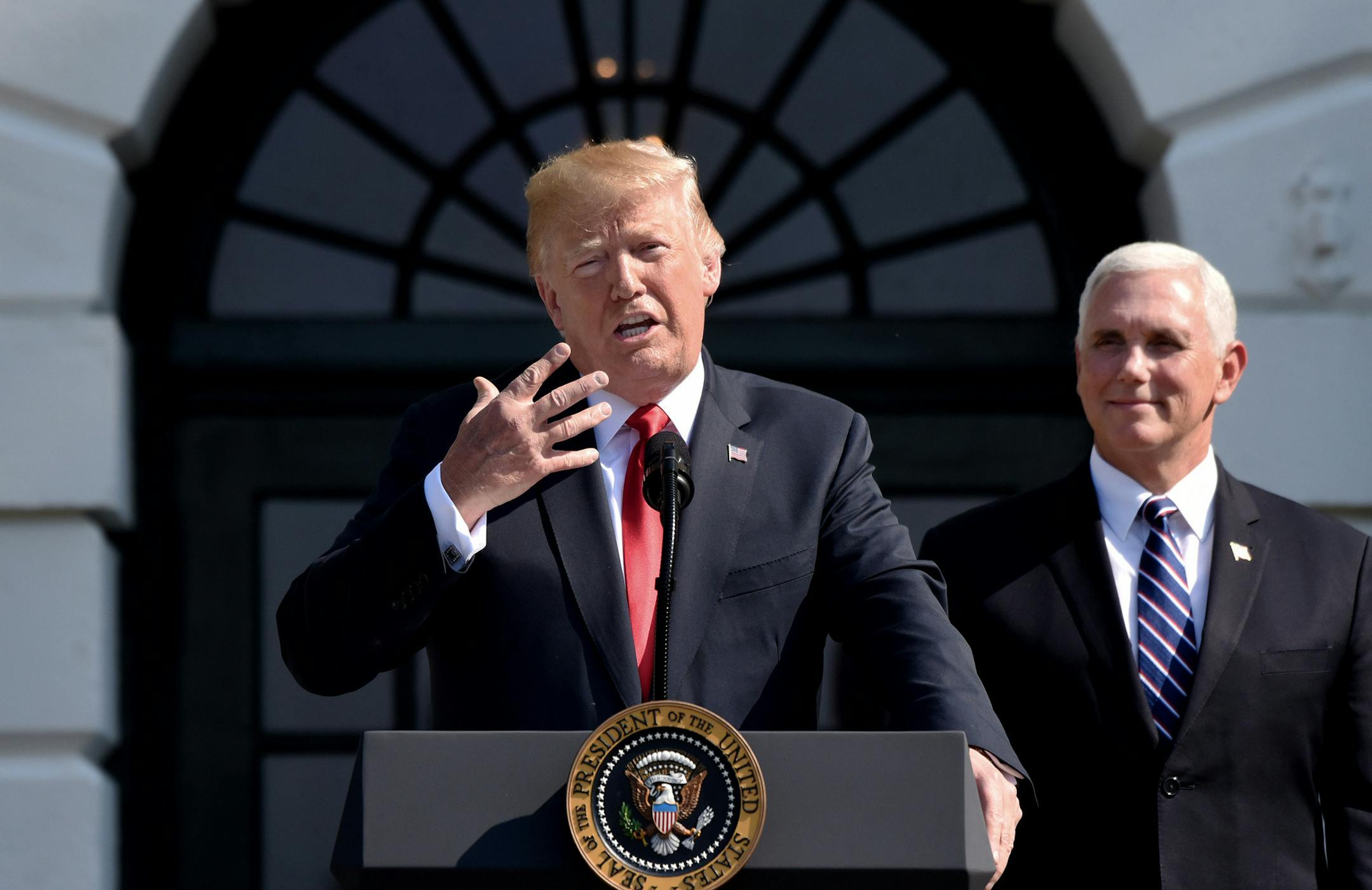
President Donald Trump has been a regular speaker at recent Values Voter Summits, and for this year's event, he will send Vice President Mike Pence to rally the religious right. This will not surprise many people on the left who have questioned the authenticity of social conservatives' values and their place in the Trump-Pence coalition. They think the religious right has compromised its Christian values in order to attain political power for Republicans.
But new data suggest the left may have a lot more common ground with some of these conservatives than it thinks. In a Democracy Fund Voter Study Group report, I found that religious conservatives are far more supportive of diversity and immigration than are secular conservatives. Religion appears to actually be moderating conservative attitudes, particularly on some of the most polarizing issues of our time: race, immigration and identity.
Churchgoing Trump voters have more favorable feelings toward African-Americans, Hispanics, Asians, Jews, Muslims and immigrants compared with nonreligious Trump voters. This holds up even while accounting for demographic factors such as education and race.
Churchgoing Trump voters care far more than nonreligious ones about racial equality (67 percent vs. 49 percent) and reducing poverty (42 percent vs. 23 percent). These differences are reflected in their actions, too. Trump's most religiously observant voters are three times as likely as secular Trump voters to volunteer — and not just with their own church.
Religious participation also appears to pull Trump's supporters away from the administration's immigration policy. The more frequently Trump voters attend church, the more they support offering citizenship to unauthorized immigrants and making the immigration process easier, and the more opposed they become to the border wall.
It seems church teachings can curb tribalistic impulses by regularly reminding worshipers that we are all God's children. This hasn't extended to sexual minorities as much as progressives may like, but it appears to be making a difference when it comes to race and immigration.
Religious institutions also provide communities and identities that aren't based upon immutable traits such as race or country of birth. Research suggests that identities that transcend race or nationality may lead people to feel more favorably toward racial and religious minorities.
Social psychology research has also found that conservatives have a stronger desire to belong and be loyal to cohesive groups. Secular conservatives lack church membership to provide that sense of belonging and may succumb to the temptation to find it on the basis of their race or the nation, thereby bolstering white nationalism or the alt-right movement. We found that secular Trump voters are three times as likely as churchgoing Trump voters to say that their white racial identity is "extremely" important to them; a majority of them report feeling like strangers in the country.


