

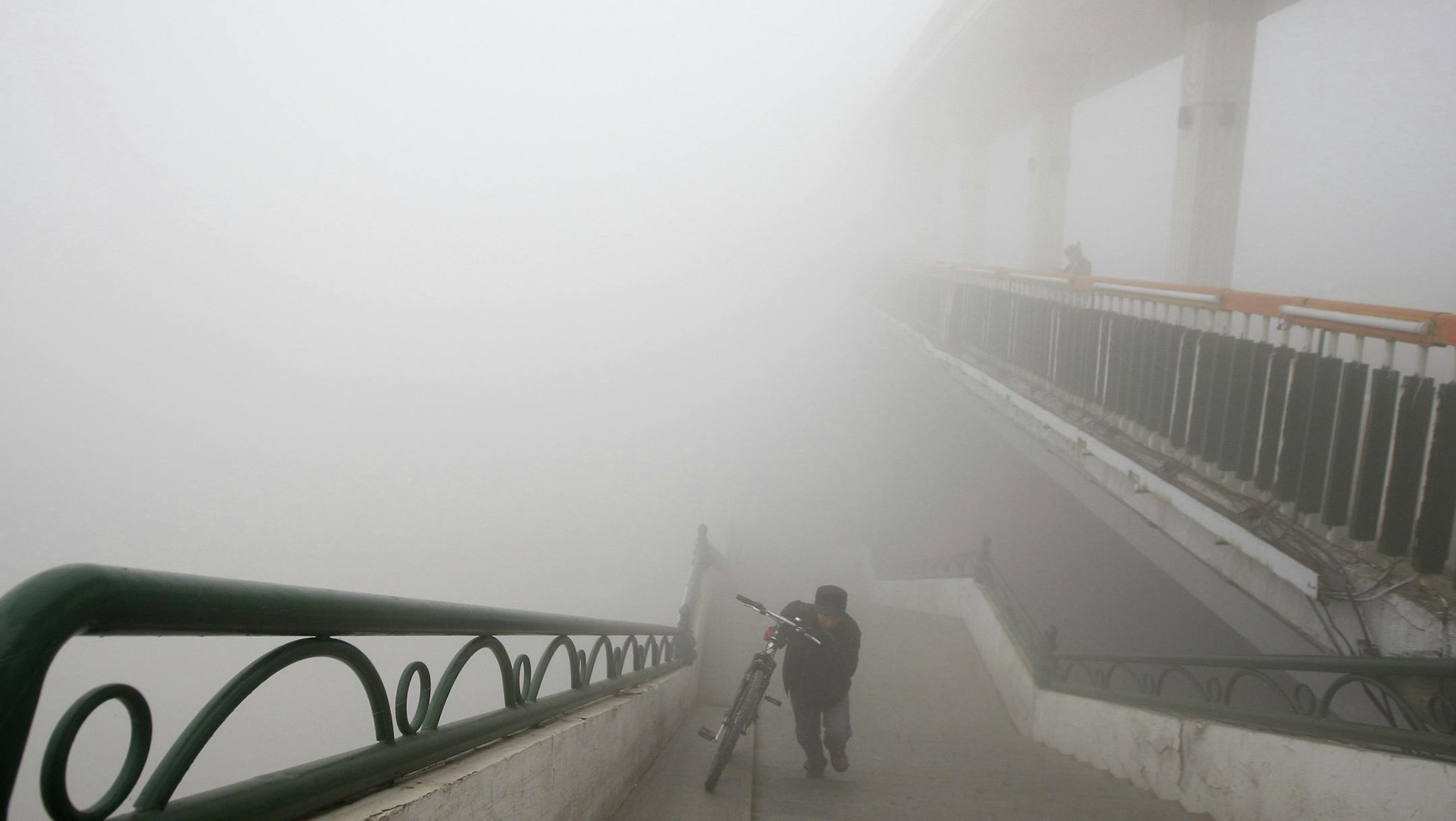
Last week, the New York Times published a cautionary tale of good intentions gone bad. "Clearing the Air in China" told of how enormously costly antipollution efforts are being "swamped" by economic growth in the world's most populous nation.
Curbing growth itself was not among the authors' proposals to reverse China's deleterious course. Charles P. Nielsen and Mun S. Ho are economists affiliated with Harvard. In academia these days, it's considered unimaginative to think outside the box — this particular box, anyway. Grants and fellowships accrue to those whose research stops just short of calling a spade a spade. Policy analysts earn their keep by reinforcing the mythology that financial incentives can fix anything.
Without an ever-expanding global GDP, so the logic goes, economies stagnate. Jobs are lost. People stop spending and lose interest in sex. Grown children move in with their parents. (Just look at Italy!) Crops shrivel and mass starvation ensues. Also, wars. Society spirals downward into chaos and death.
This is why Nielsen and Ho blame China's mounting environmental problems on its "instinctual response to such challenges: a top-down approach designed to try to engineer its way through them according to master plans." Anyone with a crystal ball could have predicted, for example, that mandated reductions in sulfur dioxide emissions would backfire when ammonia reacted to nitric acid to form an even worse chemical due to "unusually stagnant meteorological conditions" in northern China — conditions that also go by the name climate change. "Such complexities caution against assuming that poor air quality results from a failure to prevent it," the authors conclude.
Complexities that Nielsen and Ho fail to mention include the fact that Chinese citizens outnumber Americans by 4 to 1, and that we've effectively outsourced manufacturing from here to there in a single generation, and that Chinese workers fully expect to have what we have, or used to have, in the very near future.
While the authors do acknowledge that "command-and-control" mandates can work — top-down regulation is responsible for the "American blue skies" that "a Beijing citizen wheezing behind her facemask" must dearly envy — China's most successful such mandate is left out of their critique. The one-child rule, a top-down (also no-growth) policy if there ever was one, is driving a projected decline in China's population by 2050. India, meanwhile, a country with little tolerance for centralized mandates and the most horrific slums in the world, is expected to grow to 1.6 billion in the same period.
Nevertheless, the authors see market incentives, not mandates, as China's only hope of addressing "both carbon emissions and air pollution at little cost to economic growth, all in one fairly straightforward policy." This makes sense as far as it goes. Cap-and-trade is the cornerstone of the Kyoto Protocols. Taxing carbon has worked in Europe and Canada.
What irks me is the avoidance of any discussion that connects the dots — any talk of sustainability or the real consequences of climate change — as well as the authors' patronizing tone.


