University of Minnesota President Rebecca Cunningham weathers contentious first year

The U leader and her administration have made significant — often controversial — decisions since she started the top job a year ago.

The Minnesota Star Tribune
August 24, 2025 at 11:00AM
University of Minnesota President Rebecca Cunningham photographed during an interview with the Minnesota Star Tribune in 2024 before she started the top job in July 2024. (Jeff Wheeler/The Minnesota Star Tribune)

Rebecca Cunningham’s Instagram documents the high points of her first year as president of the University of Minnesota — with photos of her grinning aboard a ship in Duluth, cheering at sporting events, visiting the Minnesota State Fair and casually chatting with students while holding an ice cream cone.

The ready smile on social media belies what has been a difficult year for Cunningham, an emergency room physician from the East Coast.

In her inaugural year as the leader of Minnesota’s biggest university, the first-time president has weathered a series of controversies, from a prominent researcher resigning amid plagiarism accusations to the Board of Regents raising tuition and making steep academic cuts.

At the same time, she has also had to grapple with the Trump administration’s aggressive attempts to redesign American higher education while slashing research funding to universities.

She and her administration have made significant — often contentious — decisions, such as implementing a resolution some say limits faculty speech.

Those moves have led some U faculty to call her a “straight shooter” who doesn’t sugarcoat things. But she’s butted heads with others, including some who’ve said she’s a top-down leader who bristles at criticism.

“Many of us felt steamrolled” over the past year, Michael Gallope, a professor of cultural studies and comparative literature, said in an email. “I am hopeful that we can restore trust.”

In an era when university presidents are often expected to be fundraisers, diplomats, budget gurus and head cheerleaders, Cunningham is formal and decisive, befitting the doctor that she is. But that approach has also meant she rarely speaks to news media outlets, except for a few early interviews and a recent piece by an online publication specializing in health and medical news.

When she does speak to the media, she doesn’t share much.

“It’s a time where there’s a lot of change in higher education and certainly my administration has had the opportunity to lead during that,” Cunningham said Wednesday in a 20-minute interview with the Minnesota Star Tribune. “[With] a lot of the challenges to higher ed right now, the University of Minnesota is the solution.”

Cunningham is hardly alone in having to navigate the growing tensions and political pressures that come with running a university during the second Trump administration.

Rod McDavis, the former president of Ohio University who now runs an executive search firm, said it’s “a very challenging time to be a president.”

“The landscape in higher education is one that you have to be nimble, but you have to be able to make tough decisions ... where you might not make everyone happy,” he said.

From Michigan to Minnesota

At the University of Michigan, where she served as vice president for research and innovation, Cunningham spoke more openly and publicly about her personal life. She told the academic journal Science then that her family had a history of domestic violence, which spurred her interest in preventing violence as a doctor. She researched how to prevent firearm injuries in children.

As a child, she attended college classes at night with her mother, who finished her bachelor’s degree when Cunningham was a senior in high school. The experience inspired her own educational path.

Now, as the leader of the U, Cunningham oversees a $5 billion budget, five campuses, 70,000 students and nearly 28,000 employees.

The controversies began one month into the 2024-25 school year. Pro-Palestinian protesters attempted to take over Morrill Hall. Later, faculty voted down a new core curriculum, to some administrators’ dismay. And then a new provost — the U’s second-in-command — was chosen with little community input.

Cunningham has also been part of fraught negotiations over a new partnership between the U and Fairview Health Services, which owns the university’s teaching hospital.

Former Regent David McMillan said he likes Cunningham’s focus on creating a systemwide strategic plan and the fiscal responsibility she’s shown, though tuition hikes and cuts aren’t popular.

“President Cunningham makes decisions and moves forward,” said McMillan, who has also served as interim chancellor at the Duluth campus. “Maybe some of that’s being an ER doctor where you’ve got to make no-regrets, really high-quality decisions in short order.”

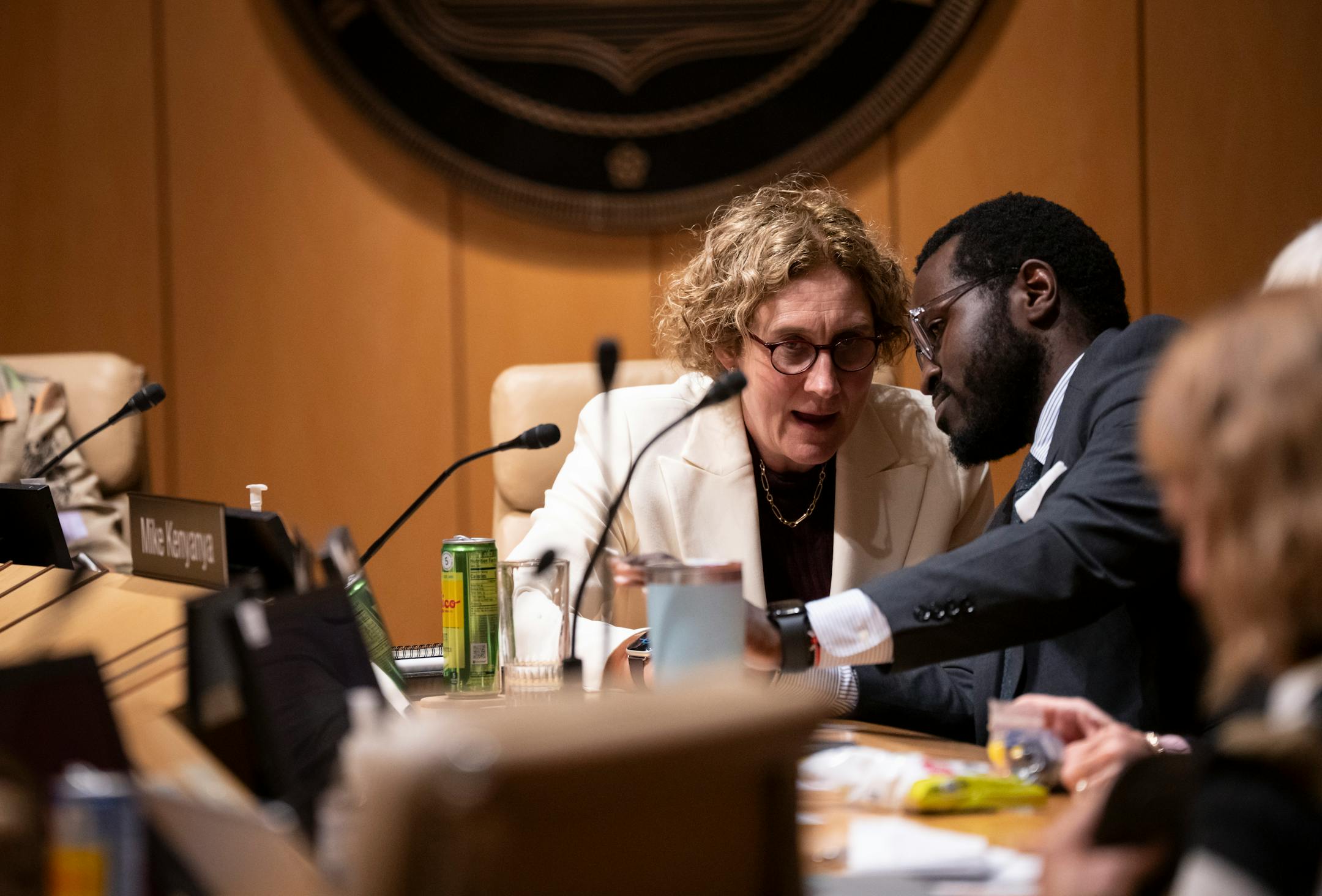
University President Rebecca Cunningham and Regent Co-Vice Chair Mike Kenyanya chat after a public forum in June about budget cuts and tuition hikes. (Renée Jones Schneider/The Minnesota Star Tribune)

Perry Leo, an aerospace engineering mechanics professor who worked with Cunningham on a Faculty Senate committee, said she’s direct, easy to talk to and eager to get things done.

“She came in, I think, as a change agent,” he said. “[She] sees the university as a place that is positioned to be better and hasn’t maybe made the decisions to become better.”

Cunningham said she’s held numerous faculty forums to gather input and believes in collaborating to make decisions.

She said she’s spent a lot of time over the last year listening to alumni, legislators and people involved with health care across Minnesota. She said she’s proud of her work on a strategic plan that will be unveiled this fall.

The Board of Regents, the governing body that oversees the U, has largely supported Cunningham. In June, it approved a 4% raise, bringing her pay to more than $1 million, with $120,000 in retirement contributions.

Regent Doug Huebsch said he “wholeheartedly supports” a June performance review that found Cunningham has “risen to meet the tremendous challenges confronting the University of Minnesota.”

The performance review committee concluded that Cunningham has been outstanding and led with “vision and decisiveness.” She also has brought a “fresh perspective and innovative approach” to discussions about the U’s clinical partnerships, the review noted.

Jacob Richter, a member of the U’s Undergraduate Student Government who graduated this year, said he wants to see Cunningham involve students in more decisions and “open and honest dialogue.”

“Students are the fuel of universities, but the president has not always made it clear that our voices are valuable,” he said.

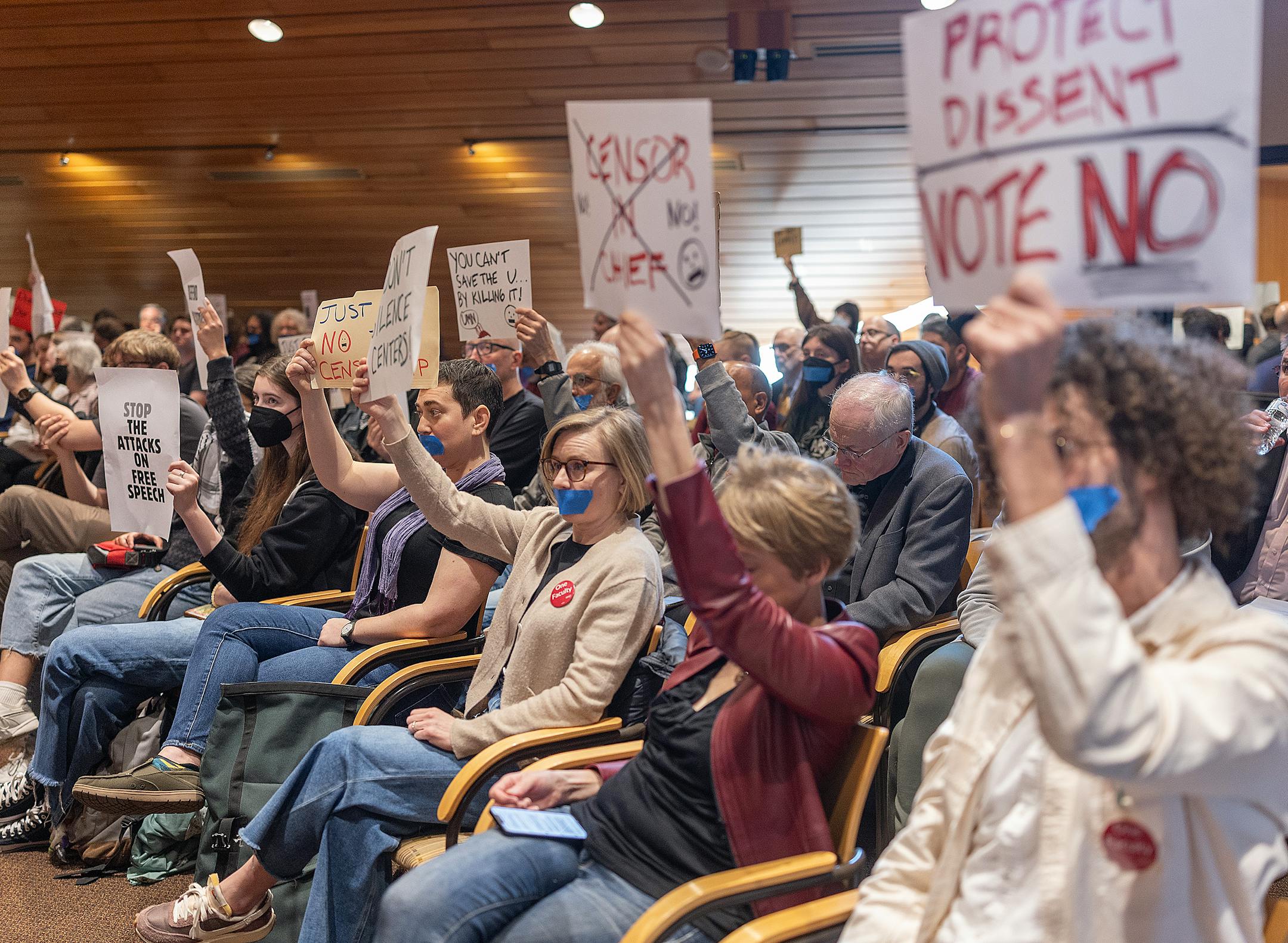
Faculty and students filled the University of Minnesota Board of Regents meeting in March to protest an institutional speech resolution. (Elizabeth Flores/The Minnesota Star Tribune)

Leo said she’s “less patient” than others in academia, “but that’s not a bad thing, in and of itself.”

Nate Mills, an English professor, said the administration’s impatience has led to strained relationships. They see faculty’s disagreement with policies as a problem rather than a chance for discussion, he said.

“Of the presidents I have seen at the U (only four), Cunningham has the most authoritarian style of leadership,” Howard Louthan, a history professor, added in an email.

U controversy

In January, Cunningham announced a proposed merger between Fairview and Duluth-based Essentia Health. The proposal would have created a new statewide nonprofit run by Essentia, but Fairview officials opposed it.

Fairview has said it won’t renew its arrangement with the U, leaving the university without a health system partner after 2026 if no deal is reached. The state attorney general’s office intervened and chose a facilitator.

McMillan, the former regent, praised Cunningham for “tackling it head-on.” But Dr. Beth Thielen, a pediatrics professor at the U’s medical school, said “there’s been a high level of anxiety and uncertainty” about the hospital’s future. She wants more small-group discussions about plans.

“We have lots of ideas and we’re negotiating about them right now,” Cunningham said about the confidential process.

Faculty had mixed reactions to Cunningham’s response after the Trump administration cut research funding at universities. Some said her communication was limited, or they were frustrated not to get a response to their emails. Others said she handled it well. The U has lost $22 million in grants; that number climbs to $34 million if future funds are counted.

Then in March, more than 100 faculty and staff packed a Board of Regents meeting, opposing the institutional speech resolution the regents passed that clamped down on public statements from departments or schools. The decision followed concerns from state lawmakers about U groups supporting the Palestinians in 2023. Some faculty said the resolution curtails academic freedom and speech.

The resolution “limits us even to do things like having a program in evolutionary biology,” said Jerry Cohen, a horticulture science professor, adding that departments now have to ask for permission to share a public position on it. “That’s crazy. Any constraint on academic freedom has a chilling effect on down the line.”

After it was passed, administrators removed references to the Hamas-Israel conflict and the Ukraine war from the U’s website. Cunningham will update the board on the resolution in October.

“I want you to know I, and the University of Minnesota and the Board of Regents expressed as well, an unwavering support for free expression on our campuses,” Cunningham said in an interview.

Some faculty said the board should’ve used recommendations from the University Senate in 2024 to craft their resolution, which would have allowed some groups to make public statements.

Logan Spector, a professor and the division director of pediatric epidemiology and clinical research, said he thought the resolution was wise because the Trump administration is targeting institutions believed to be too accommodating of pro-Palestinian views.

In the spring, Rachel Hardeman, the founding director of the U’s Center for Antiracism Research for Health Equity who was once named to Time magazine’s list of the 100 most influential people, announced her resignation as plagiarism allegations surfaced.

She denied the allegations and said a U investigation found no wrongdoing. The center later closed.

Cunningham said the Hardeman case was handled through the appropriate administrative policies. But Cohen said the issue “was handled poorly and certainly not transparent.”

Also in the spring, the federal government terminated a mechanical engineering professor’s grant worth more than $2 million, alleging he fabricated the project’s results and data. A Department of Energy letter said Sayan Biswas admitted to falsifying data, but his lawyer said that wasn’t true and he used acceptable computer simulations.

Increasing tuition

In June, the regents approved a new budget, hiking tuition 6.5% for most students and cutting academic programs by 7%. The decision spurred outcry from students and faculty, who worried about affording tuition and accused the U of spending too much on administrators.

Richter, the U graduate, called the tuition increases “staggering.”

Thielen said she was concerned about cuts to multiple colleges, including at her medical school, along with tuition increases. The changes came “while carving out large line items for presidential discretion,” she added.

Some criticized the budget for allotting $15 million for the strategic plan and $60 million for “strategic initiatives.” The budget also included a total raise of 4% for faculty and staff, though most increases are merit-based.

Cunningham defended the budget, saying the Legislature’s funding of the U was flat and the “decade-long trend of diminishing support from the state” is real.

In the ’70s, the state covered 45% of all university costs — it now funds 14%.

“I want folks to know that I’m taking a fiscally prudent course ... so that we continue a strong university and emerge from this time even stronger,” she said.

Cunningham said she’s committed to keeping costs low for families, noting that tuition at the Twin Cities campus is 7% lower than it was 10 years ago when adjusted for inflation. The U has a 95% career placement for graduates and great retention rates, and half of its students leave with no loans, she said.

She said she’s felt well-prepared to be president, having come from a “big, public research university with all the same issues and challenges that we have here.”

“It’s been a great year,” Cunningham said, “and I’m looking forward to many more.”

about the writer

about the writer

Erin Adler

Reporter

Erin Adler is a news reporter covering higher education in Minnesota. She previously covered south metro suburban news, K-12 education and Carver County for the Minnesota Star Tribune.

See Moreicon