Can Jacob Frey triumph over his critics one more time?

Five years after George Floyd’s killing, Minneapolis’ two-term mayor is trying to convince voters that the city is finally on the upswing.

The Minnesota Star Tribune
October 24, 2025 at 11:00AM
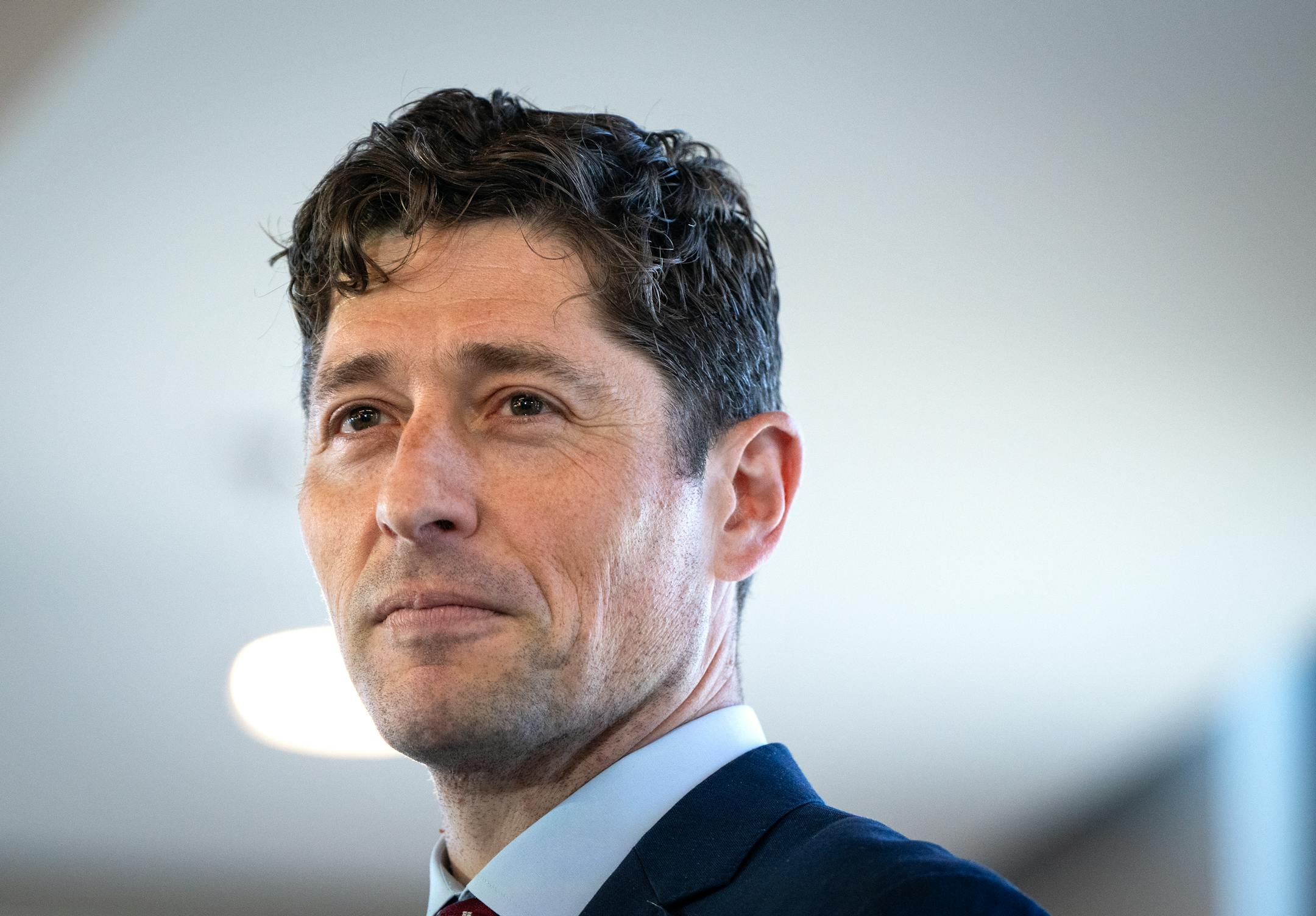
Minneapolis Mayor Jacob Frey delivers his State of the City Address at the Abyssinia Event Center in Minneapolis on May 6. (Leila Navidi/The Minnesota Star Tribune)

On a perfect weekend in late September, Minneapolis Mayor Jacob Frey glad-handed at neighborhood fall festivals and community events, mingled in backyard meet-and-greets, and even stole a chance to spin his daughter and other youngsters on a merry-go-round in a city park. He hit every quadrant of the city.

And no one heckled him.

It wasn’t always this way. Five years ago, just days after George Floyd was murdered by police, thousands of protesters marched through the streets — straight to Frey’s doorstep.

Gathering in front of his apartment in northeast Minneapolis, they demanded that Frey come outside and tell them whether he would support defunding the police.

His response, captured for the world on social media, was uncharacteristically blunt: “I do not support the full abolition of the police department,” he said, an answer that prompted the throng to jeer and shout him down.

“Go home, Jacob, go home!” they shouted. “Shame!”

It was a moment Frey thought might end his political career. Instead, it defined it, in ways that are still reverberating.

Some progressives saw it as a shameful display by a politician lacking the courage to confront the city’s discriminatory history of policing. Others saw it as a welcome and necessary pushback, a bulwark against a leftward lurch they feared was going too far.
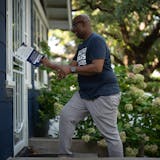
“That moment, which at the time was very embarrassing, we now use in our campaign,” Frey said.

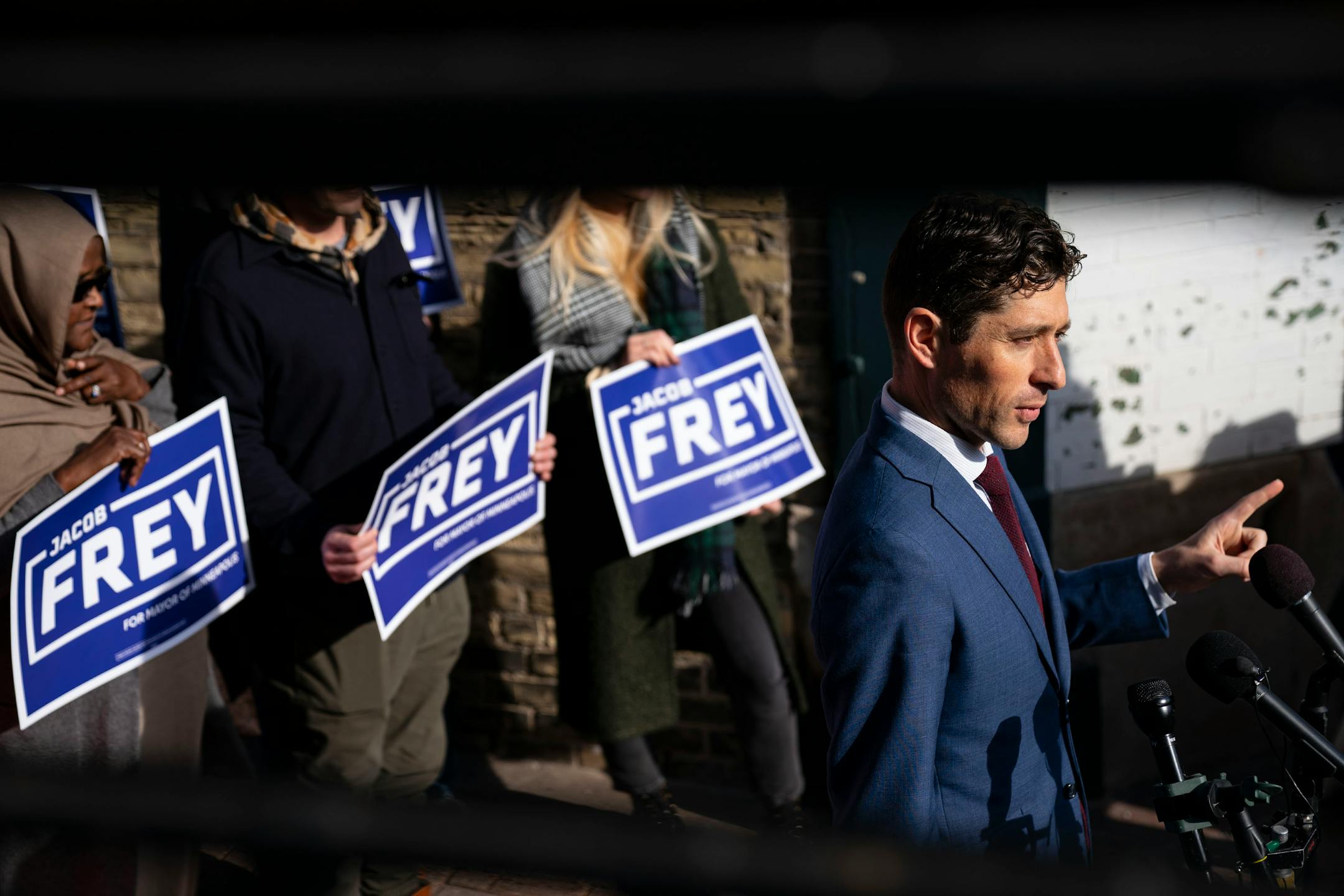
Incumbent Minneapolis Mayor Jacob Frey holds a news conference after being declared the winner of the 2021 election on Nov. 3, 2021, outside Loring Corners in Minneapolis. (Alex Kormann/The Minnesota Star Tribune)

The next year, not only did Frey easily win re-election, voters also approved a ballot measure giving him more power.

As he campaigns for a third term, that polarized view of Frey is once again in play. Facing challengers who have energized the most left-leaning wing of the city electorate, Frey is trying to convince voters that the city has moved beyond its pandemic-era turmoil onto an upward trajectory — and that he’s the man to keep it going.

A promise to reform police

On a recent Saturday morning, Frey’s 5-year-old daughter, the wide-eyed Frida, who looks just like her mom, is ignoring the mayor’s demand that she get ready for dance class in their spacious apartment above the street where that protest played out five years ago.

Frida often tags along with Frey to events and makes frequent appearances on his social media. She said she wants to be a mayor some day — much to the chagrin of her mother — and sometimes stands on a metal fire escape outside their apartment and gives speeches to the surrounding apartment buildings.

Frida was recently joined by a baby sister, Estelle, who looks like her dad and has jet-black hair that sticks straight up like a mohawk, no matter what her parents do to tame it.

After the trauma of the pandemic and post-Floyd challenges, Frey and his wife, attorney Sarah Clarke, waited a couple of years to decide whether to have another child.

“It took us a little while to recover,” Frey said when announcing the pregnancy earlier this year.

Minneapolis Mayor Jacob Frey makes breakfast for his 5-year-old daughter, Frida, before her dance class while holding his infant daughter, Estelle, at their home in Minneapolis on Sept. 27. (Jaida Grey Eagle)

The same could be said for the city he leads.

Frey was elected mayor in 2017 in the aftermath of two fatal police shootings, running on a promise to reform the police department.

Two years in, Floyd was killed by police, and the relationship between the community and police hit bottom.

The next year, in the run-up to the city’s 2021 election, progressives gathered enough signatures to ask voters to overhaul the police department and replace it with a new public safety department.

Frey, who was running for his second term, already had sole authority over the MPD, but in the face of the ballot measure, he doubled down. He vigorously opposed the public safety initiative while advocating for still another ballot measure that would give him more control over City Hall.

It paid off: The police measure lost and Frey cruised to re-election, armed with more control over the city than ever.

He began his second term again promising police reform.

Just a month later, a SWAT team broke into a downtown apartment and killed 22-year-old Amir Locke while executing a no-knock warrant — the kind Frey claimed to have banned while campaigning. In truth, police were still barging into homes without knocking in some cases.

Frey acknowledged the error, saying he needed to regain the public’s trust.

“I’m the mayor of Minneapolis,” he said. “I’m responsible.”

Both the Minnesota Department of Human Rights and the U.S. Department of Justice had launched investigations into the MPD following Floyd’s killing. Both concluded that the department had a record of discriminating against Black and Native American people as well as a long history of unjustifiable use of deadly force.

The feds ordered reforms, which would later be abandoned by the Trump administration. But the state still has a court-enforceable agreement requiring Minneapolis to address some of the department’s longstanding problems.

Frey argues that the city has made progress on reforming the MPD — creating a more diverse department with new recruitment approaches that have resulted in the largest graduating class of new officers in years, while retaining those who stayed with a big pay raise and retention bonuses.

To Frey’s critics, though, the pace of police reform has been glacial.

In August, residents and activists packed a meeting held by police overseeing the changes mandated by the city’s agreement with the state Department of Human Rights.

“It just seems like a bureaucracy,” north Minneapolis resident Angela Williams said at the meeting. “It’s a vicious circle and the community needs some answers. It seems like it has taken years for you all to give it to us.”

She also questioned why training for new use-of-force policies had not already gone into effect. “How do you not enforce something that the community is demanding you to enforce?” Williams said. “It’s egregious in the Black communities.”

In addition to balancing crime-fighting and police reform, Frey was forced to respond to a spike in homelessness during the pandemic.

When Frey first ran for mayor in 2017, he vowed to end homelessness in five years. This year, police began more vigorously clearing encampments, and the city says there has been a 33% decrease in unsheltered homelessness compared with last year.

But comprehensive data on homelessness is hard to come by, and advocates say the city has merely pushed the problem into the shadows. The progressive majority on the City Council, as well as Frey’s most prominent challenger, state Sen. Omar Fateh, have criticized his policies as inhumane.

Frey has also pushed to add more low-cost housing, and the city has seen success on that front. Since 2018, Minneapolis has spent more than $400 million on affordable housing and homelessness prevention, and between 2018 and 2022 the annual average number of new affordable rental residential units financed nearly tripled.

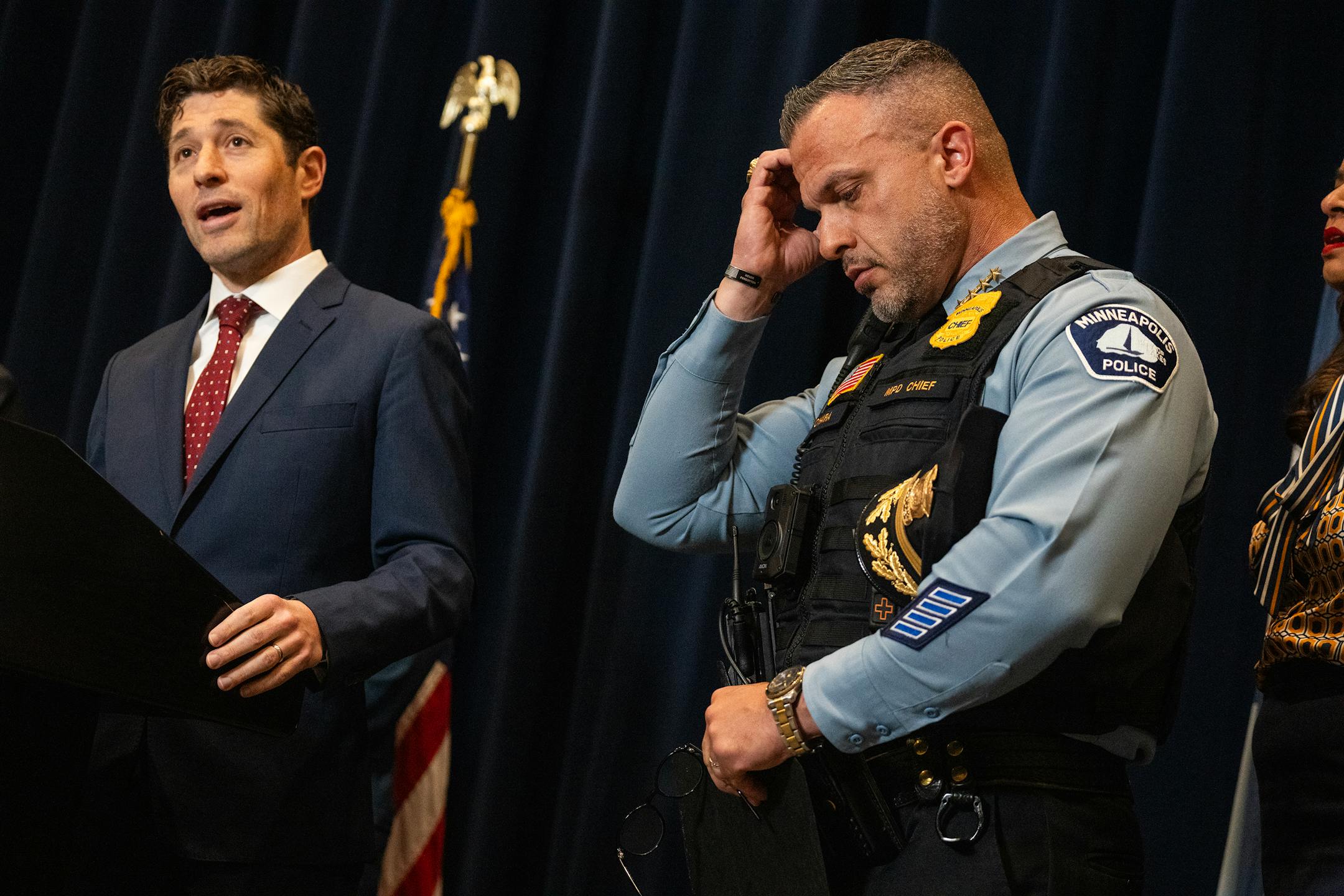
Minneapolis Mayor Jacob Frey and Police Chief Brian O’Hara address the dismissal of the federal consent decree in Minneapolis on May 21. (Richard Tsong-Taatarii/The Minnesota Star Tribune)

Shootings stun south Minneapolis

But in August, the city was shattered by four mass shootings in three weeks, including the Aug. 27 shooting at Annunciation Catholic Church, where two children were killed and 28 people were injured.

At a news conference following the Annunciation shootings, Frey found himself in front of a wall of national media cameras.

“Don’t just say this is about thoughts and prayers right now,” he said to the cameras. “These kids were literally praying. It was the first week of school. They were in a church.”

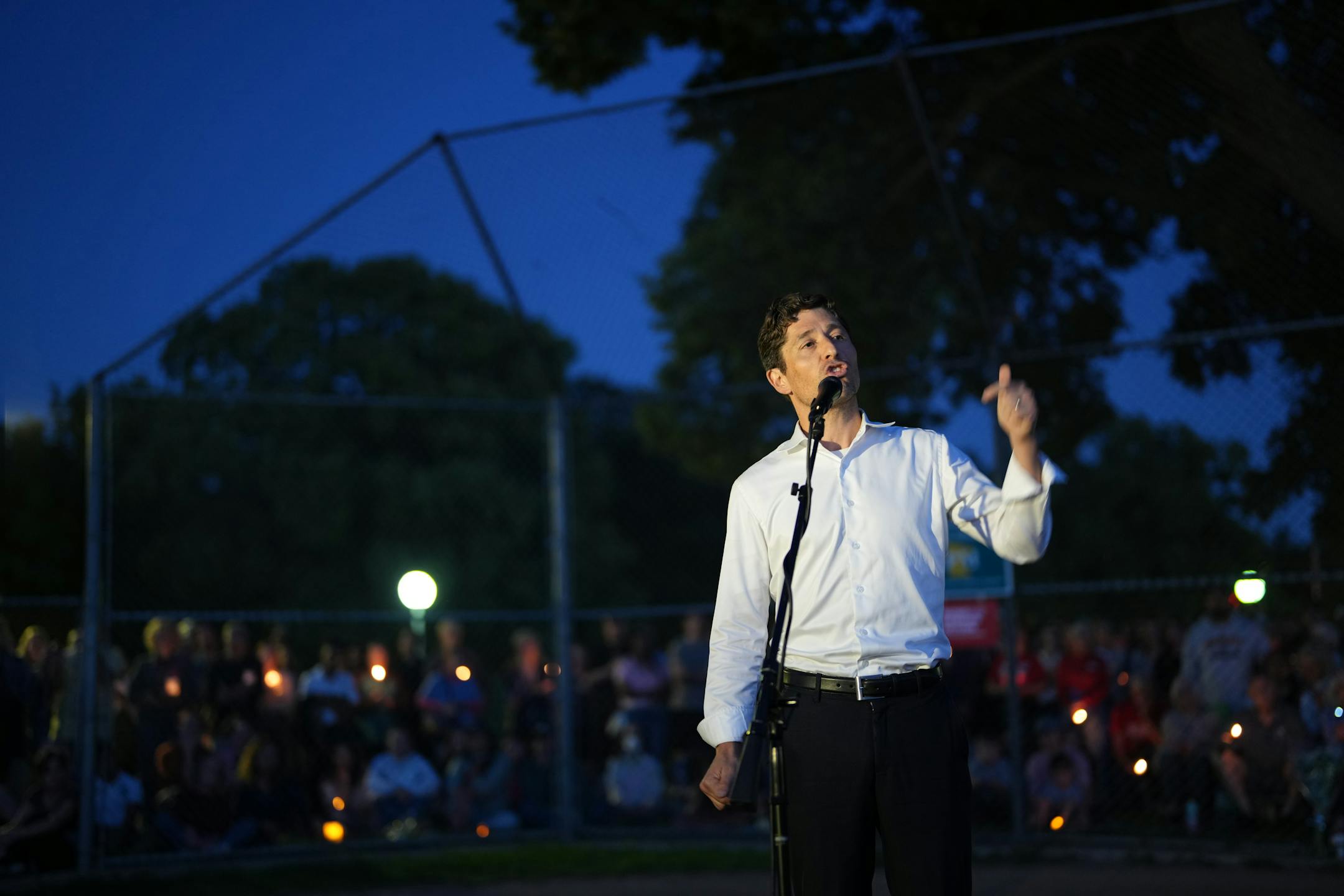
Mayor Jacob Frey speaks as community members gather at Lynnhurst Park in Minneapolis for a candlelight vigil to honor the victims and survivors of the shooting at Annunciation Catholic Church in Minneapolis on Aug. 27. Earlier that day, two children were fatally shot and 28 people were wounded when a shooter opened fire on an all-school Mass. (Jeff Wheeler/The Minnesota Star Tribune)

Frey was blasted by right-wing commentators for his remarks, but didn’t retreat, and instead chose to use the moment to push state lawmakers to enact or allow cities to pass more gun regulations.

While Frey’s Annunciation response was heartfelt, it also provided a contrast to how he sometimes appeared in the hours and days after the Floyd killing.

Former MPD commander Giovanni Veliz said he thought Frey looked like a leader after the Annunciation shooting, and a photo of Frey sitting on the steps of the church’s school, hands folded as if in prayer or exasperation, still resonates with him.

Having fun being Jacob Frey

Before embarking on a half-dozen events on a recent Saturday, Frey and his family took his parents to lunch at a Ukrainian restaurant. Jamie and Chris Frey recently moved to Minneapolis after retiring and closing their chiropractic office at the end of 2024.

Frey, 44, grew up in the northern Virginia city of Oakton, a suburb of Washington, D.C., and just a few miles from where Fateh grew up. (Fateh’s and Frey’s wives recently gave birth to babies 10 days apart.)

After lunch, Frey took Frida along to a community event at North Commons Park in north Minneapolis. When they arrived, he told Frida to wait awhile before going to a playground about a half a block across the park.

But Frida bolted over to the playground while Frey worked the sparse crowd. His bodyguard and driver kept one eye on Frida but stuck by the mayor, who seemed to know everybody.

Frey ran into Mike Tate, a longtime youth football coach in north Minneapolis, who praised the mayor for delivering on a promise to bring a $45 million overhaul to the park. Tate reminded Frey how he used to say, “I want our kids to play together” there some day.

At that very moment, Frida was playing with the daughters of Anndrea Young, a Ward 5 City Council candidate. Eventually, Frey joined them and pushed all three on a merry-go-round until one of Young’s daughters fell off while trying to get off.

That afternoon, Frey swung by Karmel Plaza, a south Minneapolis mall where hundreds of Somali Americans run shops and restaurants.

At one point, Frey, who speaks a little Somali, albeit poorly, saw a gaggle of Somali men about to dig into a bowl of rice, goat meat and bananas. When they invited him to join, he didn’t hesitate to sit down and dive into the communal plate with his fingers.

As much as it was a typical round of campaigning, it was also a reminder of how much had changed in five years, for the city, and for Frey, who was clearly having fun.

About a year ago, Frey was given a big, framed photo of that moment of confrontation from 2020 outside his home. Showing him surrounded by protesters, the picture seems like an artifact from another era.

Rather than hang it on his wall, he put it in his closet.

about the writer

about the writer

Deena Winter

Reporter

Deena Winter is Minneapolis City Hall reporter for the Star Tribune.

See Moreicon

More from Minneapolis

See More
card image
Richard Tsong-Taatarii/The Minnesota Star Tribune

Girl said she was walking to a gas station late at night when a stranger grabbed her, according to prosecutors.

card image