
Minneapolis residents question pace of police reform, training

During a public forum, some residents questioned the pace of how changes will be implemented.

The Minnesota Star Tribune
August 13, 2025 at 10:36PM
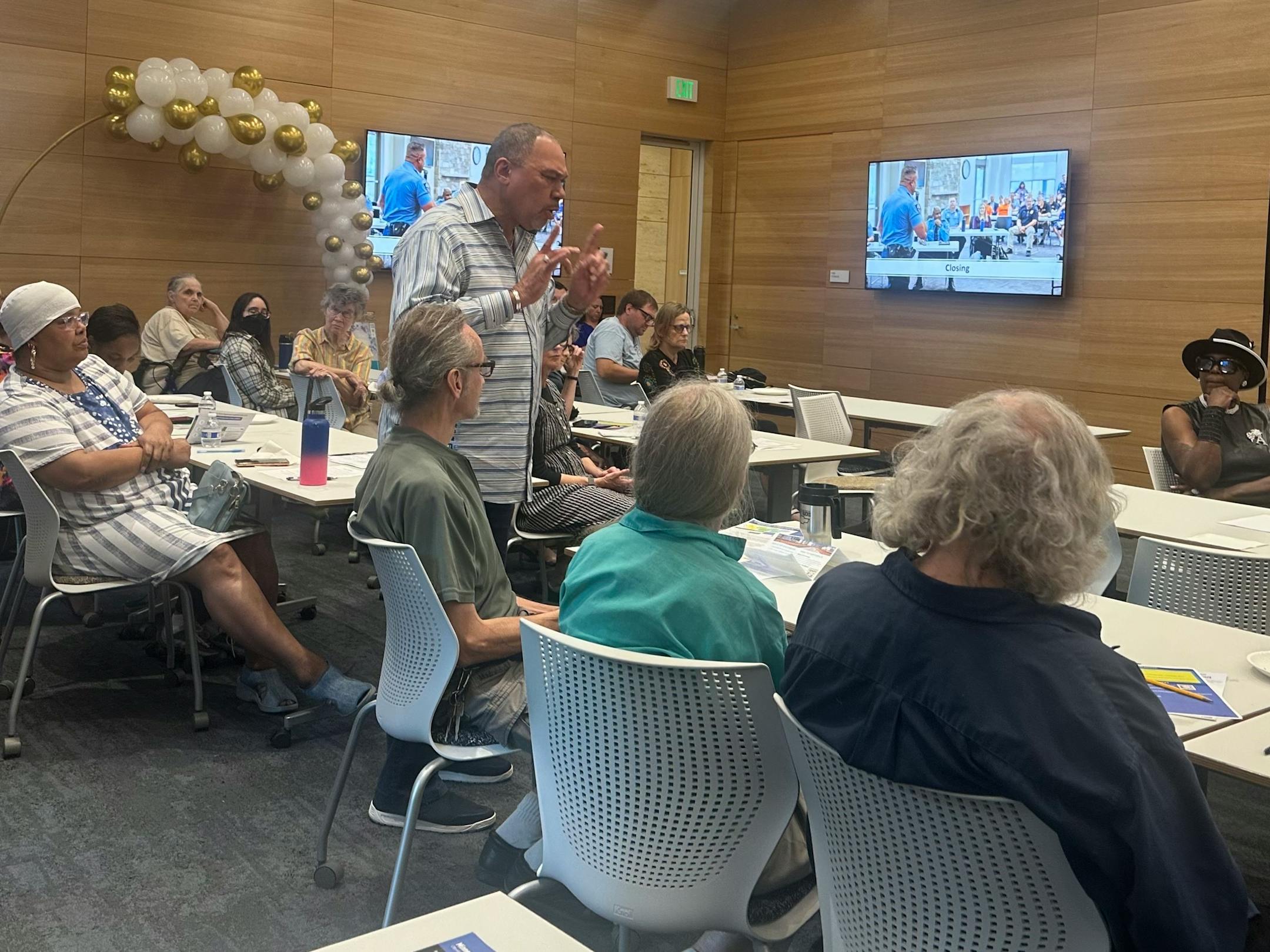
The Rev. Ian Bethel of New Beginnings Baptist Tabernacle in south Minneapolis speaks at a community engagement follow-up meeting for Minneapolis police reform efforts. (Louis Krauss/The Minnesota Star Tribune)

A packed room of activists and residents questioned the pace of Minneapolis police use-of-force training during an outreach event Tuesday, where a commander laid out the city’s progress towards implementing state-mandated reforms.

The gathering in downtown Minneapolis was led by Minneapolis Police Cmdr. Yolanda Wilks, who oversees the department’s implementation unit responsible for enacting the reforms required by the Minnesota Department of Human Rights (MDHR) settlement agreement. The city has said it will follow through with implementing similar reforms in the U.S. Department of Justice Consent Decree although President Donald Trump’s Justice Department dismissed it last May. However, the MDHR agreement remains intact.

Following the murder of George Floyd in 2020, the Minnesota Department of Human Rights and the U.S. Department of Justice investigated Minneapolis police and found over a decade of civil rights abuses, particularly against Black and Native American residents.

Wilks detailed how the 24-person civilian and sworn officer unit tasked with enacting the reforms has progressed from feedback gained from 2023 community engagement sessions, to the approval of some proposed policies.

A report released earlier this year by the nonprofit Effective Law Enforcement For All (ELEFA) showed Minneapolis police made progress toward reforms by the state-ordered settlement agreement in its first year, such as reductions in the backlog of use-of-force and police misconduct cases and in crafting new policies, including regarding use of force.

Policies approved by ELEFA so far include use-of-force, the department’s mission, vision, values and goals, non-discriminatory policing, emergency medical response and critical decision making, and crisis intervention, Wilks said.

So far this year the department has been training officers in use-of-force policies, which Wilks said takes multiple days for each officer. The department is tentatively set to complete the use-of-force training by October, Wilks said.

North Minneapolis resident Angela Williams said she’s frustrated by a process that strikes her as moving too slowly.

“It just seems like a bureaucracy ... It’s a vicious circle and the community needs some answers,” she said at the meeting. “It seems like it has taken years for you all to give it to us.”

She also questioned why training for the new use-of-force policies have not already gone into effect.

“How do you not enforce something that the community is demanding you to enforce?” Williams said. “It’s egregious in the Black communities.”

Wilks explained earlier in the presentation that it takes a significant amount of time and resources to train every officer in the comprehensive new policies, and that all officers must first complete training before it goes into effect.

“There’s a lot of work that goes into it — a lot of staffing, a lot of staffing needs, a lot of areas that we know we’ve been learning by trial by fire,” Wilks said. “We’ve just been going through the process and learning of all the needs that we need to complete.”

She noted in response to the concerns that some of the use-of-force changes have already been implemented.

“I understand where you’re coming from,” Wilks said. “The only thing I can say to that is, from our perspective, they want the whole department to go through the training.”

The reassignment of lead use-of-force trainer Sgt. Mark Hanneman also slowed matters, Wilks said, as it took time to find and train a replacement.

Hanneman was the officer who shot and killed Amir Locke in 2022 while serving a no-knock warrant in downtown Minneapolis. Hanneman was removed from the role last month after his appointment drew criticism from many community leaders.

Minneapolis resident James Riley said after the meeting that he wants to know more about how involved Hanneman was with designing the city’s use-of-force training.

“I think that needs to be explained to the public,” Riley said.

Addressing the room, the Rev. Ian Bethel of New Beginnings Baptist Tabernacle in south Minneapolis, said the department needs to put greater emphasis on factoring in community’s input.

“What is missing in our city is that all of us are at the table, because we’re all community,” Bethel said. “We cannot depend on just whoever is the top brass. That’s what changed.”

In one exchange near the end of the meeting, Williams, who is Black, asked Lt. Bryce Robinson, who is white and was assisting with leading the presentation, to discuss how he feels about policing communities of color.

Robinson responded by saying he loves the city and is invested in the change the implementation unit is working towards.

“I’ve been out here for 17 years. I’ve risked my life. I’ve been shot at,” he said. “But I come here every day, just working for this change. I believe in it.”

Employees provided all attendees with handouts explaining the comprehensive policy revision process and gave links for them to get in contact or offer feedback. Updates on the implementation process are available online at minneapolismn.gov/mpd-implementation-updates.

about the writer

about the writer

Louis Krauss

Reporter

Louis Krauss is a general assignment reporter for the Star Tribune.

See Moreicon

More from Minneapolis

See More
card image
Alex Kormann/The Minnesota Star Tribune

The city of Minneapolis struggled for five years after George Floyd’s death to find consensus on a permanent redesign of 38th and Chicago.

card image
card image