
Minneapolis City Council approves plan for George Floyd Square

The city of Minneapolis struggled for five years after George Floyd’s death to find consensus on a permanent redesign of 38th and Chicago.

The Minnesota Star Tribune
December 12, 2025 at 2:34AM
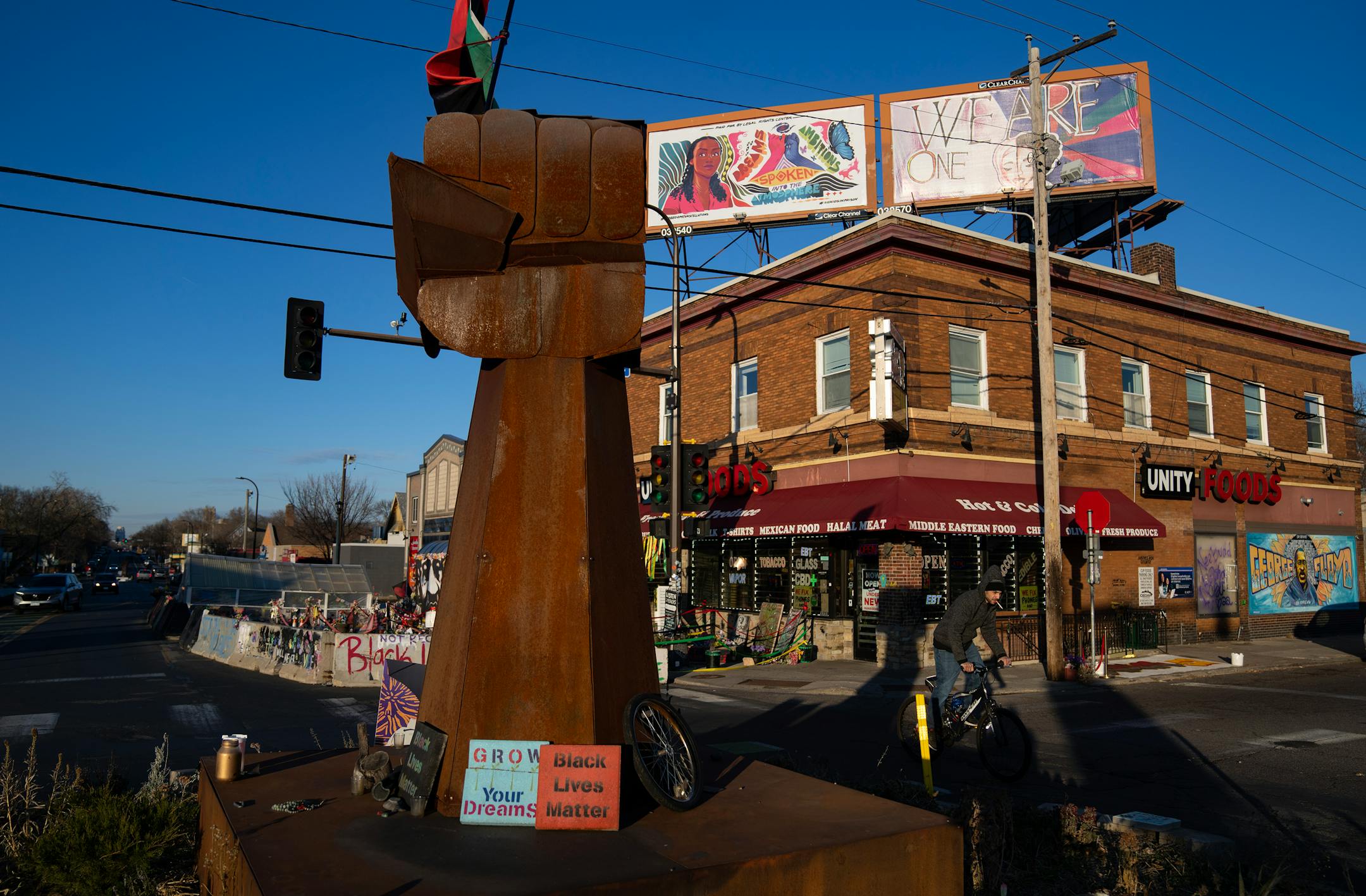
A man bikes through the roundabout at George Floyd Square in Minneapolis in 2023. (Alex Kormann/The Minnesota Star Tribune)

After years of disagreement and millions of dollars spent in the process, a divided Minneapolis City Council approved a plan for George Floyd Square on Thursday.

The layout, supported by Mayor Jacob Frey, will allow vehicle traffic on E. 38th Street and Chicago Avenue, but traffic will not tread on the actual spot where Floyd was murdered by a police officer more than five years ago.

“We can continue to live in the challenges of the past, or we can move forward,” said Council Member Andrea Jenkins, whose district borders the intersection.

Mayor Jacob Frey celebrated immediately following the vote, saying in a statement: “Thousands of voices shaped this plan, and today we turned years of work into real progress.”

Thursday’s 9-4 vote in favor of the plan is a reversal for the council.

A year ago, the council supported a pedestrian plaza that would have excluded most traffic. When Frey vetoed a council action supporting the pedestrian-only plan, the council overrode his veto, 9-4.

On Thursday, five council members who voted to override Frey last year instead voted to support the plan he wanted all along: Council Members Aurin Chowdhury, Katie Cashman, Jamal Osman, Jeremiah Ellison and Emily Koski.

Some council members who voted for the open-flexible plan expressed reluctance in doing so, scolding the city’s approach.

“What there was consensus on is that this neighborhood has been highly disrespected by the city of Minneapolis,” Chowdhury said. “Council has been put in a position where there’s no will or ability for our mayor and this administration to move on any other plan. That’s just the fact of the matter.”

Also voting in favor of the plan Thursday were Council Members Linea Palmisano, Michael Rainville, LaTrisha Vetaw and Andrea Jenkins.

Council President Elliott Payne, Vice President Aisha Chughtai and Council Members Jason Chavez and Robin Wonsley voted against it.

How freely traffic should move through the intersection has been a matter of contention since the day a Minneapolis officer killed Floyd in 2020, igniting global protests against police brutality.

Activists who have continuously occupied the square advocated for a pedestrian plaza. They said creating a gathering space for people and preserving protest art will honor the movement inspired by Floyd’s death.

Some business owners wanted the council to adopt a more free-flowing street plan, saying 38th and Chicago’s association with tragedy has stalled the economic progress of its historic Black business community. They argued the city has waited long enough to chart a path forward for the intersection, which is visibly in disrepair.

The city conducted an extensive public engagement process from 2021 to 2023, concluding after more than $3 million spent that the community supported a flexible-open model allowing for two-way traffic and buses to return to Chicago Avenue.

However, deep-seated disagreement in the community made it difficult to keep marathon community meetings on track, with some activists accusing the city of manufacturing consent for a predetermined plan. They lobbied council members to explore the feasibility of a pedestrian plaza, and in February, the council requested that study after overriding Frey’s veto.

Another $400,000 in taxpayer funds was spent.

According to city staff, construction can begin next year, but construction on a pedestrian mall likely wouldn’t have happened until 2028 because of technical and legal work that still needed to be done. Under state law, owners of properties abutting a proposed pedestrian mall can object and halt its construction.

The street reconstruction is estimated to cost about $11 million.

Adam Hayow, principal project engineer with the city, examined the consequences of closing both lanes of traffic adjacent to 3744 Chicago Ave., the former Speedway gas station turned-protest headquarters now known as the People’s Way, per the council’s instructions.

He reported back last week that large trucks and emergency vehicles, totaling about 20 per week, would still have to drive through the pedestrian plaza. And the Metro D Line — a bus rapid transit connecting Bloomington to Brooklyn Center, would have to be rerouted around George Floyd Square, increasing travel times for 13,000 riders a day.

“The D Line project was partially funded with federal money, and a permanent detour would potentially require payback of federal funds,” he warned about the pedestrian mall concept, adding that keeping personal vehicles out of the mall and cul-de-sac would be an “ongoing operational challenge.”

Council members also heard different ideas from two community organizations last week.

Community proposals

The Community Visioning Council, a group led by the protesters still occupying the intersection, described making the 3700 block of Chicago a one-way southbound street opposite a raised pedestrian plaza where Floyd’s memorial in front of Cup Foods would remain in its current-day footprint. In their plan, the raised-fist sculpture at the center of 38th and Chicago would continue to form a roundabout there with stop signs in each direction. This would have allowed the D Line to return to Chicago Avenue, CVC co-chair Mileesha Smith said.

Unity Community Mediation Team, a group of south Minneapolis residents and business owners, also asked the council to explore a one-way street as a compromise but ultimately approved a plan that would prioritize emergency vehicle access and increase business visibility. They recommended the city create tax abatement and low-interest loan opportunities for struggling shopkeepers.

To the community groups’ suggestion of a one-way street, Minneapolis Public Works Director Tim Sexton said studying the feasibility of that would take months longer and push construction until at least 2027. In a memo, he explained how the ways in which elements of the Community Visioning Council plan aligned with the city’s goals and promised to work with community members to incorporate more of their designs where possible.

The council on Thursday also unanimously approved a position statement to continue to work toward ending systemic racism according to the activists’ demands and to support businesses and annual remembrance events at the square.

about the writer

about the writer

Susan Du

Reporter

Susan Du covers the city of Minneapolis for the Star Tribune.

See Moreicon

More from Minneapolis

See More
card image
Alex Kormann/The Minnesota Star Tribune

The city of Minneapolis struggled for five years after George Floyd’s death to find consensus on a permanent redesign of 38th and Chicago.

card image
card image