

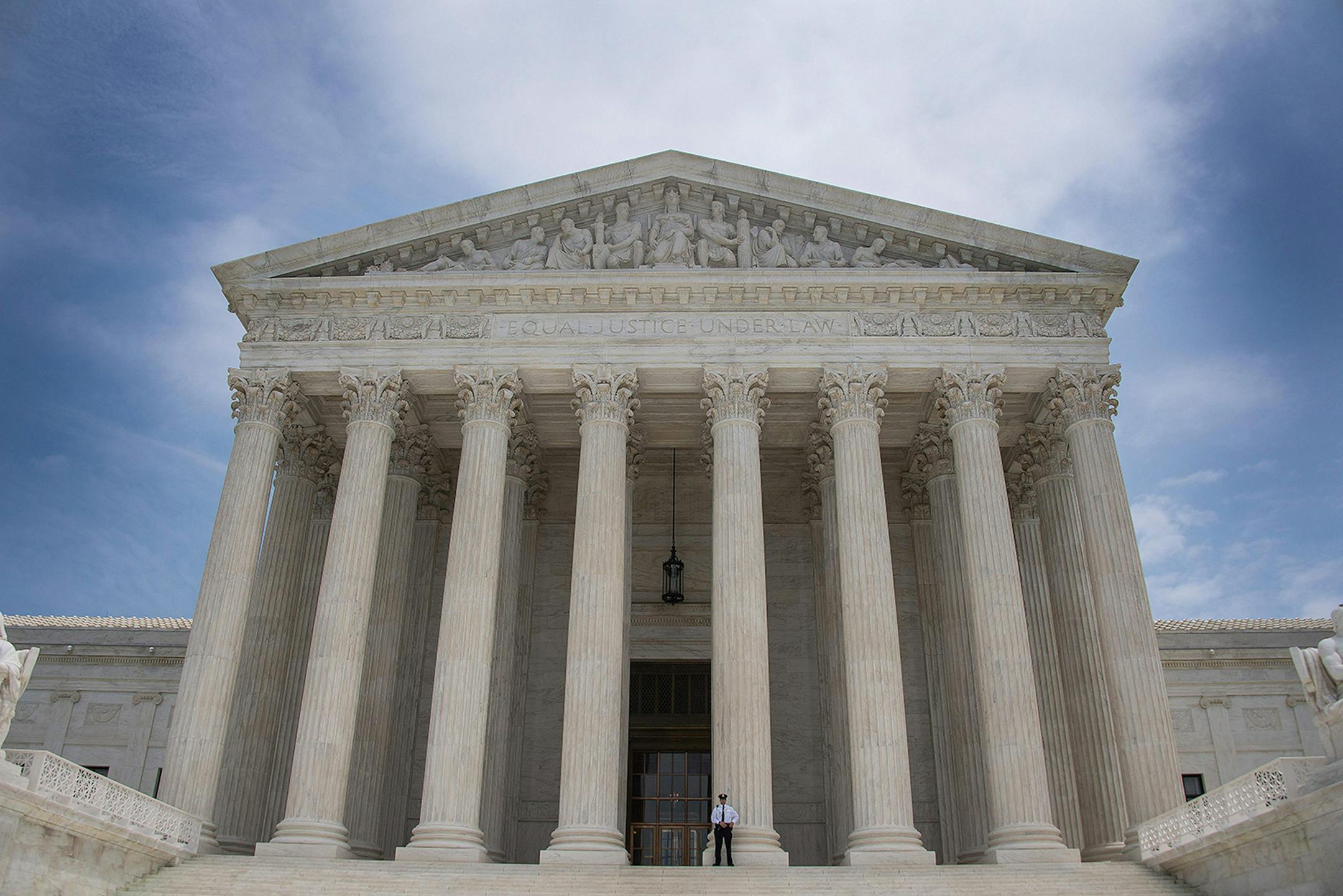
The 2010s will go down in history as a contradictory period at the Supreme Court. The decade featured one liberal decision — the same-sex marriage case, Obergefell v. Hodges — that will be read as long as the justices' opinions are taught in law schools. Yet the decade also saw the emergence of important new libertarian trends in First Amendment law, regarding both free speech and religious liberty, that are widely seen as conservative. And although the court shifted rightward over the last 10 years, that may seem mild compared to the rightward shift we could see in the 2020s.
The marquee marriage equality decision assures Justice Anthony Kennedy, who wrote the decision for the majority and retired in 2018, a place in the judicial firmament. Kennedy had been building the constitutional case for gay rights for nearly twenty years in a series of decisions that brought together two different doctrines: the right to autonomy over crucial life decisions and the right to equal protection under the law. In the 2015 Obergefell decision, Kennedy finally fused the two different ideas together in the principle "equal dignity."
Kennedy's language may have gone a little too far into would-be profundities for some tastes. (Justice Antonin Scalia was particularly dismissive of it; and even I find myself taken aback by Kennedy's suggestion that marriage is the only solution to the problem of existential loneliness.) But no other Supreme Court decision has entered the ritual lexicon by being recited at weddings, both gay and straight. The Obergefell case belongs in the pantheon of all-time important Supreme Court decisions. It expands human liberty and equality.
Even as Kennedy deployed liberty together with equality, another major doctrinal development was driving a wedge between the two sometimes-competing concepts. Increasingly, conservative majorities of the court held that First Amendment freedoms trumped legislation that liberals considered to be aimed at equality.
The best-known free speech decision of the decade, Citizens United v. FEC, started the ball rolling in 2010. Famously, the court held that corporations possess free speech rights — enabling them to evade campaign finance limitations intended to prevent money from tilting the political playing field. There followed a series of increasingly absolutist free speech decisions, leading Justice Elena Kagan, herself long committed to free expression, to warn of a "weaponized First Amendment" that could be used by conservative justices to strike down various progressive laws. Remarkably, the trend is turning free speech, once a liberal objective, into a conservative cause — a development fueled by left-of-center advocacy for speech codes on college campuses.
A parallel shift has taken place regarding the free exercise of religion. Once, liberals favored granting religious minorities exemptions from laws that burdened them. Now liberals have balked at such exemptions while conservatives have come to favor them. The 2014 Hobby Lobby v. Burwell case featured a 5-4 conservative decision favoring exemptions from contraceptive health insurance requirements over liberal insistence on equality. A similar preference for religious liberty over equality almost prevailed in the wedding cake case, 2018's Masterpiece Cakeshop v. Colorado Civil Rights Commission, although Kennedy managed to duck the big issue there days before retiring.
Until Kennedy stepped down, the ideological balance of the court had been largely maintained over the course of the decade. Liberals had replaced liberals, and, with the Senate refusing to consider Barack Obama's nominee to replace the right-wing Scalia, conservatives replaced conservatives. Nonetheless the court did shift: Brett Kavanaugh, who replaced Kennedy, clerked for him, but is to his right.
That has left conservative Chief Justice John Roberts as the swing vote, alternating between hard-line conservative and more moderate positions. More than once he saved the court from what would have been viewed as partisan Republican decisions, such by siding with the court's liberal wing to block the Trump administration from putting a citizenship question on the 2020 census. It was a role he had already occasionally played when Kennedy voted with the conservatives, as in the Affordable Care Act case, where he split the baby, upholding the individual mandate while gutting the Medicare extension.


