Remote policies helped women work. In-office mandates and child care costs are driving them back out.

Low flexibility and high child care costs are pushing mothers with young kids back out after they joined the workforce in record numbers during the pandemic.

The Minnesota Star Tribune
September 13, 2025 at 9:13PM
Emily Wallace runs with her three-year-old daughter outside their home in Minneapolis on Sept. 2. Emily Wallace left the workforce in 2022, when she was pregnant with her first child. (Leila Navidi/The Minnesota Star Tribune)

When Jackie Gabrielson became pregnant with her fourth child, she planned to take maternity leave and then return to work.

But as she and her husband started envisioning life with four young children, “that’s when the reality of it really started to sink in.”

“Not just financially,” said Gabrielson, 33, of St. Cloud, “but also just the flexibility needed.”

So they made a decision: She will quit her professor job at the end of the year, joining the growing ranks of women opting out of the workforce.

The labor participation rate for women with children younger than 5 had the biggest midyear drop in more than 40 years during the first six months of 2025. June’s rate was 67%, according to U.S. Census data analysis by researchers at the University of Kansas.

That decline, the lead researcher said, largely was caused by return-to-office mandates.

Raising kids requires constant adaptation, particularly for women who tend to bear more duties at home regardless of their employment status. The rising cost of childcare, coupled with a reversal of COVID-era flexibility, has complicated mothers’ ability to juggle work and home.

It’s a big shift from the past few years, when women’s labor force participation hit an all-time high and drove the post-2020 economic recovery.

Return-to-office policies are forcing many to make tough decisions about whether working while raising a family is worth it — or even possible.

“I’m excited to spend more time with my kids and just have that flexibility,” Gabrielson said. “I am scared though, too. I never pictured myself as a stay-at-home mom. I never pictured myself not working.”

While workers have been back to some version of in-person work for a while — and many never left — return-to-office mandates were supercharged when President Donald Trump called federal workers back to the office five days a week. Many private employers quickly followed suit.

Major Minnesota employers including 3M, Medtronic, U.S. Bank, General Mills, UnitedHealth Group and Target are calling at least some workers back to the office.

Mothers of young children are more likely than other adults in their prime working years to report teleworking, according to the Brookings Institution.

“When we have this backslide, for me, all that really indicates is that we’re going to be in a society and in a labor market that is less understanding of what women need to thrive in the economy,” said Misty Heggeness, an associate economics and public affairs professor at the University of Kansas.

People make their way around the downtown skyway system early in Minneapolis on March 6. Employers in Minnesota and across the country are calling workers back to the office -- some five days a week -- in a 180-degree shift from the flexibility of the pandemic years. (Elizabeth Flores/The Minnesota Star Tribune)

The limits of flexibility

Lindsay Whipple of Minneapolis gave notice at her job in higher education administration this summer, after years of working full-time to support a growing family while her husband went back to school.

The job allowed Whipple to do what she needed to balance it all: to leave and nurse her infant son when he wouldn’t take a bottle or to use vacation and sick time when she was patching together multiple sources of child care. But there were strings attached.

“There was a lot of flexibility offered to me ... but there were a lot of restrictions, too, and a lot of guilt,” said the 38-year-old.

Now a mother of four, Whipple recently started a part-time job and doesn’t envision going back to 40 hours a week.

“That’s just a grind that seems impossible,” she said.

Bridget Engelbrektson, 38, of Minnetonka, chose a nursing career because of the flexibility it offered. But as her three kids grew, she said, “It became clear that daycare, for one, is a business that requires commitment and ongoing cash flow.”

She and her husband expected it to ease when their oldest started kindergarten, Engelbrektson said. But while the cost was less, the logistics of having their children in different places were more complicated and generally fell on her to manage.

“This is an uphill battle that, at some point, felt not worth fighting anymore,” she said. “And that was difficult for me, because I loved my work, and I still do.”

While Engelbrektson still works the occasional shift, she said, “my job right now is to get these children grown.”

“I was paying literally every dollar to cover those hours somewhere else,” she said.

Child care ‘collapse’

The cost of child care often is a key factor when women decide to stay home with their children.

In Minnesota, it costs $22,569 a year on average to send an infant to daycare — more than in-state tuition for a four-year public college, according to data from the Economic Policy Institute.

“It’s no longer a child care crisis: It’s a child care collapse,” said WomenVenture CEO LeeAnn Rasachak. “And we, as a community, need to create urgency around it if we care about the workforce, if we care about the economics, if we care about childhood development. All of those are vital to the longer-term success of our whole community and our economy.”

Rasachak is among those calling for government subsidies, for both parents and child care providers, to lower costs and boost availability.

Speaking at a Minnesota Women’s Economic Roundtable event in Minneapolis last week, Federal Reserve Bank of Minneapolis President Neel Kashkari compared subsidies for child care to those for agriculture.

“All around the world, countries subsidize agriculture. Why? Because they want high prices for farmers and low prices for consumers,” Kashkari said. “The only way you can achieve higher wages for quality child care workers and affordability for middle class families is through subsidies.”

Neel Kashkari, president of the Federal Reserve Bank of Minneapolis, photographed Sept. 2, 2021. (Anthony Souffle/The Minnesota Star Tribune)

Working, but not employed

Another complication in the child care equation, Kashkari said: Who counts as employed, and who doesn’t.

“If a mom or dad is staying home taking care of a child, they are in the workforce. They’re just not in the measure of the workforce,” Kashkari said. “Parents staying home with their children are not counted, but they are doing very important work for their family and their society.”

Emily Wallace, 40, of St. Anthony Village, decided to leave her job at a mental health therapy clinic when she was pregnant with her first child.

Now a mother of two, she said she feels fortunate to be able to stay home with her kids, but it’s been a big shift. Though Wallace’s choice is becoming more common, she doesn’t have a community of other stay-at-home moms to lean on, as her own mother did. And there’s still stigma.

“When I go to social situations, like parties, people almost never talk to me,” Wallace said. “Because if they know I’m a stay-at-home parent, I think they just feel like, ‘Well, what would I have to talk to you about?’”

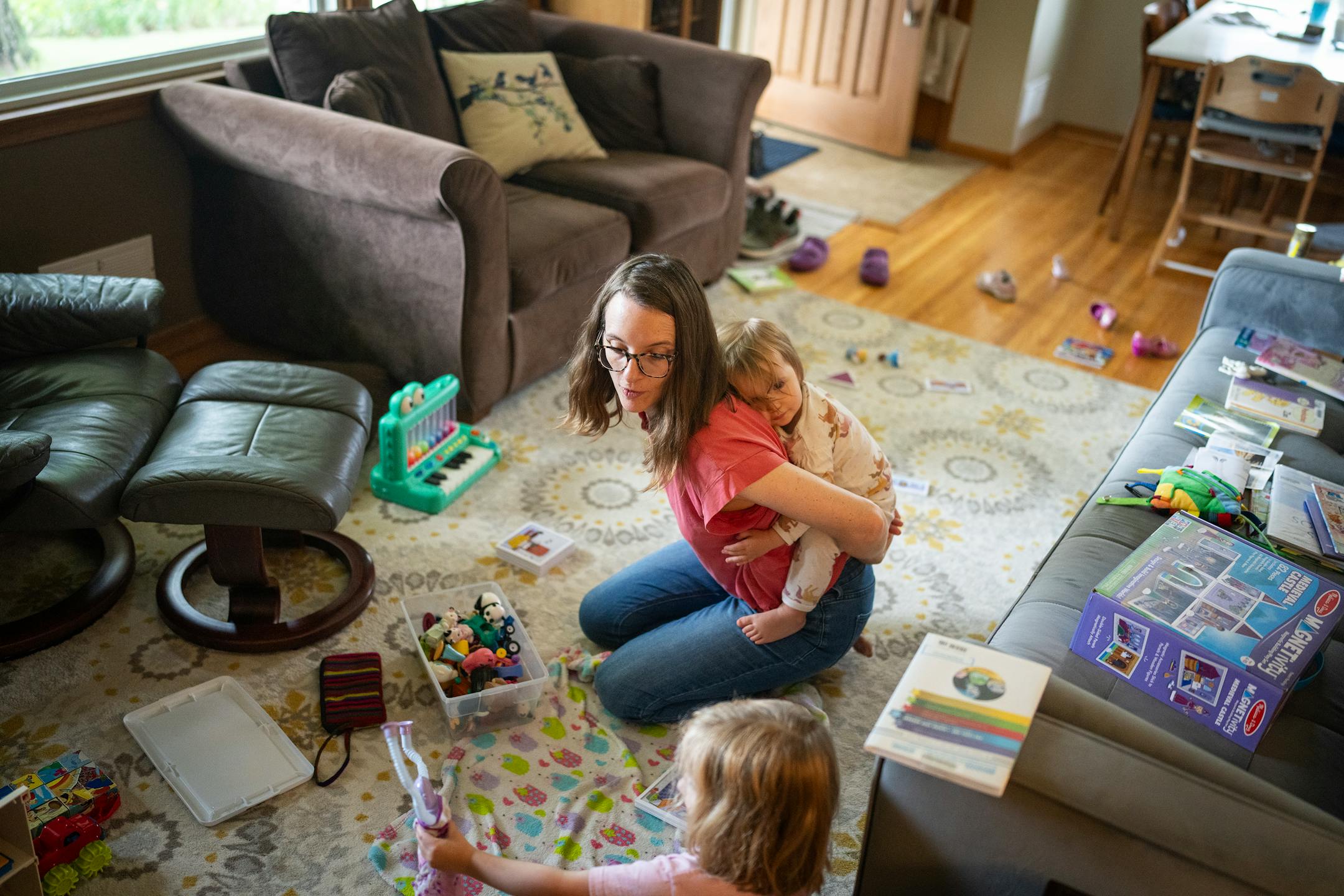
Emily Wallace takes care of her three-year-old and one-year-old daughters at home in Minneapolis on Sept. 2. (Leila Navidi/The Minnesota Star Tribune)

The idea of returning to work is appealing, she said, but she’s not sure when she’ll do it.

Gabrielson, of St. Cloud, feels the same. It’s brought up some anxiety, she said: As a professor, she’s seen first-hand how quickly the job market is changing for her students.

“What is that going to be like in five or 10 years?” she said. “It could be a totally different world.”

about the writer

about the writer

Emma Nelson

Editor

Emma Nelson is a reporter and editor at the Minnesota Star Tribune.

See Moreicon

More from Economy

See More
card image
Mary Altaffer/The Associated Press

There are seven answers in the form of tech companies like Nvidia, Apple and Microsoft. But their outsized impact could spell disaster if the AI bubble bursts.