

Advertisement

ICE drawdown may be too late for small businesses like El Sazon

Operation Metro Surge kept many people of Latino and East African descent home, afraid to go to work or out to shops and restaurants. This caused a drastic drop in revenue for small businesses, which are now seeking aid.

The Minnesota Star Tribune
February 19, 2026 at 12:00PM
Cristian and Karen DeLeon, owners of El Sazon, said they had to shut down some of their restaurants because ICE actions kept customers away and workers at home. Now that the immigration crackdown has slowed down, they fear it's too late to save their business. (Elizabeth Flores/The Minnesota Star Tribune)
Advertisement

Cristian and Karen DeLeon are out of money and ready to file for Chapter 11 bankruptcy for their five El Sazon restaurants unless aid and customers arrive soon.

In December, federal agents started showing up in parking lots at their Minneapolis, Eagan and Stillwater locations, scaring away employees and customers.

Without workers, the DeLeons temporarily shut three of the five locations and now owe $200,000 in back rent, taxes and food vendor bills. They drained savings to pay workers and say they have nothing left.

“We lost everything,” Cristian DeLeon said.

They are among hundreds of Minnesota small business owners — spanning industries from hospitality to manufacturing, farming to construction — in crisis after the protracted federal immigration operation.

The city of Minneapolis estimates that Operation Metro Surge, and the sometimes chaotic and violent scenes that accompanied it, resulted in $200 million in economic damage in January. Of that, small employers like El Sazon account for an estimated $81 million.

As the Department of Homeland Security pledges to largely withdraw the 3,000 agents that descended on state, mostly in the Twin Cities area, businesses are assessing how to move forward. Some are considering permanent closure. Others are trying to cover a big revenue gap or restore a sense of safety so workers can return.

The DeLeons are reopening their El Sazon restaurants, one by one, and have applied for emergency assistance grants through the Latino Economic Development Center (LEDC), Show Up For Eat Street and the Minneapolis Foundation.
Advertisement

Several organizations are fundraising on behalf of small businesses. Gov. Tim Walz said Feb. 12 he wants the state to offer $10 million in small-business assistance loans to those in trouble.

That same day, the Minneapolis Foundation, with the help of 35 corporations, opened applications for affected small businesses to apply for grants up to $10,000. So far, the foundation has raised $4 million.

Distribution of the funds could take weeks, though, and businesses like El Sazon are running out of time.

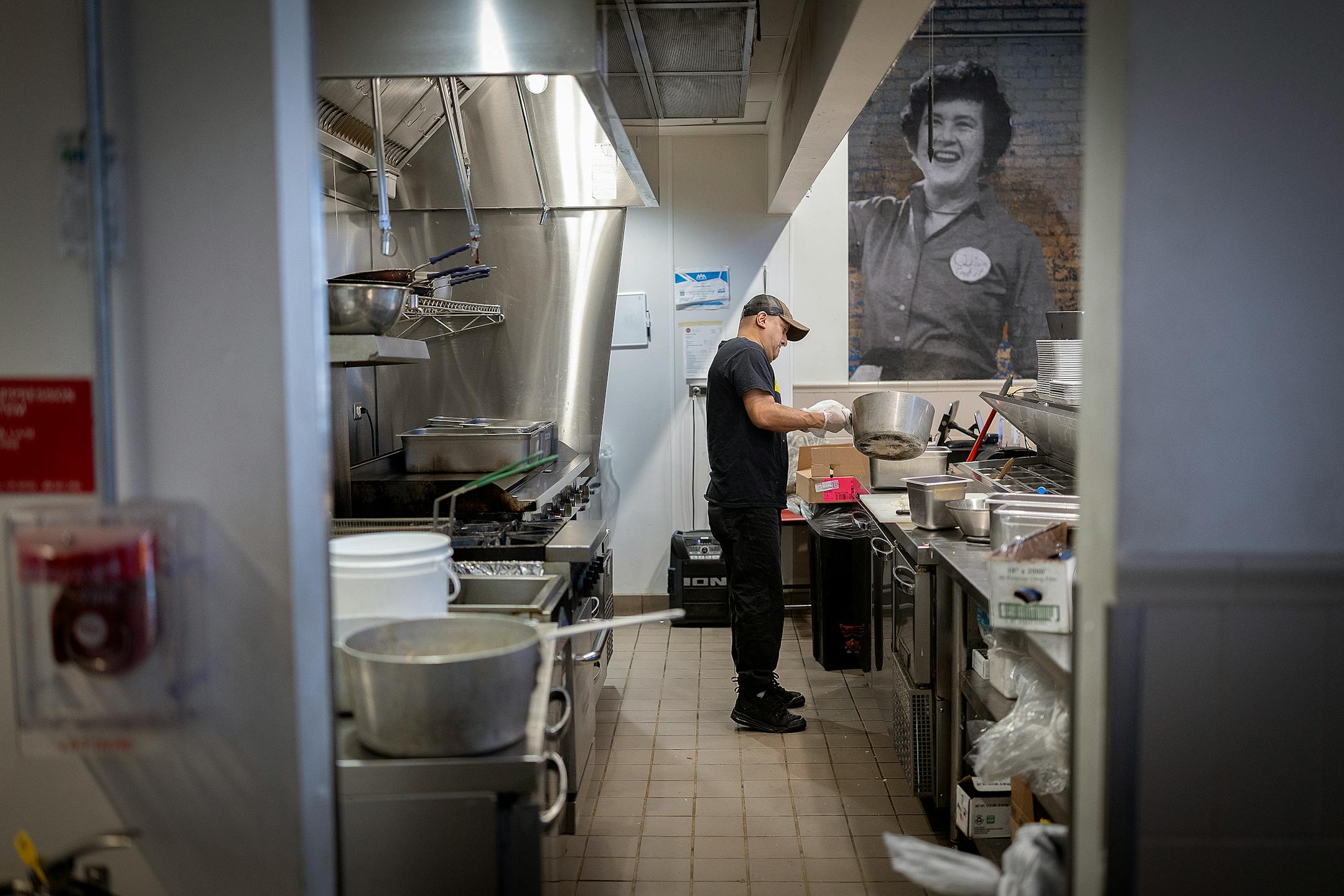
An employee at El Sazon Tacos at Eat Street Crossing prepares for a hoped-for lunch rush on Feb. 16. (Elizabeth Flores/The Minnesota Star Tribune)

Matt Varilek, commissioner of the state Department of Employment and Economic Development, said El Sazon’s story is common.

“Many Minnesota businesses — especially small businesses — are facing economic hardships that may prove insurmountable for some," he said last week. Despite the promised federal drawdown, “we know economic repercussions for small businesses will be ongoing.”

DEED is urging landlords and others to temporarily waive fees and debt payments owed by businesses hurt by the crackdown. Religious, labor and community groups have started rent and food drives for entrepreneurs. It may not be enough, however, to fend off hundreds of permanent business closures and jobs lost.

Advertisement

When Alex Pretti was killed by federal agents Jan. 24 on Eat Street in Minneapolis, it escalated the fear that hung over the area after the nearby killing of Renee Good by an ICE officer two weeks earlier.

The Whittier Alliance is trying to raise $325,000 for 65 Eat Street restaurants between 24th and 29th streets on Nicollet, said Alex West Steinman, CEO of the office co-working firm the Coven. She is helping the Whittier Alliance market its Show Up For Eat Street fundraiser.

The goal is to initially provide each of the nearby businesses with $5,000. As more funds are raised, the grant amount could rise to $20,000.

“We know that’s not enough, so that is meant to be a bridge support” until businesses can obtain other grants, West Steinman said.

Like the Eat Street restaurants, David Bassekle has lost three south Minneapolis contracts since December because his five drywall and roofing subcontractors rely on Latino workers who were afraid to come to work.

Those projects would have brought in $68,000 — which would have netted $20,000 after payroll and supplies.

Advertisement

Now, Bassekle, an immigrant from Togo, is scrambling to find smaller drywall jobs he can do solo.

Bassekle has not yet decided if he will apply for aid. “I just pray things turn back in a good way,” he said.

Hoyo’s frozen sambusa wholesale business on Lake Street, which employs many naturalized U.S. citizens originally from East Africa or the Middle East, is hobbled, with sales down 25% because of the disturbances, said CEO Ghita Worcester.

The 11-year-old food wholesaler, which moved into its new $1.6 million commercial kitchen last summer, hopes to get a business grant from the Minneapolis Foundation, Worcester said.

“It’s useful, but for many businesses, it’s a drop in the bucket,” Worcester said. “One $10,000 grant does not solve that drop in sales. It’s a Band-Aid.”

Still, the money would cover a few months’ rent, which could help them get through this difficult period.

Advertisement

“What we really need are for workers and customers to come back [stronger] than before” — and consistently, Worcester said.

At El Sazon, Cristian DeLeon sees glimmers of hope. While receipts were still down 70% last week at the El Sazon spot a block from where Pretti died, the Lyndale Avenue location was packed as neighbors rushed to show support.

Racing around in the back kitchen and manning a skillet, the former chef of Chino Latino said, “To be honest, we feel proud to live in this state. All the support we have from the people is unbelievable. They make us feel welcome,” even in “these crazy times.”

about the writer

about the writer

Dee DePass

Reporter

Dee DePass is an award-winning business reporter covering Minnesota small businesses for the Minnesota Star Tribune. She previously covered commercial real estate, manufacturing, the economy, workplace issues and banking.

See Moreicon

More from Business

See More
Sleep Number headquarters in downtown Minneapolis. (DAVID JOLES)
The Minnesota Star Tribune

The deal is even bigger than RBC Gateway’s $225 million price, when its 16 floors of new office space sold in 2023. Meanwhile, other downtown office buildings are selling at major discounts.

card image
Advertisement