
Advertisement

U of M report finds Ramsey County restorative youth justice program is working

The “(Re)Imagining Justice for Youth” initiative is providing alternatives to the traditional court route for some youth offenders in order to better address underlying issues and reduce recidivism.

The Minnesota Star Tribune
February 19, 2026 at 5:00PM
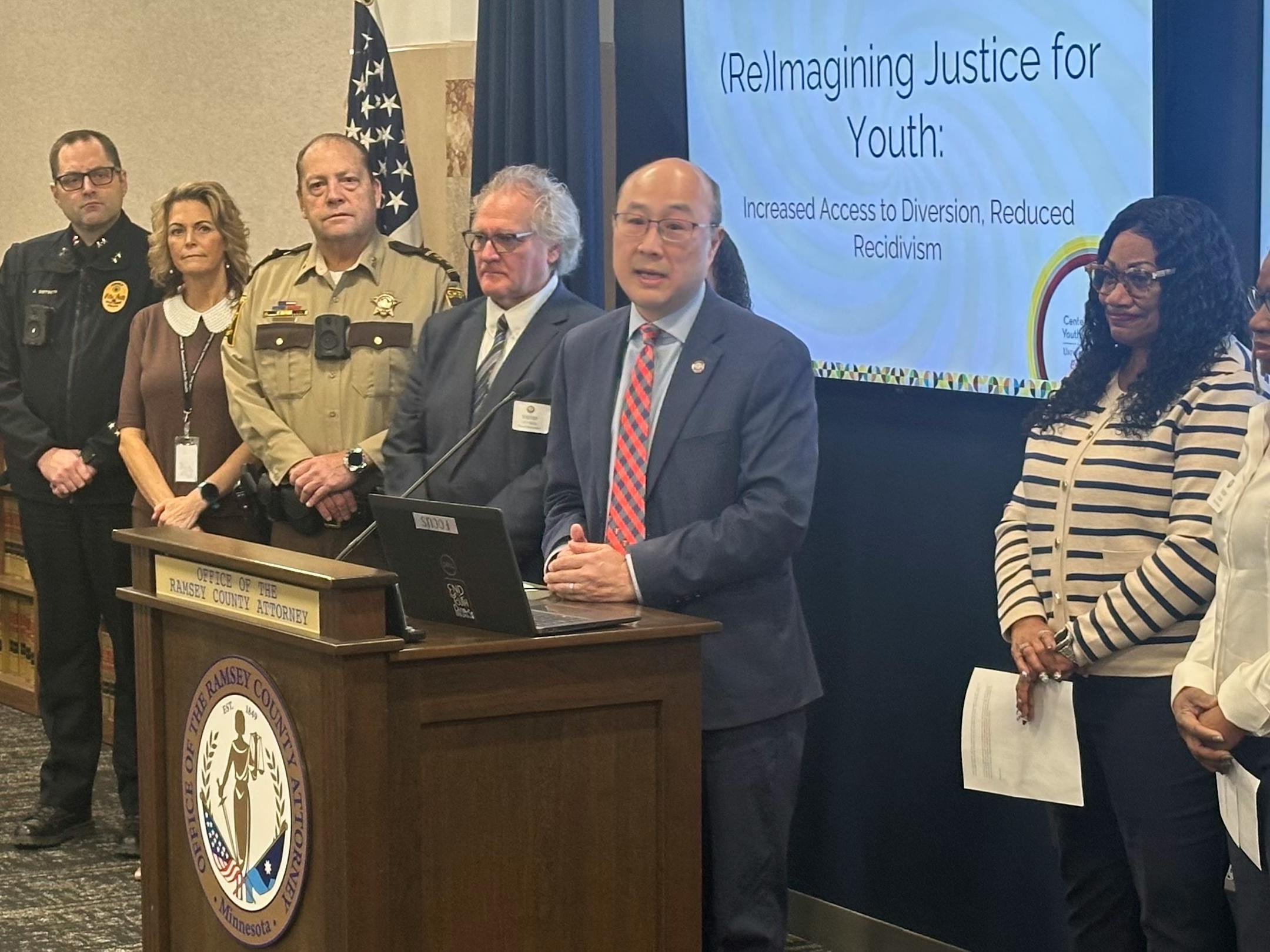
Ramsey County Attorney John Choi discusses the findings of a new report looking at the results of his office's "(Re)Imagining Justice for Youth" initiative since it was implemented in 2021. (Louis Krauss)
Advertisement

Ramsey County’s new approach of offering alternatives to youth entering the criminal justice system is reducing repeat offenses and leading to better long-term outcomes, according to a newly released report.

In July 2021, Ramsey County Attorney John Choi launched the “(Re)Imagining Justice for Youth” initiative, in which Choi’s office works with the public defender’s office, impacted families and service providers to determine if youths who commit a crime would be better served through an alternative path to a traditional juvenile court case.

At a news conference Tuesday, Feb. 17, Choi and a variety of partners presented the results of a University of Minnesota study that compared how children who participated in the new program fared with those who were traditionally prosecuted.

Choi said the new model should be the “new path forward” for prosecutors when it comes to youth criminal justice.

“This is what everybody should be doing, and I think one of the conclusions should be that it would be malpractice to go back to doing something that was producing a lesser result,” Choi said.

In the past, the “vast majority” of youth cases, such as thefts and low-level assaults, would be handled like any other adult prosecution, Choi said, typically leading to a probation period, community service and maybe an apology letter.

Now, a “Collaborative Review Team” reviews youth offenses to determine if the community and affected parties would be better served by the offender going through the new “community accountability” route.

Under the new model, prosecutors work with partners to consider underlying questions about why the child committed the crime and what can be done to prevent recidivism. More serious crimes, such as murder and violent sexual and physical assaults, are typically not eligible for this alternative.

Advertisement

Kara Beckman, a researcher at the University of Minnesota Medical School, said the report’s findings “clearly indicate” the community accountability model outperforms traditional court procedures.

That includes finding a 66% reduced risk of reoffending for children who commit assault, compared to those in similar assault cases who were charged in traditional court.

It also found that just 4% of youth whose first case went through the new initiative reoffended within one year, compared to 29% of those who were prosecuted traditionally.

“Our study is further evidence that turning to each other keeps us more safe than relying on punishment and control,” said Beckman. “As our neighbors have reminded us over the past few months, when we value humanity first, center the wisdom and lived experience of those most impacted and are transparent and honest with data, we can come together to make a difference.”

As part of the program, participants must attend “restorative circle” meetings, where youth offenders sit with victims, peers and trained facilitators to listen and craft agreements to repair the harm caused. Dr. Tamara Mattison, from the company Generation 2 Generation, which assists with the county program, said the restorative circle “builds emotional literacy, strengthens empathy and reinforces accountability.”

“It does not minimize harm. It addresses it directly, but in a way that promotes growth instead of shame,” Mattison said.

Advertisement

Before deciding if a youth is eligible for the initiative, a coordinator calls the youth offender’s family and the victim and their family to gather input, which is then read to the Collaborative Review Team for consideration.

While Choi said this model was met with “a lot” of criticism when it was introduced — which included concerns from Ramsey County Sheriff Bob Fletcher — the Sheriff’s Office and a variety of police agencies attended on Tuesday to show support.

Ramsey County Undersheriff Mike Martin said he and the other police department representatives in attendance Tuesday are “all on board” with the program.

“We appreciate this work,” he said. “I don’t have all the fancy terms for the data analysis, but empirically, I can tell you that it works.”

about the writer

about the writer

Louis Krauss

Reporter

Louis Krauss is a general assignment reporter for the Star Tribune.

See Moreicon

More from St. Paul

See More
card image
Leila Navidi/The Minnesota Star Tribune

The judge said the government has offered no evidence or argument to keep him detained as his immigration status case continues.

card image
card image
Advertisement