
Walz says there’s no evidence of $9B in fraud, exposing rift between state and feds

The statements exposed tensions that have been simmering between Walz and Joe Thompson, the federal prosecutor who has led the fraud investigations.

December 19, 2025 at 11:39PM
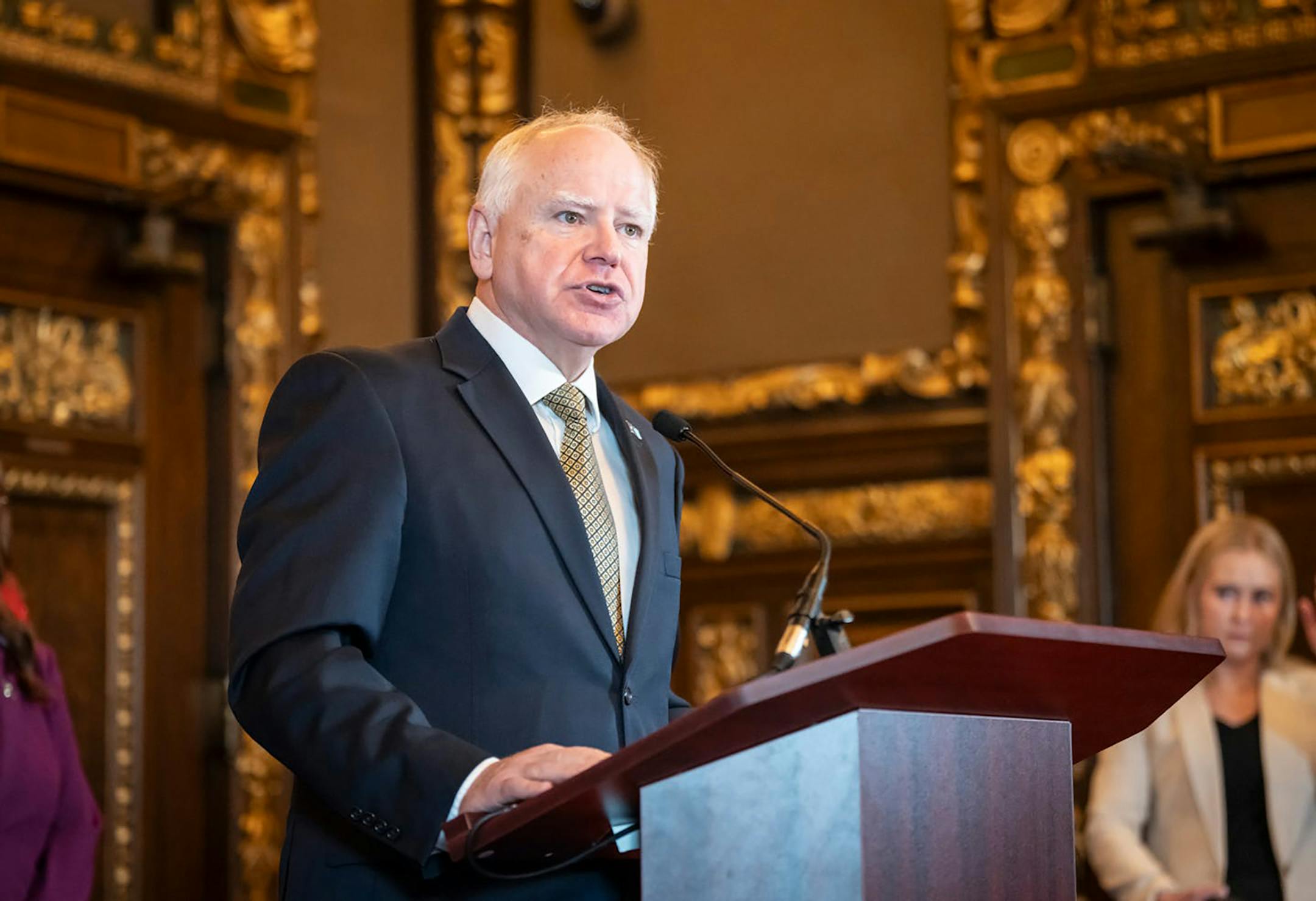
Minnesota Gov. Tim Walz answers questions after a signing a bill expanding support for service dogs in training at the State Capitol in St. Paul on May 8. (Renée Jones Schneider/The Minnesota Star Tribune)

Gov. Tim Walz lashed out at federal prosecutors Friday for proclaiming without evidence that the total amount of fraud in Minnesota social services programs could top $9 billion.

“It’s speculating,” Walz told reporters during a news conference at the State Capitol. “To extrapolate what that number is for sensationalism, or to make statements about it, it doesn’t really help us.”

The governor’s statements came a day after Assistant U.S. Attorney Joe Thompson went public with the breathtaking prediction during a news conference about a handful of new cases involving $11.6 million in suspected fraud.

Thompson said federal investigators have uncovered what he called “staggering, industrial-scale fraud” on a level unmatched in the U.S., and he scolded Minnesota officials for not doing more to protect the public’s money.

“It is swamping Minnesota and calling into question everything we know about our state,” Thompson said. “I think it is fair to say … that our state has not done a good job of minding these programs.”

The statements exposed tensions that have been simmering for months between the governor, who is defending his leadership as he runs for re-election, and the prosecutor who has made himself the face of the investigation into state-run programs.

While there’s always some tension between state and federal officials on big cases, the current situation is without precedent in Minnesota.

Federal officials are visibly frustrated with the state’s failure to protect taxpayer funds from fraudsters, and for not moving quicker to erect barriers to criminals bent on cheating the system after the Feeding Our Future scandal erupted in 2022.

Walz acknowledged that fraud is a problem in Minnesota, but state officials are seemingly frustrated that federal prosecutors won’t share details about suspected fraudsters that would allow them to block additional payments to bad actors.

John Connolly, deputy commissioner and state Medicaid director at the Department of Human Services (DHS), said his agency has seen evidence of “tens of millions of dollars in fraud to this point,” not $9 billion. DHS oversees all 14 of the “high-risk” programs under investigation by federal authorities.

The Walz administration has taken steps in the past several months to guard against fraud, including hiring a former FBI agent to lead prevention, shutting down a program susceptible to fraud and ordering an outside audit of billing in 14 Medicaid services. But critics say the administration’s actions come years too late.

Former U.S. Attorney Tom Heffelfinger questioned whether Thompson’s statements may violate U.S. Justice Department rules for communications with the press.

Those rules typically bar prosecutors from discussing an investigation before an indictment except in “extraordinary” circumstances, such as an “imminent threat to public safety.”

Heffelfinger agreed that Minnesota has been slow to crack down on fraud, but he said it was “unfair” for Thompson to talk about billion of dollars in suspected fraud in advance of an indictment without providing some details about the government’s findings.

“I was trained that you don’t deprive someone of a fair trial by throwing out all sorts of allegations,” Heffelfinger said. “It seemed premature not to include an identification of the individuals responsible and the methodology by which they allegedly committed the crime.”

In response to Walz’s comments Friday, Thompson said in a statement that “this investigation has been underway for more than four years and is being handled by career prosecutors and law enforcement agents here in Minnesota.

“We will continue to follow the evidence wherever it leads and will remain transparent with the public about the magnitude of the problem. We welcome and appreciate the support of everyone committed to the fight against fraud,” Thompson added.

At the news conference the day before, Thompson also said he is heartened that state officials are taking the situation seriously and trying to “shut off the faucet” of money that has gone to bad actors.

Walz said he is grateful for the work the U.S. Attorney’s Office has done building these cases and putting fraudsters in jail, but he maintained federal prosecutors have not given the state sufficient credit for its efforts to turn cases over to them and stop payments to providers.

“What they didn’t tell you yesterday was is that June, I was given the authority to stop payments,” Walz said. “We stopped payments on [housing stabilization providers] in July and turned the case over to law enforcement to prosecute. They didn’t come in here and find that. They didn’t come in here and stop payments.”

Walz added that he thinks “it’s been very clear that this is being driven from D.C.,” suggesting the U.S. Attorney’s Office’s actions are influenced by the Trump administration.

Walz also told reporters Friday that he takes accountability for the fraud that has unfolded during his administration.

“This is on my watch. I am accountable for this, and more importantly, I am the one that will fix it,” the governor said. “They’re not interested in that, so they throw up these numbers.”

Asked in July if he agreed with Thompson’s earlier claim that fraud in Minnesota could surpass $1 billion, Walz said, “yes.”

James Clark, inspector general at DHS, said federal authorities need to share information with DHS so it can “slam the door on these people and businesses that are engaging in fraud.”

In September, Clark wrote to Thompson, then-acting U.S. Attorney, asking for more collaboration “to bring bad actors to justice.”

“Armed with an extensive array of data, billing records from defrauded recipients, your office has been connecting the dots between calculated schemes that reach across programs, service sectors and organizations to steal Medicaid resources from Minnesotans that need them most,“ Clark wrote. ”It is clear to me and my team that you have much broader data sets that could benefit our regulatory work."

Clark wrote to the office again in November, asking for any data or information the office may have to show credible evidence of Medicaid fraud so the state could immediately stop payments to potential criminals.

However, a spokesperson for the U.S. Attorney’s Office said it cannot legally share evidence obtained pursuant to a grand jury subpoena.

Clark said he wants an immediate meeting with federal prosecutors to talk about partnering to stop criminals.

“I want to collaborate. I want to partner with law enforcement. That’s how this system should work,” Clark said. “We investigate, we suspend payments, we refer cases to law enforcement. And to the extent there is information about massive fraud in our programs — billions or $9 billion worth of fraud — I desperately want to see that evidence.”

The clash between the Walz administration and U.S. Attorney’s Office has not affected the work of the Medicaid Fraud Control Unit at the Attorney General’s Office, which partners with both various federal and state agencies on cases, said the unit’s director, Nick Wanka.

Unlike the U.S. Attorney’s Office, he saidhis unit shares fraud allegations with the Department of Human Services and gives the state agency monthly reports on open investigations.

“They know who we’re investigating in our cases and that’s not new practice — that’s been something we’ve done for years and years,” Wanka said.

Former U.S. Attorney Anders Folk, who is running for Hennepin County Attorney, said fighting fraud should be a “team effort.”

“We are going to get the best outcomes fighting fraud when we get state and federal agencies working together to root out the fraud and hold people accountable,” he said.

about the writers

about the writers

Jeffrey Meitrodt

Reporter

Jeffrey Meitrodt is an investigative reporter for the Star Tribune who specializes in stories involving the collision of business and government regulation. 

See Moreicon

Jessie Van Berkel

Reporter

Jessie Van Berkel is the Star Tribune’s social services reporter. She writes about Minnesota’s most vulnerable populations and the systems and policies that affect them. Topics she covers include disability services, mental health, addiction, poverty, elder care and child protection.

See Moreicon

Ryan Faircloth

Politics and government reporter

Ryan Faircloth covers Minnesota politics and government for the Star Tribune.

See Moreicon

More from News & Politics

See More
.
Tony Cenicola/The New York Times

A Ramsey County jury found Johnson & Johnson products exposed her to asbestos and caused her to develop mesothelioma.