
What the struggle over money and power at the U of M Medical School means for Minnesota

The university, its doctors and Fairview are negotiating once again after rhetorical fireworks this month.

The Minnesota Star Tribune
November 26, 2025 at 8:46PM
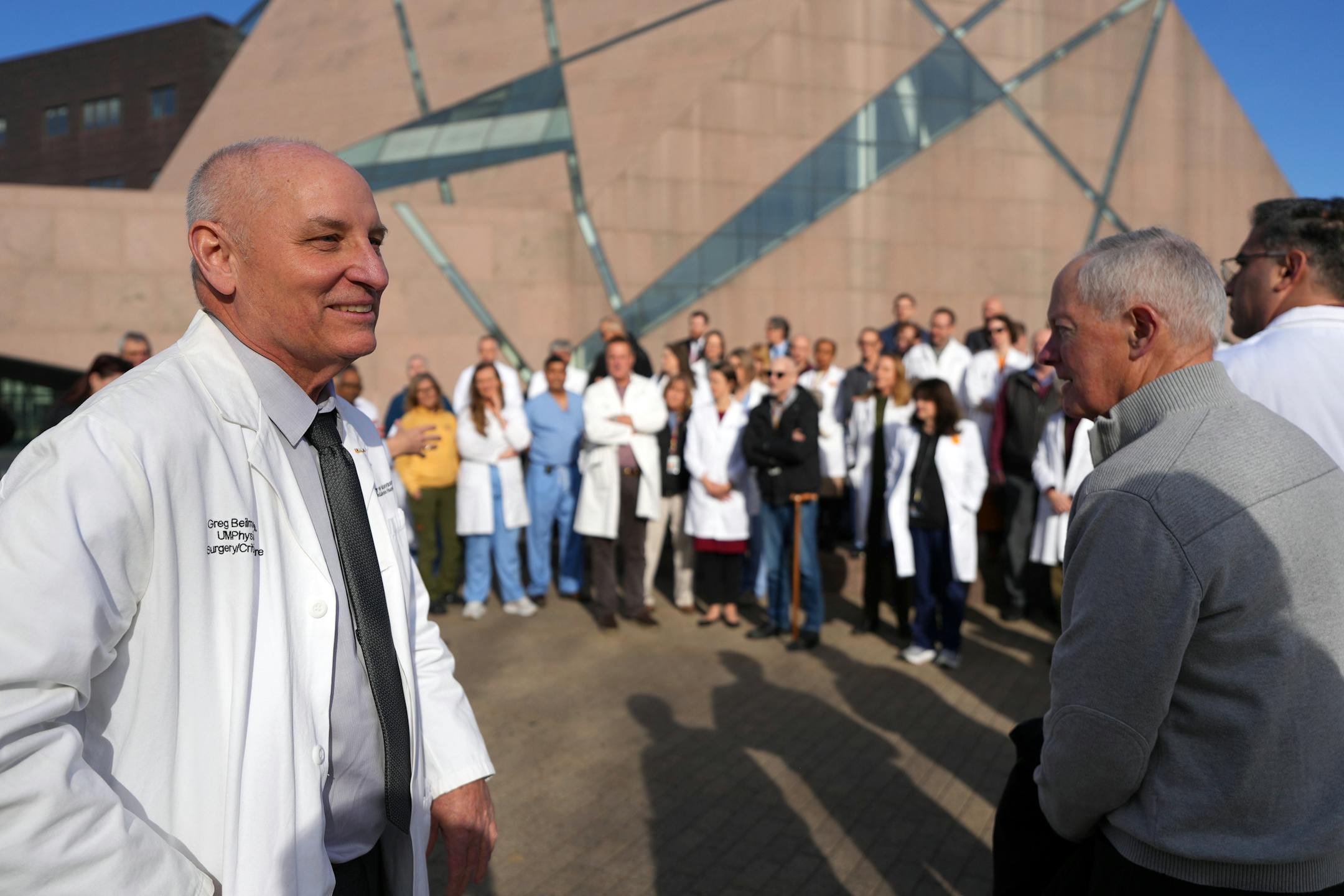
Dr. Greg Beilman, interim CEO of University of Minnesota Physicians, gets a round of applause after posing for a photo with a group of U doctors on Nov. 21 outside the McNamara Alumni Center in Minneapolis. (Anthony Souffle/The Minnesota Star Tribune)

The long-running dispute over money and power at Minnesota’s largest medical school hit a new level of public dysfunction this month, as the University of Minnesota launched rhetorical fireworks over a funding agreement struck by Fairview Health Services and the U’s physicians.

It all started when Fairview announced a deal with the group practice for the university’s medical faculty, an agreement that promises at least $500 million over 10 years for teaching, research and patient care at the U.

The doctors’ move, endorsed by the state attorney general, was highly unusual because it essentially cut out university administrators, leaving details to be negotiated later about how money would be passed from doctors to the U.

U leaders slammed the deal as a “hostile takeover” of the Medical School, saying it could significantly cut funding to the school while shifting control of the physicians group and University of Minnesota Medical Center toward Fairview.

They stripped academic jobs from two leaders of the doctors group, known as University of Minnesota Physicians. And the sequence raised questions about the leadership of Dr. Rebecca Cunningham, the U president who was hired in 2024, in part, to clean up the messy, decadeslong relationship with Fairview.

Physicians defended the deal in the face of withering criticism by the U’s Board of Regents. Minnesota Attorney General Keith Ellison closed the volatile chapter late last week by calling all parties back to the negotiating table.

The news has been quiet since then, but a clock is ticking. The existing deal between Fairview and the university expires at the end of 2026, and Ellison has pushed the sides to strike a deal this year because unwinding the Medical School funding and the M Health Fairview system without a deal would take a full year.

The dispute is hard to follow because M Health Fairview, the network of hospitals and clinics run jointly by Fairview and the U, is large and complex. Financial details for how the health system operates now, and would run under the new agreement, aren’t fully public.
And all parties tend to publicly employ vague talking points about the U’s academic health mission, rather than detailing how various proposals shift the balance of money and power between Fairview, the university and the physician group.

It would be tempting to ignore the debate if it didn’t involve such a critically important institution.

The University of Minnesota has trained about 70% of all physicians practicing in the state. Its health system conducts cutting-edge research and provides advanced specialty care that draws patients from across the state to University of Minnesota Medical Center in Minneapolis.

“The U’s academic health enterprise is an essential public good,” said Jan Malcolm, the former state health commissioner during the Walz and Ventura administrations. “It is a cornerstone of Minnesota’s health care and public health system.”

Here’s what we know and don’t know about the dispute, as well as some key questions going forward.

What’s the deal?

Fairview and University of Minnesota Physicians (UMP) call it the “Strategic Partnership for Minnesota’s Healthcare Future.”

It would take effect Jan. 1, 2027, and stretch for 10 years, with Fairview guaranteeing $50 million per year in payments to UMP to support teaching, research and patient care at the U.

Currently, Fairview is providing about $100 million per year in financial support, but the health system has called that sum unsustainable. Fairview and UMP officials say their new agreement includes a “variable” funding component, where Fairview might provide additional funding — perhaps another $50 million per year, or more — based on financial performance of their joint health care operations.

“This is a way to align what our doctors are doing, to help improve care and improve efficiency of care, within our health system,” said Dr. Greg Beilman, the interim CEO at UMP, during an interview earlier this month.

The health system centers on the University of Minnesota Medical Center (UMMC), the sprawling teaching hospital campus that spans the Mississippi River including a large outpatient clinic and surgery center on the East Bank campus and a children’s hospital near the U’s West Bank. Fairview acquired UMMC in a financial bailout in 1997.

In addition, U doctors and Fairview in recent years have increasingly cooperated in running hospitals and clinics such as Fairview Southdale in Edina and St. John’s in Maplewood under the brand M Health Fairview.

“The better the system does and the better UMMC does, the better UMP and, therefore, the Medical School does,” said James Hereford, the Fairview CEO.

Who’s upset?

The University of Minnesota says it’s received only limited information about the deal, which is a problem because “the devil is in the details,” said Dr. Keith Ghezzi, a U adviser from the health care consulting firm Alvarez & Marsal.

In comments this month to an emergency meeting of the U’s Board of Regents, Ghezzi said the agreement seems to transfer primary control and oversight of UMP to Fairview and would eliminate three university representatives from the health system’s board of directors.

Regents say U administrators were wrongly excluded from negotiations.

Dr. Penny Wheeler, a regent and former CEO of Allina Health System in Minneapolis, criticized the agreement for linking variable pay to financial performance, but not measures for training and research.

Wheeler faulted the deal for emphasizing “Fairview’s revenue over teaching and discovery” and not making clear how money would flow to the Medical School, as well as the university’s other schools in the health sciences.

“Allowing Fairview and the University of Minnesota Physicians to retain all clinical revenue ... leaves the broader university underfunded,” Wheeler said during the regents meeting.

Regent Samuel Heins, a retired U.S. ambassador to Norway under President Barack Obama, called the announcement by Fairview and UMP “a bit of a stunt” and said he was “profoundly disappointed” in Ellison.

Douglas Huebsch, chair of the regents, said the deal put the interest of one health system and one physician group before the concerns of all Minnesotans. He also offered a defense of Cunningham, saying that by taking the U president position she had walked into a mess that was not of her own making.

“No one should expect you to correct 30 years of dysfunction in a little over a year,” Huebsch said.

Cunningham has not commented publicly since the board meeting.

Were doctors fleeing?

Following the regents meeting, Beilman stressed UMP’s commitment to passing funds to the university and said he wanted to keep talking with the U about specifics.

“I am a 30-year faculty member at the University of Minnesota School of Medicine,” he said in an interview. “If you think that in my current role I would neglect my institution, please think again.”

Hereford acknowledged there always are tensions in academic health centers between how much time doctors spend conducting research and teaching students vs. treating patients, which generates revenue for operations. But he questioned whether anyone besides UMP doctors, as the clinical faculty at the Medical School, is in a better position to make those determinations.

Fairview says the deal provides certainty for physicians who were beginning to flee the uncertainty, since the current M Health Fairview partnership expires at the end of 2026. Hereford has said nearly 200 physicians have left UMP since 2024.

Talks for a renewal were private, lengthy and apparently stalled.

“The doctors made a tough call under very difficult circumstances and achieved the only real results so far in this protracted and frustrating process,” said former Gov. Tim Pawlenty, a Republican who assisted a state task force in 2023 and 2024 that deliberated over the future of the U’s academic health program.

How much of this is ‘secret’?

U officials this week say they still haven’t been provided a copy of the agreement between Fairview and UMP.

Before it was announced this month, Fairview and UMP were in arbitration over a financial dispute touching on their joint operations at a large outpatient clinic and surgery center (CSC) at Fulton Street on the U’s East Bank campus. Eight months after the matter was first reported by the Minnesota Star Tribune, details still haven’t been released.

Hereford downplayed the significance of the arbitration, saying disagreements were inevitable since Fairview pays hundreds of millions of dollars each year to UMP for physician services in the health system’s hospitals and clinics. These payments are governed by an agreement that’s not publicly available.

The U this month characterized negotiations between Fairview and UMP as “secret,” even though Dr. Jakub Tolar, the medical school dean, is board chair at the medical group.

The university says Tolar voted against the deal. Beilman said the board approved the deal, although he has not disclosed the tally for “aye” and “nay” votes.

This week, Fairview and the University of Minnesota released to the Minnesota Star Tribune timelines for all that’s preceded the latest dust-up, including U proposals to reacquire UMMC and for a merger between Fairview and Essentia Health.

The Fairview timeline includes a number of items not previously public including a proposal in early 2025 for the U and Duluth-based Essentia to jointly purchase UMMC from Fairview. Another idea floated in August would have combined University of Minnesota Medical Center with UMP in a new nonprofit entity.

The U timeline mentions a February proposal for the university to purchase Fairview’s interest in the CSC joint venture on Fulton Street. But the U did not immediately provide details on this or the seven other proposals it’s made since February 2024.

about the writer

about the writer

Christopher Snowbeck

Reporter

Christopher Snowbeck covers health insurers, including Minnetonka-based UnitedHealth Group, and the business of running hospitals and clinics.

See Moreicon

More from Health Care

See More
card image
Elizabeth Flores/The Minnesota Star Tribune

A Ramsey County judge backed a state petition for ‘rehabilitation’ at the health insurer, which ultimately will be liquidated.

card image
card image